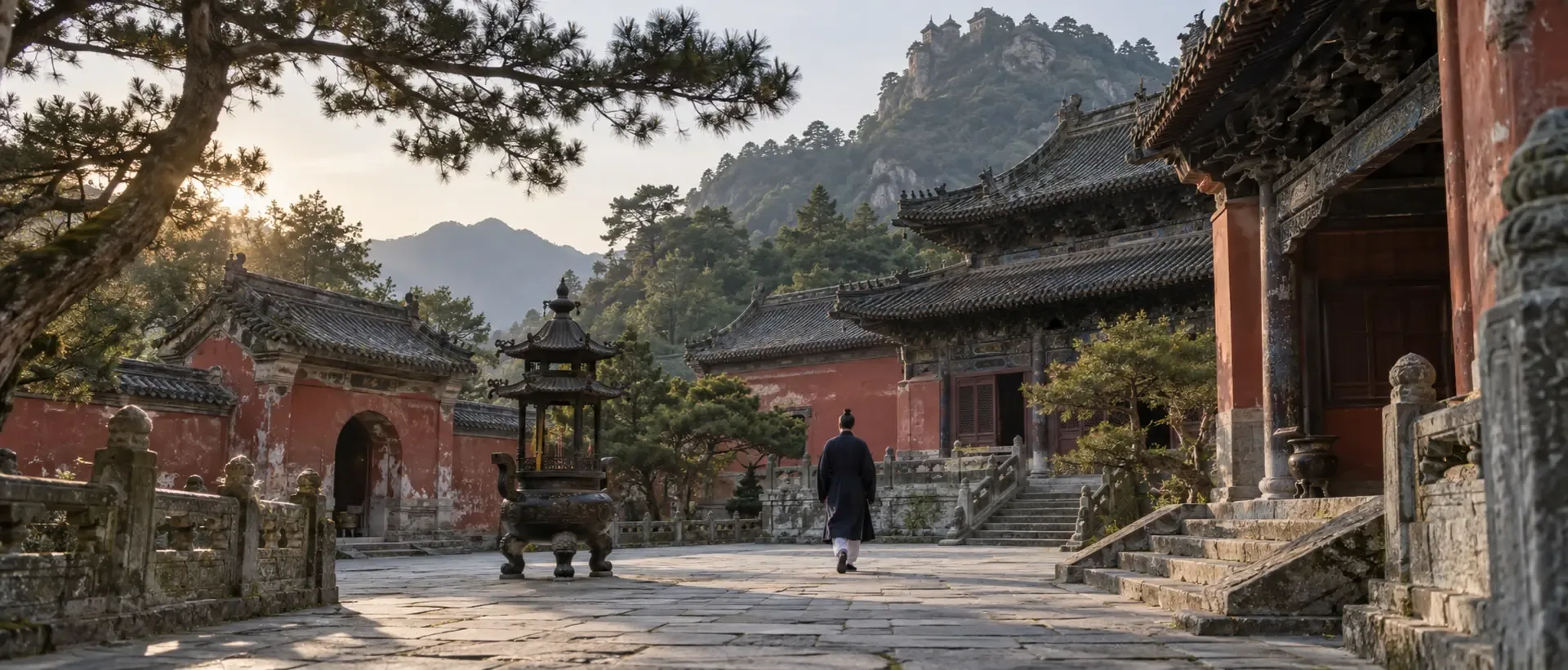
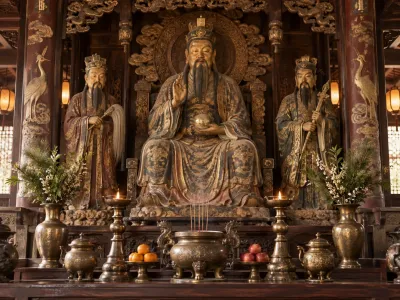
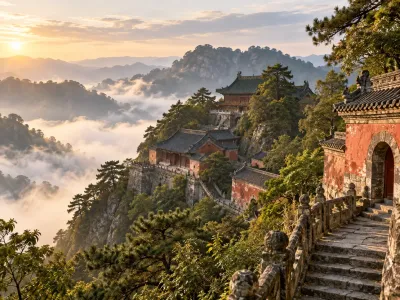
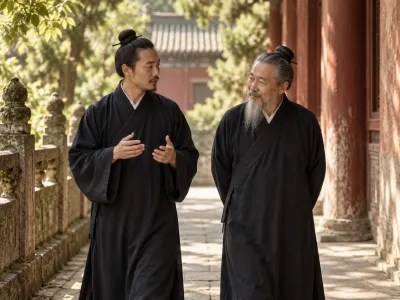
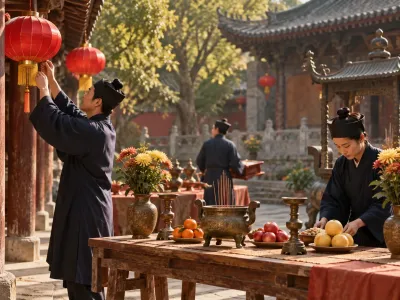
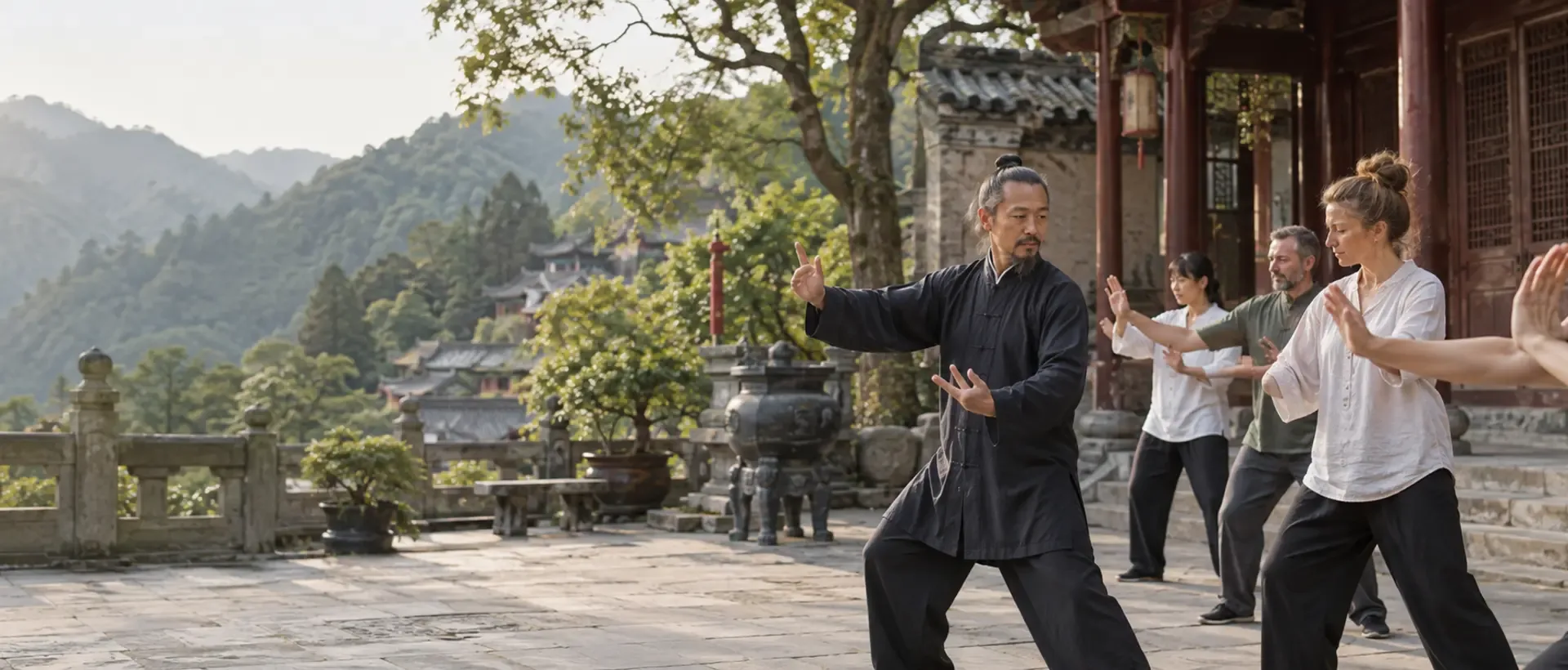
The Tao Philosophy section of this site deals with books: the Laozi, the Zhuangzi, the Book of Changes. This section deals with something different — the religion that grew up around those books, and around a great deal that has nothing to do with them. Temples, priests, gods, festivals, ordination registers, funeral rites, and the ordinary business of a community that has been running for roughly two thousand years. It is a larger and messier subject than the philosophy, and it is the part most visitors to a place like Wudang Mountain actually encounter.
“Taoism” names two different things
English uses one word where Chinese uses two, and the confusion this creates is worth clearing up before anything else. Daojia is the philosophical current: a body of writing and argument, no clergy, no buildings, no membership. Daojiao is the religion: an organised tradition with ordained priests, liturgy, a scriptural canon, temples, a hierarchy and a calendar.
They overlap, but the relationship is not what most introductions suggest. The religion did not simply grow out of the philosophy the way a plant grows from a seed. It assembled itself out of several sources — regional cults, healing practice, ritual specialists, imperial sacrificial tradition, techniques for prolonging life — and then adopted the Laozi as a founding scripture, and Laozi himself as a deity. The book came first in time, but it was recruited into the religion rather than giving birth to it.
This matters practically. Someone who reads the Tao Te Ching carefully has learned very little about what happens in a temple. And a priest performing a ritual at Wudang may go weeks without opening the Tao Te Ching. Neither is a defective version of the other. They are related traditions doing different work.
Where the religion actually began
The conventional starting point is the second century of the common era, in what is now Sichuan, with a movement usually called the Celestial Masters. Its founder, Zhang Daoling, is said to have received a mandate directly from Laozi in his deified form. Whatever one makes of that account, the movement itself is historically solid: it collected contributions from households, appointed local officials, kept registers of members, treated illness as a consequence of moral fault to be resolved by written confession, and for a period governed territory as an autonomous religious state.
That is the important point about origins. The earliest organised Taoism was not a school of thought. It was an administration — with paperwork, jurisdictions and appointed officers. Almost everything else in this section, including the way the gods themselves are arranged, follows from that.
Later centuries added layers rather than replacing them. The Shangqing and Lingbao traditions brought elaborate visualisation practice and large-scale liturgy. The Tang court made Taoism something close to a state religion. In the twelfth century the Quanzhen movement introduced full monasticism — celibacy, vegetarianism, communal residence — which had not previously been standard. Nothing was discarded along the way, which is why the tradition looks internally inconsistent when you examine it closely. It is a sedimentary formation, not a designed system.
The gods are organised as an administration
Chinese religion arranges its deities the way an empire arranges its officials. There are ranks, jurisdictions, promotions, delegated authority and reporting lines. A god has a portfolio: a river, a city wall, a trade, a disease, a household stove. Petitions travel upward through appropriate channels, which is why so much Taoist ritual takes the form of a document read aloud and then burned.
This explains features that otherwise look arbitrary. Deities are added over time, because administrations create new posts. Historical people are promoted into the pantheon, sometimes by imperial decree — Guan Yu, a third-century general, is the clearest case. Some gods rise and others fade. There is no fixed and final list, and no central authority that could issue one.
It also explains the tone of ordinary worship. A worshipper at a temple is not usually in a state of mystical absorption. They are lodging a request with an office, respectfully and in the correct form. That is not a debased version of religion. It is what this religion has always looked like at ground level.
Temples are workplaces before they are monuments
A functioning temple is a residence, a workplace and a ritual venue at once. Clergy live there. Halls are cleaned, repaired and reroofed. Services run to a timetable. Meals happen at fixed hours. Visitors arriving with a heritage-site expectation often misread this, and then treat a working building as an exhibit.
Temple layout is also readable once you know what to look for. The axis, the sequence of gates, the position of the incense burner, which deity occupies the main hall and which the side halls — these encode the ranking described above. Sacred mountains work the same way at larger scale, with the ascent itself organised as a progression. Wudang is an unusually complete example, and this site treats it in detail in its own section.
The calendar carries more weight than doctrine
If you want to know what a religious tradition actually believes, a reliable method is to look at what it does on which days. Taoism has a dense festival calendar: birthdays of major deities, seasonal offerings, rites for the dead, and large periodic ceremonies that can run for days and involve an entire community.
The calendar is lunar, so dates move against the Gregorian year. It is also local: a temple in Fujian and a temple in Hubei will not keep identical schedules, because each serves its own community and its own principal deity. There is no single Taoist liturgical year in the way there is a single Christian one.
Lineage, ordination and who is actually a priest
Taoist clergy are not interchangeable. The two broad categories you will meet are Quanzhen, which is monastic — celibate, vegetarian by rule, resident in a temple — and Zhengyi, whose priests may marry, live at home, and serve a community as ritual specialists. Both are legitimate. They train differently, dress differently and do different work.
Ordination is a formal matter involving lineage, a register and recognised transmission. It is not a self-description. This is worth knowing because the twentieth century was severely disruptive for religious institutions in China, transmission was broken in many places, and some claims made today cannot be verified from any surviving record. This site describes how the system is supposed to work and says plainly where the evidence stops.
How it sits alongside Buddhism and popular religion
Almost everything written about Chinese religion for outside readers describes Taoism, Buddhism and Confucianism as three separate systems. That is useful for a first orientation and misleading as a description of practice. For most of Chinese history the ordinary person did not belong to one of them in the way a European might have belonged to a church. They used whichever institution handled the matter in front of them, and the institutions borrowed from each other steadily.
The borrowing is easiest to see in the buildings. Taoist halls adopted the layout conventions of Buddhist monasteries, including the gate hall with guardian figures and the arrangement of courtyards along a rising axis. Buddhist temples absorbed local gods that had no Buddhist origin at all. Both took over the visual grammar of the imperial office: the seated official, the attendants ranked by size, the plaque above the door announcing the occupant. When you cannot tell from the architecture which tradition you are standing in, that is not your failure of observation. The architecture was never designed to make the distinction.
What does distinguish them is the clergy and the texts they use. A Taoist priest performs rituals drawn from a Taoist canon, addresses gods organised in the celestial administration described above, and traces authorisation through a Taoist lineage. A Buddhist monk works from a different body of scripture, a different account of what a human being is, and a different aim. The vocabulary differs too, which is why using Buddhist words in a Taoist temple is the one verbal mistake worth avoiding: it is not offensive, but it signals that you have not noticed which building you are in.
Then there is the much larger layer usually called popular or local religion: the earth god at the edge of a village, the ancestor tablets in a family house, the deity who protects a particular trade, the spirit medium consulted about an illness. This layer has no canon, no ordination and no central organisation, and it is where the great majority of religious activity in China has always happened. Taoism has a long and complicated relationship with it. Sometimes Taoist priests served it, providing formal ritual for local gods that had grown too important to be handled informally. Sometimes they competed with it, arguing that their own methods were more effective and better authorised. Very often a god began in this layer and was gradually taken into the official structure, which is exactly the process described in the section on human beings becoming gods.
The practical consequence for a visitor is that you should expect mixture and not treat it as confusion or decline. A temple that contains a figure you cannot place, an offering that does not appear in any book, a festival that combines a Taoist rite with a village procession that has nothing to do with it, is behaving normally. Chinese religion was never tidy, and the tidiness of introductory accounts, including parts of this one, is an artefact of writing rather than a feature of the thing described.
What is documented and what is story
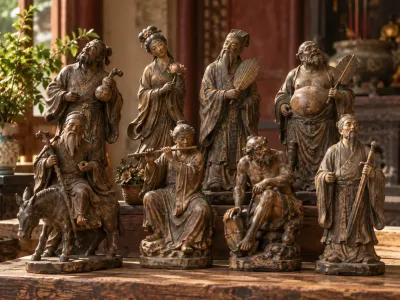
Much of the material in this section is legend, and there is no reason to be embarrassed about that. The Eight Immortals are a genuine and important part of the tradition without being a group of historical individuals. What matters is being clear about which register you are in.
So the practice here is straightforward. Where something is attested by dated inscriptions, imperially sponsored gazetteers or documentary record, it is stated as history. Where it is hagiography or folk narrative, it is labelled as such and then taken seriously as narrative — because these stories tell you what the tradition valued, which is a real fact even when the events are not.
Key points
- Chinese distinguishes daojia, the philosophy, from daojiao, the organised religion. English collapses both into “Taoism” and causes persistent confusion.
- The religion did not grow out of the Tao Te Ching. It assembled from several sources and later adopted the book, and Laozi himself, as foundational.
- The earliest organised Taoism, the second-century Celestial Masters, functioned as an administration with registers, appointed officers and territory.
- The pantheon is structured like a bureaucracy, with ranks and jurisdictions. This is why gods can be added, promoted and forgotten, and why so much ritual takes documentary form.
- Temples are working residences, not exhibits. Their layout encodes the ranking of the deities housed in them.
- The festival calendar is lunar and local. There is no single Taoist liturgical year.
- Quanzhen clergy are monastic; Zhengyi priests may marry and live at home. Ordination is formal and lineage-based, not self-declared.
- Legend and history are both present here, and this site labels which is which rather than blending them.