A path into the reading
I Ching
Sixty-four figures for thinking with change, timing and responsibility.
Start here
01 Find your bearings
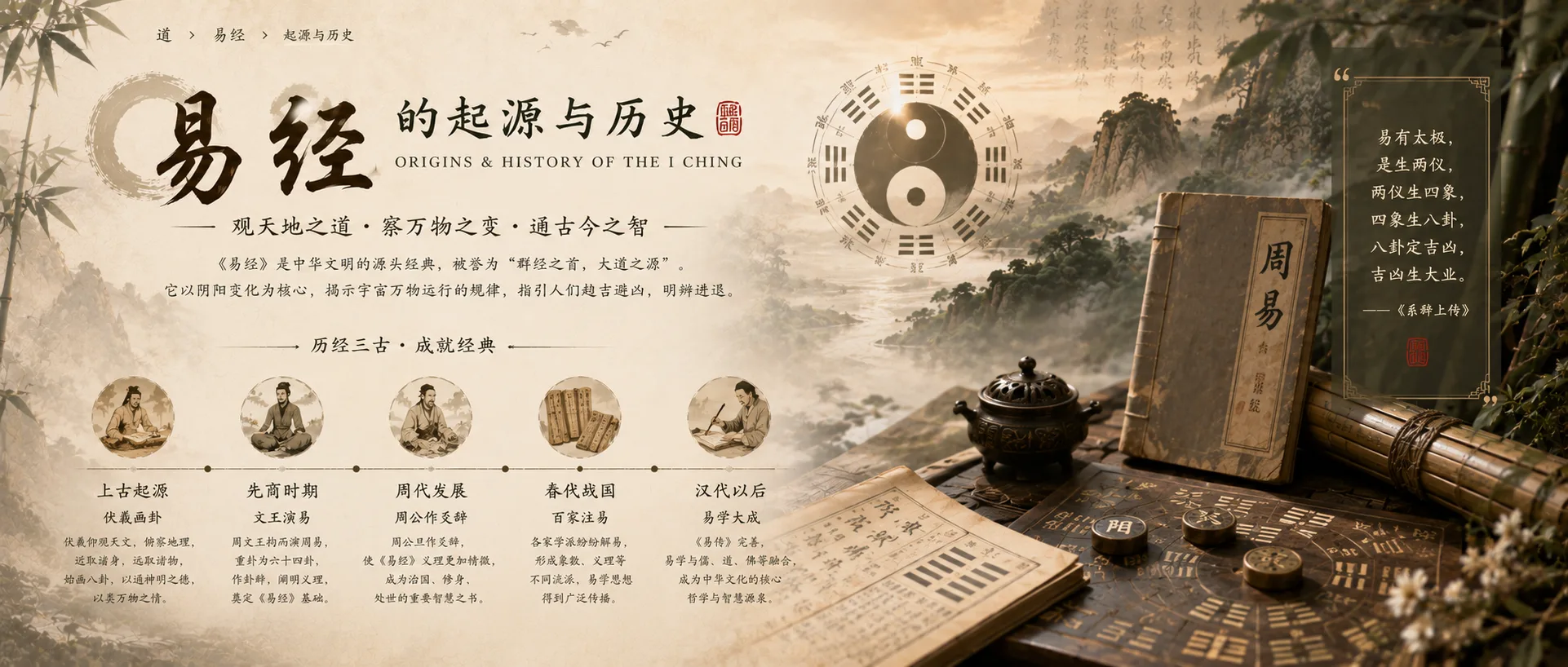
Origins & History of the I Ching
Who wrote it, what the excavated manuscripts changed, and how it reached the West
Explore this section
02 Explore the subject
Yin, Yang & the Philosophy of Change
Relationship, timing and transformation in the Book of Changes
Explore this section
03 Keep reading
Key Translations & Further Reading
A guide to the major editions and studies for readers who wish to go further
Explore this sectionGo further
Deeper reading
- Origins & History of the I ChingWho wrote it, what the excavated manuscripts changed, and how it reached the West
- The Eight Trigrams (Bagua)The eight primal images from which the Book of Changes is built
- The 64 HexagramsBrowse all sixty-four GUA in sequence and understand their figures, changing lines, and practical meaning for modern life
- Yin, Yang & the Philosophy of ChangeRelationship, timing and transformation in the Book of Changes
- Divination Method & PracticeHow a hexagram is cast, and how the practice has been understood
- The I Ching in Taoist PracticeHow the Book of Changes entered Taoist cosmology, ritual and cultivation
- Key Translations & Further ReadingA guide to the major editions and studies for readers who wish to go further
The full guide
What should I know before reading further?
The I Ching, also called the Yijing or Book of Changes, is at once an early divination text, a Chinese classic and the centre of a long commentary tradition. Its received form brings together terse hexagram and line statements with later interpretive layers. That history matters because there is no single timeless voice speaking from every part of the book.
Read more The complete guide
The I Ching, also called the Yijing or Book of Changes, is at once an early divination text, a Chinese classic and the centre of a long commentary tradition. Its received form brings together terse hexagram and line statements with later interpretive layers. That history matters because there is no single timeless voice speaking from every part of the book.
The Changes does not remove uncertainty. It gives uncertainty a form: six-line figures, changing relationships, images, judgements and questions about timing. Read carefully, it can help a person slow down, see a situation from more than one angle and consider what kind of action the moment asks for.
From Lines to Hexagrams
Yin and yang lines
A broken and an unbroken line become meaningful through position and relationship. Neither is permanently good or bad.
Eight trigrams
Three-line figures name recurring fields of experience such as Heaven, Earth, thunder, wind, water, fire, mountain and lake.
Sixty-four hexagrams
Two trigrams combine into a six-line figure. Each hexagram presents a patterned situation rather than a fixed personality type.
Changing lines
One or more moving lines can show where a situation is under pressure or in transition and may lead to a second hexagram.
A Responsible Reading Method
Begin with one clear, open question. Record the method and result, read the primary text in context, then compare more than one reputable translation or commentary. Ask what the figure reveals about position, relationship, timing, risk and conduct before turning it into a prediction.
A reading should widen judgement rather than close it. Do not keep casting until a preferred answer appears, use frightening language to force a decision or treat one line as permission to ignore facts, consent, professional advice or the consequences for other people.
Consultation boundary: the I Ching may support reflection and cultural practice. It must not be sold as a guaranteed forecast or used to replace medical, legal, financial, safety or mental-health advice.
Read the Complete Library
Wudang.Org retains all sixty-four hexagram pages in the received King Wen sequence. Every page should distinguish source text, translation, traditional commentary and present-day reflection; show the upper and lower trigrams; explain line position; and provide previous and next navigation.
The Eight Trigrams — Learn the names, images and relationships of the eight three-line figures before memorising correspondences.
The 64 Hexagrams — Browse the complete sequence with consistent bilingual titles, diagrams and reading structure.
Divination Method — Understand yarrow-stalk and coin methods, record-keeping and the ethics of asking a question.
Continue your journey: Eight Trigrams · Complete library · Philosophy of change
Choose a reading or learning path
For independent study, use I Ching translations and further reading alongside the hexagram library. If you prefer learning with an instructor, browse I Ching learning events. Before enquiring, check whether a course focuses on the classical text, commentary or a particular divination method, and confirm its language, level and current dates with the organiser.
Recommended next page
Where next?
The Eight Trigrams (Bagua)The eight primal images from which the Book of Changes is builtA few alternatives