A path into the reading
Chinese Heavenly Stems and Earthly Branches (Ganzhi)
How ten stems and twelve branches form the sixty-part cycle behind Chinese calendars and metaphysics
Start here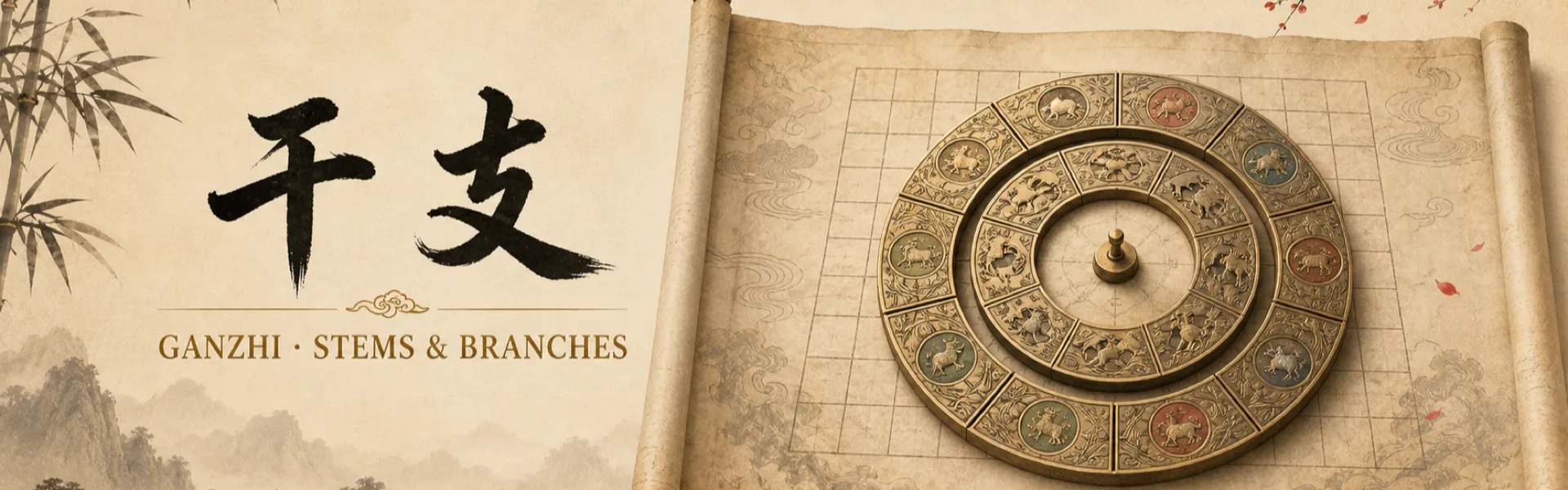
01 Find your bearings
Origins and History of the Chinese Sexagenary Cycle
From Shang oracle-bone dates to the continuous sixty-part Ganzhi count used today
Explore this section
02 Explore the subject
The Sixty-Part Jiazi Cycle: How Stems and Branches Combine
Why ten stems and twelve branches produce sixty terms used for years, months, days and hours
Explore this section
03 Keep reading
Heavenly Stems, Earthly Branches and Ganzhi: Sources and Further Reading
Oracle-bone evidence, calendar history, cosmology and technical studies
Explore this sectionGo further
Deeper reading
- Origins and History of the Chinese Sexagenary CycleFrom Shang oracle-bone dates to the continuous sixty-part Ganzhi count used today
- The Ten Heavenly Stems: Names, Five Phases and MeaningsHow the ten-day Shang count became a yin–yang and Five-Phase language used across Chinese metaphysics
- The Twelve Earthly Branches: Animals, Hours, Months and MeaningsHow the twelve-part time cycle connects zodiac animals, directions, seasons and hidden stems
- The Sixty-Part Jiazi Cycle: How Stems and Branches CombineWhy ten stems and twelve branches produce sixty terms used for years, months, days and hours
- How Heavenly Stems and Earthly Branches Encode Yin–Yang and the Five PhasesThe polarity, phase and seasonal correspondences that turn Ganzhi into a working interpretive language
- How Ganzhi Is Used in BaZi, Feng Shui, Date Selection and Other ArtsThe shared technical vocabulary connecting Chinese calendars, fate calculation, placement, medicine and ritual
- Heavenly Stems, Earthly Branches and Ganzhi: Sources and Further ReadingOracle-bone evidence, calendar history, cosmology and technical studies
The full guide
What should I know before reading further?
The stems and branches are the least glamorous and most indispensable part of Chinese metaphysics. They are a counting system: two series of names which combine to produce a cycle of sixty, used to label days, months, years and double-hours. Nothing in fate calculation, date selection or compass feng shui can be done without them, because they are the mechanism that turns a moment in time into something you can compute with. If you intend to study any of these arts, this is where the real work begins.
Read more The complete guide
The stems and branches are the least glamorous and most indispensable part of Chinese metaphysics. They are a counting system: two series of names which combine to produce a cycle of sixty, used to label days, months, years and double-hours. Nothing in fate calculation, date selection or compass feng shui can be done without them, because they are the mechanism that turns a moment in time into something you can compute with. If you intend to study any of these arts, this is where the real work begins.
What the system is
There are ten terms in the first series, conventionally called the heavenly stems, and twelve in the second, called the earthly branches. Neither set of names means much on its own; they function much as the letters A to J and a set of twelve further symbols would. Their importance lies in what has been attached to them and in how they combine. Each stem and each branch carries a yin or yang polarity and a five-phase value, and it is these attached values, not the names, that the calculation arts actually use.
The two series
The ten stems and twelve branches are ordered lists, and their order never varies. The stems are the shorter and simpler series, and their main additional content is that they pair up neatly across the five phases, giving a yang and a yin form of each phase. The branches are more complicated. They carry the twelve animals, they map onto the months of the year and the double-hours of the day, they distribute unevenly across the phases, and each of them additionally conceals further stems inside it. Most of the difficulty in learning this system lies with the branches.
How they combine, and why sixty
The two series are run in parallel: the first stem with the first branch, the second stem with the second branch, and so on. When the stems are exhausted after ten pairings they begin again while the branches continue, so the eleventh pairing is the first stem with the eleventh branch. The combination returns to its starting point after sixty steps rather than a hundred and twenty, because ten and twelve share a common factor of two. A consequence worth noticing is that only sixty of the hundred and twenty conceivable pairings ever occur, and a stem is always matched with a branch of the same polarity.
What the cycle is used to count
Its oldest use is counting days, and this has continued without interruption for longer than any other dating system in the world remains in use. It was later applied to years, which is the use most people encounter, and also to months and to the twelve double-hours into which the day is divided. Because all four can be expressed in stems and branches, any moment can be written as four pairs, which is exactly what a fate chart consists of. The system therefore functions as a general-purpose notation for time rather than as a calendar in its own right.
The twelve animals
Each branch is associated with an animal: rat, ox, tiger, rabbit, dragon, snake, horse, goat, monkey, rooster, dog and pig. The animals are the most widely known part of the system internationally and the least important technically. The evidence suggests they were attached to the branches later than the branches themselves, and possibly under influence from Central Asia, though this is debated. Serious practitioners work with the branches and their phase values rather than with the animals, and a source that discusses only the animals is not engaging with the system as it is actually used.
Why this is not a zodiac
Calling the twelve animals the Chinese zodiac invites a misunderstanding worth clearing up. A zodiac in the Western sense is a division of the ecliptic into twelve constellations, and a birth sign records where the sun appeared against those stars. The twelve branches are not constellations and the animal of a year is not an astronomical observation; it is a position in a counting cycle. The two systems also work at different scales, since the Western signs change monthly and the animals annually. The similarity of the number twelve is the whole of the resemblance.
Polarity and phase
This is where an inert counting device becomes an analytical tool. Stems alternate strictly, the odd-numbered being yang and the even yin, and the branches do the same. Each stem takes a phase, with two stems to each phase. The branches distribute across the phases less tidily, with Earth taking extra positions to accommodate the seasonal transitions. On top of this, each branch contains one or more hidden stems, so a single branch may carry several phase values at different strengths. This is why eight characters yield far more than eight pieces of information.
Why the calendar underpins every other art
Consider what each art needs. Fate calculation needs a birth moment expressed as computable values, which the cycle supplies. Date selection needs each day to have a determinate character, which the cycle supplies. Compass feng shui needs to know what year and period a site is in, which the cycle supplies. Divination by the six-line method assigns branches to the lines and consults the branch of the day. In every case the cycle is the input layer. This is why experienced teachers insist on it first and why students who skip it find the later material impossible.
The cycle in history and ritual
Beyond the calculation arts, the cycle is embedded in Chinese life in ways that still show. Historical events are commonly identified by their cycle year, and several well-known episodes in modern Chinese history are named this way. Traditional festivals fall on lunar dates whose selection often reflects cycle reasoning. Taoist ritual specifies days by stem and branch, and the timing of rites, ordinations and offerings is set accordingly. At Wudang, as at any working temple, the ritual calendar is organised by this system rather than by the Gregorian one.
The calendar in outline
It helps to know that the traditional Chinese calendar is not simply lunar. It is lunisolar: months follow the moon, so a month begins at each new moon, but the year is kept aligned with the seasons by inserting an intercalary month roughly every three years. Alongside this runs a purely solar division of the year into twenty-four periods marking the sun's progress, and these solar terms, not the lunar months, are what the fate arts actually use to determine the month pillar. This is a frequent source of error, since a birth date near the boundary of a solar term can change the chart.
From a moment to four pillars
It is worth seeing the whole procedure in outline, because the abstract description above can seem pointless until you watch it produce something. Start with a date and time of birth. The year pillar is the stem and branch of that year, adjusted so that the year turns at the solar term beginning spring rather than at midnight on any civil date. The month pillar is taken from the solar term the date falls within, not from the lunar month. The day pillar is read from the continuous day count, which is why day-count tables or software are needed; this is the one pillar nobody calculates mentally. The hour pillar comes from the double-hour, with the stem determined by a rule that depends on the day stem. The result is eight characters, four stems above and four branches below, and every subsequent step of the analysis works from these. Notice how much of the difficulty is calendrical rather than interpretive.
The stems and branches beyond time
The two series were also used simply as ordinals, in the way English uses A, B, C or the numerals one to ten, and recognising this will save you from over-reading. Documents number their sections by stems. Examination results were graded in stem order. Traditional medical texts use branches to label sequences of points or periods within a treatment cycle. Modern Chinese still uses the first few stems for items in a list, much as a legal document might use subsections. When you meet a stem or branch in a text, therefore, the first question is whether it is doing cosmological work or merely counting, and quite often it is merely counting.
Common confusions
Several mistakes recur. The animal year does not begin on the first of January, nor reliably on the lunar new year, since for fate purposes the year is usually taken to change at the solar term beginning spring. The double-hours are two hours long and centred on the traditional divisions, so the hour pillar depends on getting local time right. Solar terms matter more than lunar months. And the hidden stems within branches are not an optional refinement but a standard part of the calculation. Errors on these points invalidate everything computed afterwards.
What to memorise, and in what order
Practical advice: learn the ten stems in order first, then their phases and polarities, which is a small and quickly mastered body of material. Then learn the twelve branches in order with their animals, hours and months, which takes longer. Then learn the branch phases. Only then work on the sixty combinations, which most students absorb through use rather than by rote. Attempting the hidden stems before the basic assignments are secure is the commonest way to become confused. None of this is intellectually difficult, but it does require the kind of memorisation that cannot be avoided.
Key points
- Ten stems and twelve branches combine into a cycle of sixty, used to label days, months, years and double-hours.
- The cycle returns after sixty rather than a hundred and twenty because ten and twelve share a factor of two.
- The names matter less than the attached polarity and phase values, which are what the arts compute with.
- The twelve animals are the best-known and least technically important part, and the system is not a zodiac.
- The fate arts use the twenty-four solar terms rather than lunar months to set the month pillar.
- Learn the stems, then the branches, then the phase assignments, and only then the sixty combinations.
Recommended next page
Where next?
The Ten Heavenly Stems: Names, Five Phases and MeaningsHow the ten-day Shang count became a yin–yang and Five-Phase language used across Chinese metaphysicsA few alternatives