What can I learn through Tai Chi?
Explore Tai Chi through movement, teaching and history. Begin with the first reading, then explore the deeper reading below.
Before you begin
- The subjectA class’s curriculum matters more than its label.
- The contextHistorical sources and lineage accounts answer different questions.
- The approachPartner practice begins with clear rules and consent.
What is a principle in practice?
Follow the language of relaxation, coordination and continuity. Ask how each principle appears in the exercise being taught.
Explore this section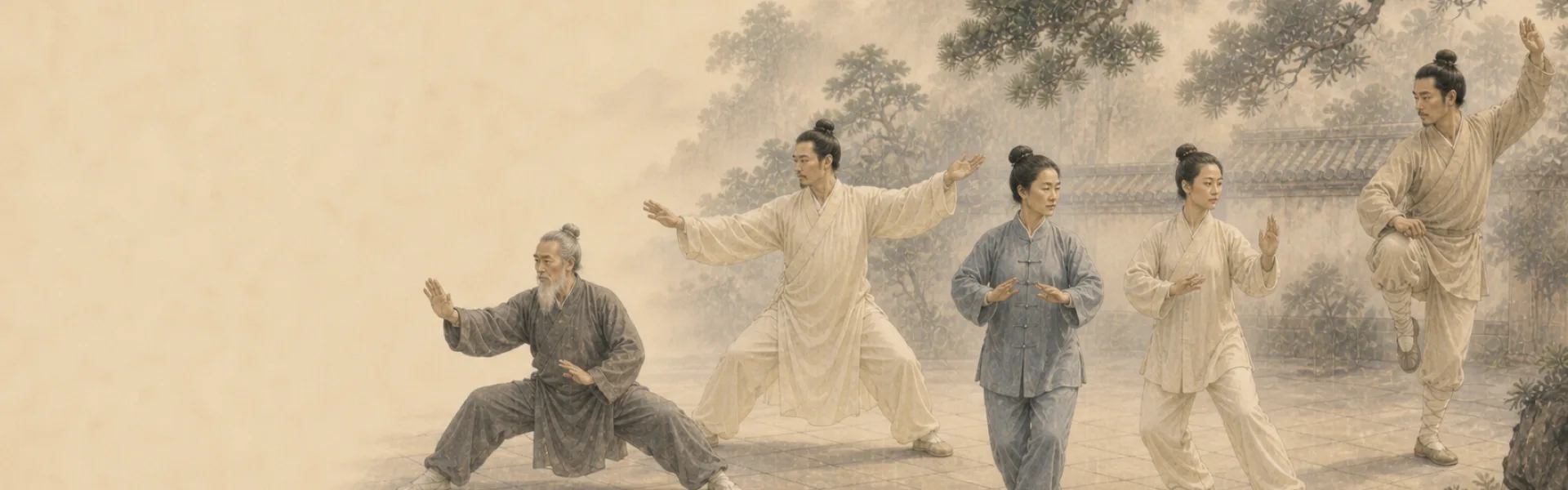
Why do styles and histories differ?
Compare sources, family traditions and present-day Wudang teaching. A style name offers a starting point for more specific questions.
Explore this section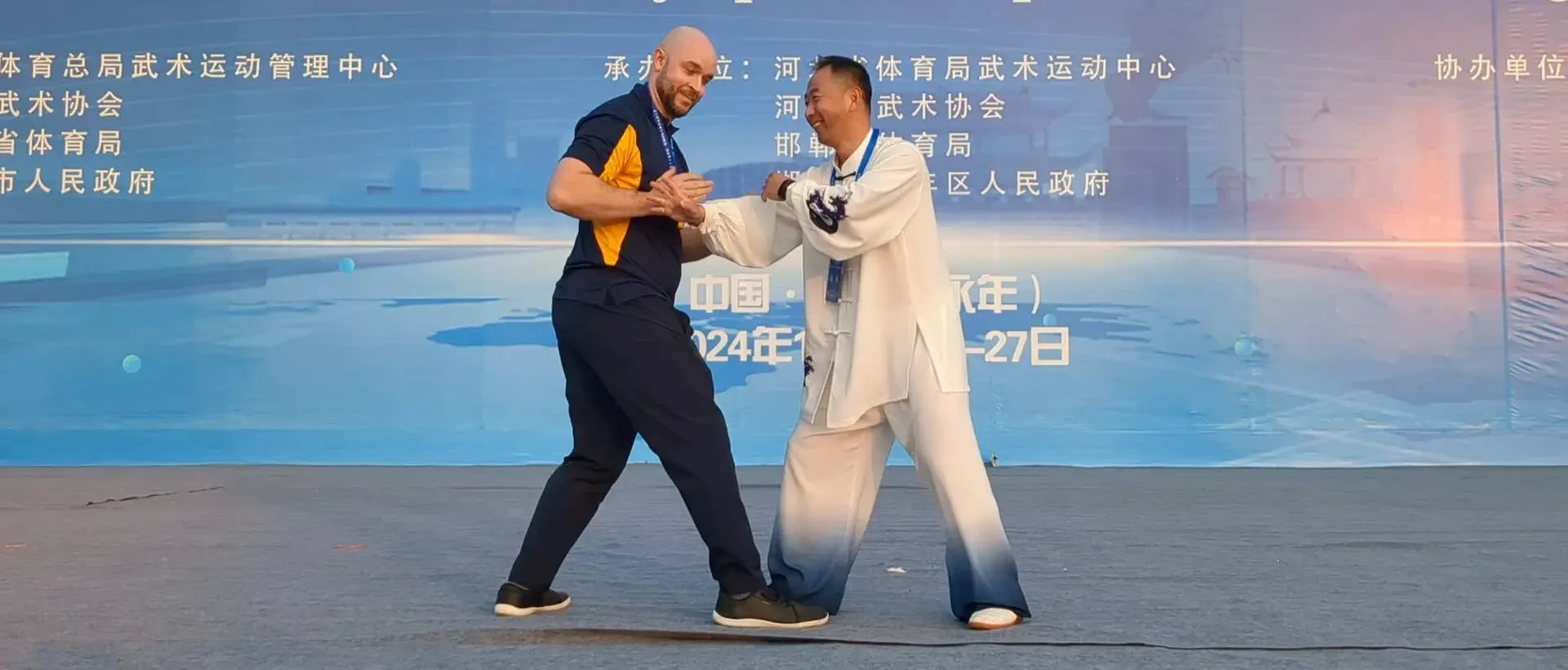
What changes when I work with a partner?
Solo forms and partner drills create different learning conditions. Explore push hands and compare the aims of health-oriented and martial practice.
Explore this section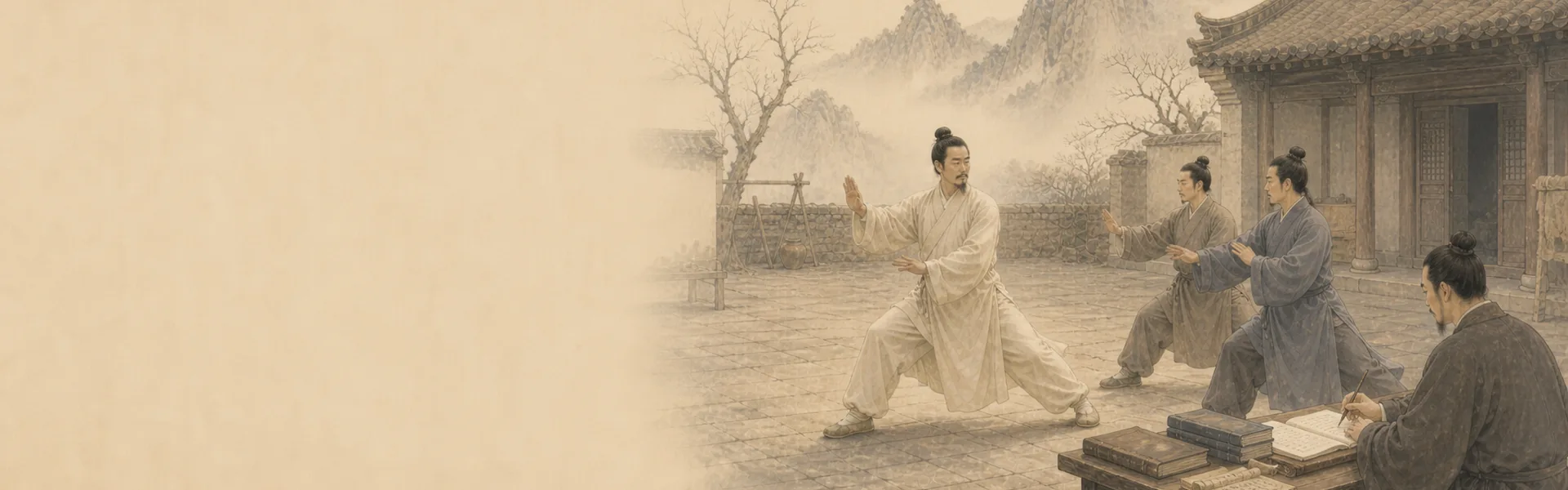
How can I keep learning?
Use the reading guide to find texts and research. Before a class, ask what it teaches, how it can be adapted and what to expect.
Explore this sectionDeeper reading
- 01
Principles & classics
Read teaching language alongside its source texts.
- 02
Origins & history
Compare inherited accounts with dated sources.
- 03
Family styles
Meet Chen, Yang, Wu, Wu (Hao) and Sun.
- 04
Wudang Taijiquan
Explore the mountain’s history and living practice.
- 05
Push hands
Understand partner tasks, contact and agreed rules.
- 06
Health & martial practice
Compare aims and the methods used to pursue them.
- 07
Sources & reading paths
Choose reliable materials for your next question.
The full guide
What should I know before reading further?
Taijiquan, often called tai chi, is a Chinese martial art practised today for different purposes: learning movement, developing martial skills, supporting wellbeing and exploring a cultural tradition. A class may emphasise one of these aims or combine them. Begin by asking what you want to learn and what the actual programme teaches, rather than assuming that every course with the same name offers the same experience.
Read more The complete guide
Taijiquan, often called tai chi, is a Chinese martial art practised today for different purposes: learning movement, developing martial skills, supporting wellbeing and exploring a cultural tradition. A class may emphasise one of these aims or combine them. Begin by asking what you want to learn and what the actual programme teaches, rather than assuming that every course with the same name offers the same experience.
This guide introduces the main questions behind the practice. It separates historical evidence from inherited accounts, solo movement from partner work, and health research from promises made about an individual class.
What does the name tell us?
In the name 太极拳, taiji is a concept from Chinese thought and quan refers to boxing or a martial art. The name invites reflection on complementary relationships, but it does not by itself explain the history of a particular routine or prove its transmission. A philosophical interpretation and a documentary claim should be identified separately.
Ask an instructor to show how a term is used in an exercise. What changes when the weight shifts? What does the teacher mean by relaxation or coordination? A clear example helps more than collecting unfamiliar vocabulary without knowing its purpose. The Foundations of the Internal Arts pathway introduces this language in context.
Choose between aims without ranking people
A person seeking an accessible movement class does not need to pursue every aspect of martial training. Someone interested in applications should ask how these are taught rather than assuming that memorising a sequence provides the same preparation. Cultural study, performance and attentive movement can also be worthwhile goals in their own right.
A useful course description names the routine or method, the level, the physical demands and the place of partner work. It also explains what the course does not cover. A health-oriented class is not automatically deficient, and a martial class is not automatically suitable for everyone. Fit matters more than a label promising a complete or secret system.
Understand slow practice without making speed a rule
Slow practice gives learners time to notice a movement and receive corrections. It is an approach to learning, not a guarantee of good alignment or a rule that everything called taijiquan must be performed at one speed. Ask what a particular pace is intended to teach and how the instructor adapts it to the exercise.
For one historical teaching example, the Ten Essentials in Chen Weiming’s 1925 Taijiquan shu discuss relaxation, coordination and continuity. Read these as instructions situated in that text, not as a modern laboratory explanation or a universal description of every school. Do not force breathing or copy a difficult posture simply to match an illustration.
Approach origins with respect and specific sources
Origin stories, dated manuals, family accounts and institutional records contribute different kinds of information. When someone says a routine is centuries old, ask whether they mean its present sequence, a teaching principle, a lineage account or the wider tradition. The age of one does not automatically establish the age of the others.
Zhang Sanfeng is a Ming-dynasty Taoist figure with enduring significance for Wudang. Our Zhang Sanfeng guide distinguishes his biographical record from later martial narratives. Appreciating that heritage does not require inventing a complete chain of documents for every modern form. Nor does an unresolved attribution justify dismissing a living tradition.
Compare schools through their actual teaching
The collection includes a guide to the Chen, Yang, Wu, Wu (Hao) and Sun family styles. These names help identify what you are studying, but a style label alone does not tell you the pace, stance demands, class atmosphere or degree of adaptation you will encounter. Request the specific curriculum rather than relying only on a short description of a family style.
The same approach applies at Wudang. Ask who teaches the particular routine, how the school describes its transmission and what the course includes. Avoid assuming that a location guarantees a uniform method or that all routines taught there have the same history. Clear identification is more useful than an unsupported claim about every Wudang school.
Know what partner practice can and cannot show
Push hands, or tui shou, belongs to the partner-practice part of this collection. When considering a class, ask whether the exercise is cooperative, constrained by particular rules or includes agreed resistance. Its meaning depends on those conditions; a smooth demonstration does not establish readiness for every kind of encounter.
Partners should understand the task, the permitted contact and how to stop. Corrections involving touch require consent. No one needs to accept surprise pressure, painful joint positions or an unwanted challenge to prove commitment. People attending for movement or wellbeing can choose a course without contact; those seeking martial study can ask about a gradual, supervised progression.
Read health evidence without turning it into a guarantee
NCCIH reports potential benefits for balance and falls in some populations, while findings vary by condition and programme. This does not establish that every routine or class has the same effect. Tai chi should not delay medical assessment or replace necessary care.
Tell the instructor about relevant movement limits and ask what adaptations are available. If you are unsure whether a class suits your health circumstances, discuss it with a qualified healthcare professional. Assess the course by its actual demands and support, not by the assumption that a gentle appearance means it is appropriate for everyone.
Build a reading route that matches your question
Use the seven topics in this collection as a map rather than a compulsory sequence. Origins and history examine sources; family styles and Wudang taijiquan identify approaches; principles and classics focus on teaching language; push hands explores partner practice; health and martial practice separates aims; further reading helps you locate sources.
Before a first class, ask the instructor three things: what will we practise, how can it be adapted, and what should I realistically expect to learn? After the class, note one explanation you understood and one question to return to. This provides a more useful starting point than judging your progress by how quickly you memorise a long routine.
From reading to a first class
Use the beginner pathway to decide what to learn first. If you are comparing local options, the Singapore tai chi and qigong class guide connects these practices with relevant event listings. Read the teacher profiles, then ask the organiser who teaches the class, which routine is covered and whether partner contact is included.