A path into the reading
Taoist Deities and the Chinese Pantheon: A Structural Guide
How the Three Pure Ones, Jade Emperor, celestial officials, immortals and local gods fit together
Start here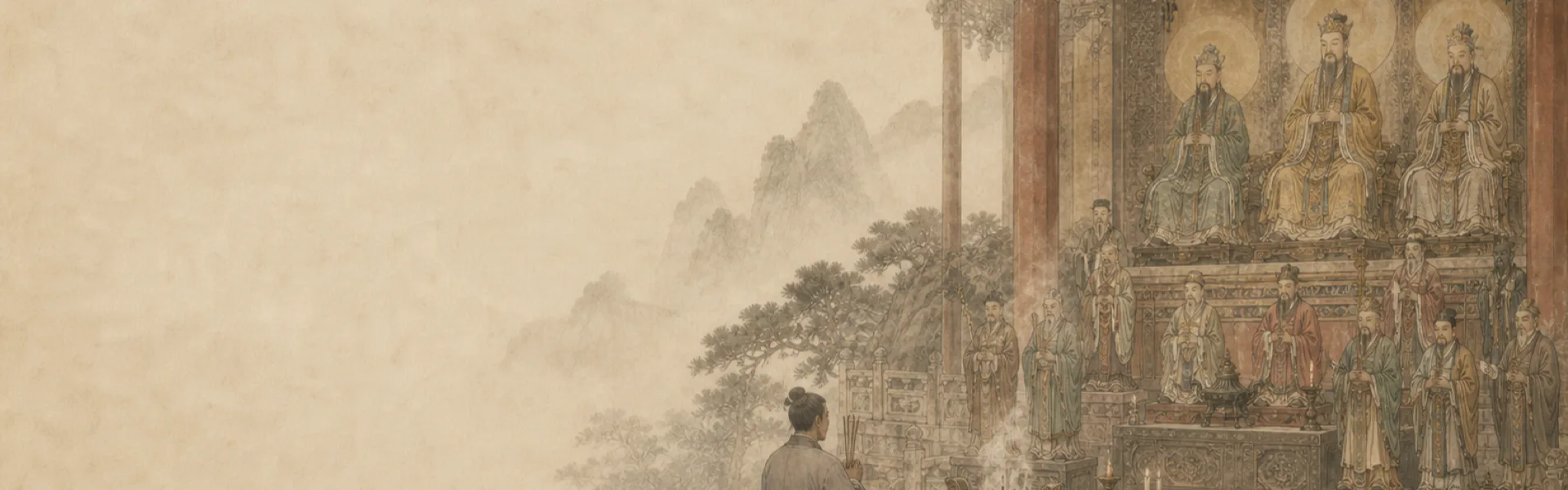
01 Find your bearings
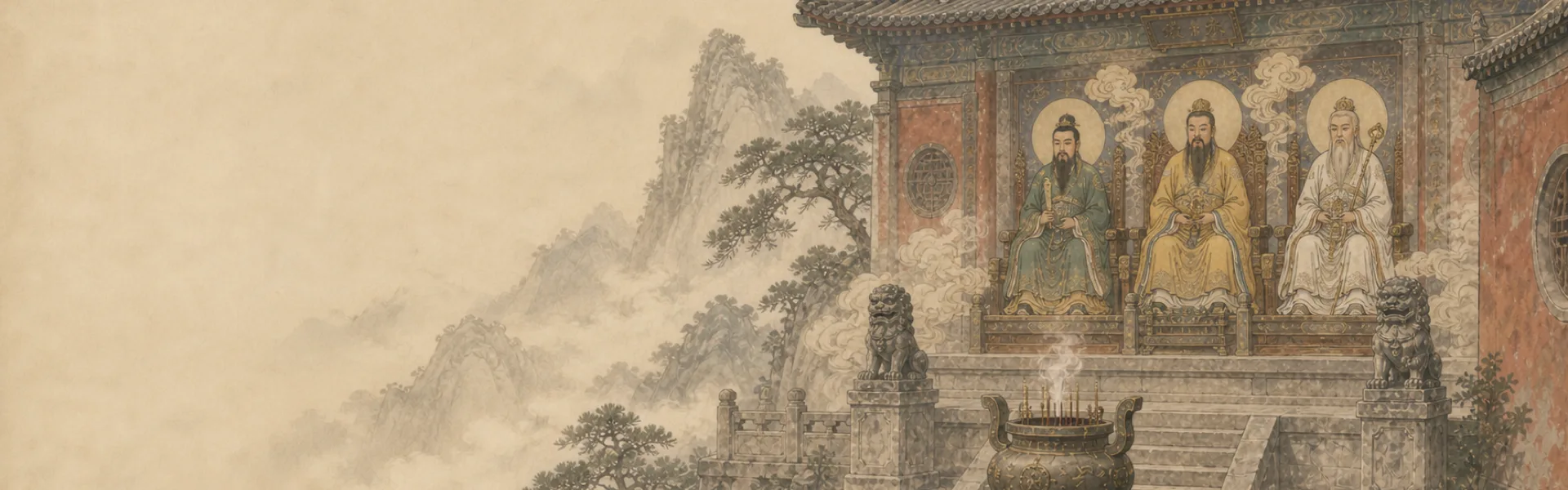
The Three Pure Ones: Highest Deities of the Taoist Pantheon
Who Yuanshi Tianzun, Lingbao Tianzun and Daode Tianzun are, how to recognise them and why they are not a trinity
Explore this section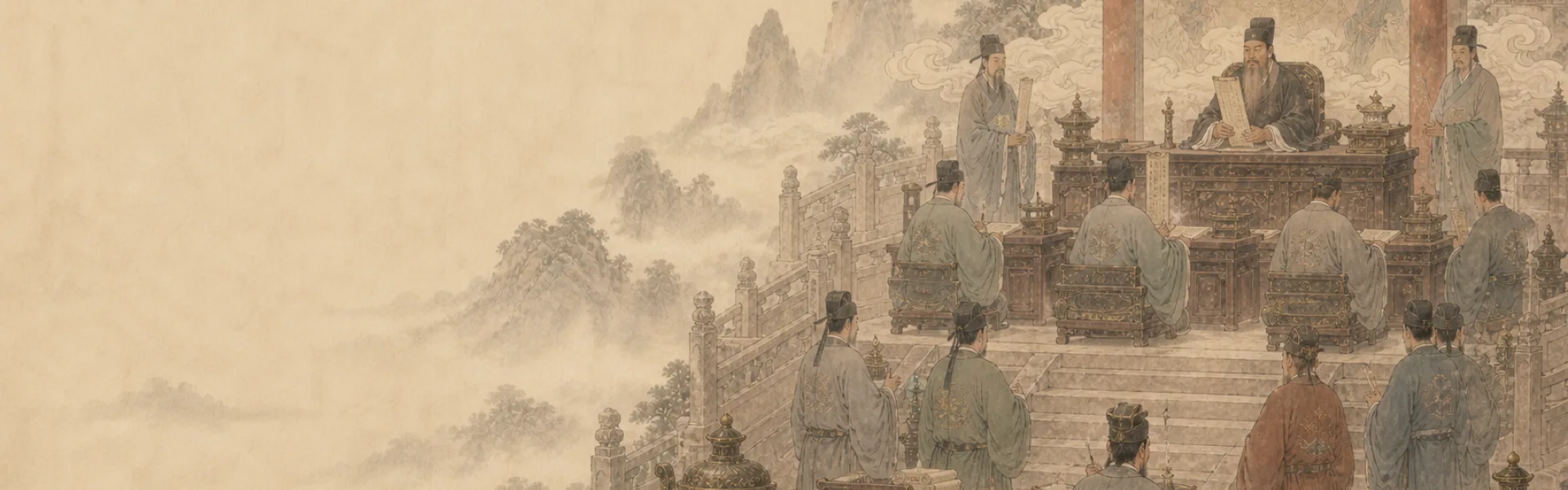
02 Explore the subject
Taoist Immortals and the Celestial Bureaucracy: Shen and Xian
The difference between gods who hold office and transcendents formed through cultivation
Explore this section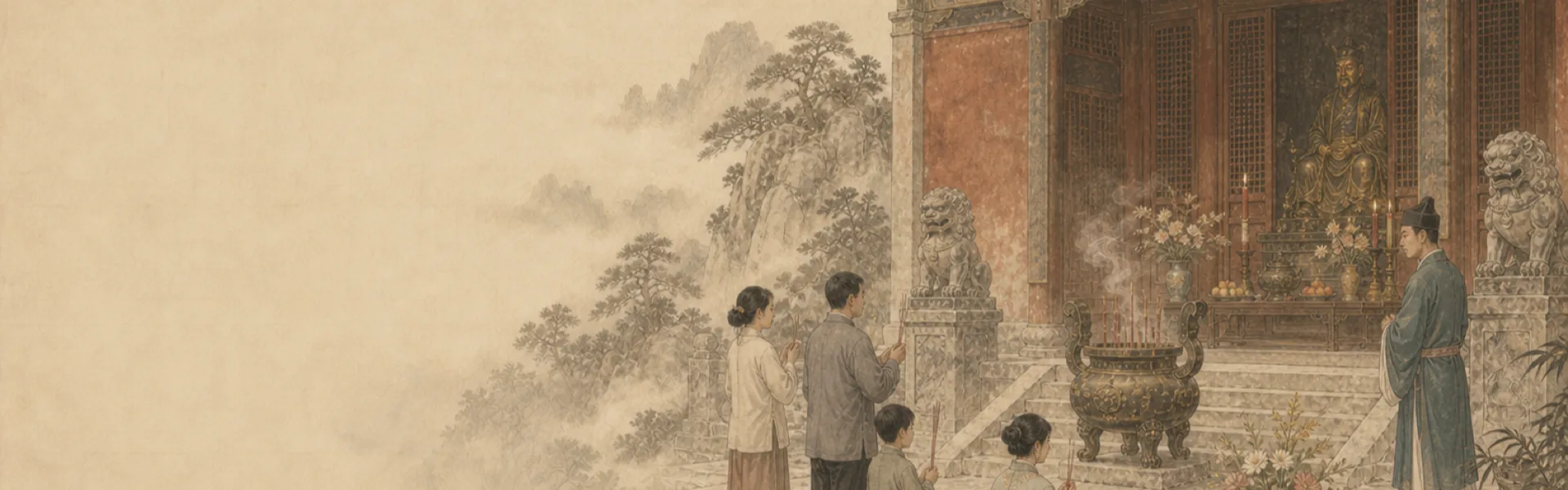
03 Keep reading
Taoist Temple Worship: Incense, Offerings, Vows and Donations
What worshippers do, what each action means and how to approach a Chinese Taoist temple respectfully
Explore this sectionGo further
Deeper reading
- The Three Pure Ones: Highest Deities of the Taoist PantheonWho Yuanshi Tianzun, Lingbao Tianzun and Daode Tianzun are, how to recognise them and why they are not a trinity
- The Jade Emperor in Taoism: Ruler of the Celestial BureaucracyWhy he governs without outranking the Three Pure Ones, how his court works and how to recognise him
- How the Taoist Pantheon Developed: Origins of Its GodsState cults, cosmological personifications, local worship, deified humans and Buddhist exchange
- Taoist Immortals and the Celestial Bureaucracy: Shen and XianThe difference between gods who hold office and transcendents formed through cultivation
- Guan Yu, Mazu and Popular Chinese Deities: How Humans Become GodsFrom local cults and reported efficacy to official titles, temples and widespread worship
- Deities of Wudang Mountain: Zhenwu and His Sacred CourtWhy Wudang centres on one principal god, how to recognise him and which attendants and other deities share the mountain
- Taoist Temple Worship: Incense, Offerings, Vows and DonationsWhat worshippers do, what each action means and how to approach a Chinese Taoist temple respectfully
- The Northern Dipper in Daoist Culture: Stars, Images and Ritual MapsHow one seven-star pattern became an astronomical marker, a field of deities and a powerful ritual image—without collapsing those histories into one story.
- The Three Officials in Daoism: Heaven, Earth, Water and the Three YuanA historical and visual guide to the Three Officials, their changing forms, the Three Yuan calendar, ritual petitions, inspection imagery and responsible temple viewing.
The full guide
What should I know before reading further?
Taoism has an enormous number of gods, and newcomers usually try to memorise them. That is the wrong first move. The useful thing to understand is not the list but the structure — because once you know how the pantheon is organised, most individual deities become predictable, and the ones you meet in a temple stop looking random.
Read more The complete guide
Taoism has an enormous number of gods, and newcomers usually try to memorise them. That is the wrong first move. The useful thing to understand is not the list but the structure — because once you know how the pantheon is organised, most individual deities become predictable, and the ones you meet in a temple stop looking random.
The pantheon is an administration, not a family
Greek and Norse gods are related by blood and marriage, and their stories are family stories. Chinese gods are related by rank and jurisdiction, and their stories are largely official business. There is a hierarchy of offices. Each office has a defined portfolio. Authority is delegated downward, petitions travel upward, and there is an expectation of correct procedure at every level.
This single fact explains more than any amount of memorisation. It explains why a god can be promoted, transferred or effectively retired. It explains why new deities keep appearing: an administration that acquires new responsibilities creates new posts. It explains why the most common Taoist ritual act is the presentation of a written document, read aloud and then burned so that it can be delivered. And it explains why worship is conducted with the etiquette of an official audience rather than the intimacy of a family gathering.
It also explains the absence of a definitive list. No central body has ever had the authority to fix the pantheon, because the pantheon grew the way a bureaucracy grows — locally, incrementally, and in response to demand.
The top of the structure: the Three Pure Ones
At the highest level stand the Three Pure Ones. They are the most exalted figures in Taoism and, for most worshippers, the least relevant to daily life — which is not a contradiction but exactly what you would expect from a hierarchy. Very senior offices do not handle routine requests.
They are best understood as aspects or stages of the Tao becoming manifest, rather than as three personalities. The first is associated with the undifferentiated origin, the second with the ordering of the cosmos and the transmission of scripture, the third with teaching in the human world — and it is the third who is identified with Laozi in deified form. Their hall is usually the most architecturally important in a large temple, and often the quietest.
If you have read the philosophical texts, this is where the two traditions visibly join. The Tao of the Laozi is not a being and cannot be worshipped. The Three Pure Ones are the religion's solution to that problem: a way of giving the ultimate a form that liturgy can address.
The working level: the Jade Emperor and the celestial offices
The Jade Emperor is the figure who actually governs. He is not the highest in rank, but he is the one with executive authority over the visible world, and the resemblance to an earthly emperor is deliberate down to the details: a court, ministries, officials, memorials, audiences, seals.
Below him the structure fans out into the offices most people actually deal with. There are gods of specific mountains, rivers and cities, gods responsible for wealth, literacy, childbirth, medicine and examinations, and — importantly — gods embedded in the household itself, such as the stove god who is understood to report annually on the family's conduct. Surveillance and record-keeping are recurring themes, and they come from the same administrative logic.
Where the gods came from
The pantheon has at least four distinguishable sources, and knowing them makes the whole thing legible.
Some deities are older than Taoism as an organised religion: sky, earth, directional and astral powers inherited from pre-imperial and imperial state cult. Some are personifications of cosmological principles, generated by the system itself rather than remembered from anywhere. Some are local cults absorbed as Taoism spread, retaining regional character. And some are historical human beings who were elevated after death, occasionally by explicit imperial decree.
Buddhism is a fifth factor. The two traditions have coexisted in China for most of two millennia, borrowing iconography, vocabulary and even figures from one another. In popular practice the boundary is often ignored entirely, though the clergy of each tradition maintain it carefully.
Human beings become gods
The clearest case is Guan Yu, a general who died in the third century, was gradually elevated over more than a thousand years, and ended up with imperial titles, temples across the country and a portfolio covering war, loyalty, commerce and sworn brotherhood. Mazu, a woman from a Fujian coastal community, became the protector of seafarers and now has temples throughout the maritime world.
What made this possible is the administrative model. If the divine order is a government, then a person of exceptional merit can be appointed to it, exactly as a competent official is promoted. Efficacy mattered more than theology: a deity that answered requests attracted worshippers, worshippers attracted donations and buildings, and success at local level could eventually attract state recognition. The system rewarded results.
Wudang and the case of Zhenwu
Wudang Mountain is worth mentioning here because it shows the process at full scale. Its principal deity, Zhenwu, began not as a person but as Xuanwu, the emblem of the north — which is why his decisive attribute is still a tortoise entwined with a snake at his feet. The name changed in the Song dynasty because the character xuan became taboo through an imperial ancestor's name. His biography as a prince who renounced the throne to cultivate on the mountain is far later than the emblem, and it grew in detail as the cult grew in political importance.
Then in the fifteenth century the Yongle emperor, who had taken the throne from his nephew, invested enormously in Zhenwu's mountain. The god of the north acquired a building programme, imperial stelae and a rank above the traditional five marchmounts. An abstract directional symbol had become a dynasty's patron. That trajectory — emblem, then deity, then imperial patron — is the pantheon's whole logic in one biography.
The pantheon is not uniform, and never was
Descriptions of the Taoist pantheon usually present a single chart: the Three Pure Ones at the top, the Jade Emperor below, then departments and officers. The chart is real in the sense that it is what the canonical texts and the ordination system assume. It is not real in the sense of describing what you will find in temples across China. Actual practice varies by region, by period, by the type of institution, and by what happened to be locally important.
Some of the variation is regional. A sea goddess dominates coastal Fujian and Taiwan and is almost absent inland. A mountain god matters enormously in one province and is unknown two provinces away. Gods attached to specific trades — carpenters, dyers, salt workers, sailors — follow the trade rather than the map. Wudang itself is an example of concentration: Zhenwu is known nationally, but at Wudang he is not one god among many, he is the reason the site exists, and the entire mountain is organised around him.
Some of the variation is historical. The pantheon has been reorganised repeatedly, usually when a dynasty wanted the celestial order to mirror its own arrangements more exactly. Gods have been promoted, given new titles, merged with other gods who had similar functions, and quietly dropped. The Jade Emperor's rise to the working summit of the structure is itself a case of this: he is not present in the earliest layers and becomes central later, partly through imperial sponsorship. A pantheon that looks like a fixed hierarchy in a diagram was in fact a hierarchy under continuous revision.
Some of the variation depends on the institution. A large monastery with an ordained clergy will keep close to the canonical arrangement, because its rituals require it. A small village shrine may contain three figures whose relationship to the official structure nobody present could explain, and it will function perfectly well. Both are Chinese religion. Neither is a corrupted version of the other, although each has at times accused the other of exactly that.
This matters for how you read a hall. Do not assume that the figures in front of you correspond to a chart you have memorised, and do not assume that an unexpected figure indicates a mistake or a decline. Read what is actually there: the position, the dress, the objects held, the animals or attendants at the feet, and above all the written name on the plaque or the couplets. The written name is the most reliable evidence in the building, because it was put there by people who knew who they were installing.
The general point is worth stating plainly. The administrative model explains the logic of the pantheon — why gods have jurisdictions, why petitions are worded like documents, why titles matter. It does not give you a complete roster. Anyone who offers you a definitive list of Taoist gods is offering a simplification, and usually one drawn from a particular text of a particular period rather than from the religion as it was practised.
What worshippers actually do
Ordinary practice is more modest than the cosmology suggests. A visitor enters, offers incense, bows, states a request or gives thanks, and leaves. The request is usually specific and practical: health, an examination, a business matter, safe travel, a family difficulty. There is nothing furtive about this and no sense that it is a lesser form of religion.
Larger matters go to a priest, who has the training and the standing to conduct formal ritual — and formal ritual is, again, largely documentary: the composition, recitation and transmission of a petition in the correct form to the correct office. The difference between a layperson and a priest is not sincerity. It is procedural competence, of the kind that only ordination and training provide.
Key points
- The Taoist pantheon is organised by rank and jurisdiction, like a bureaucracy, not by kinship like the Greek or Norse pantheons.
- Understanding the structure is far more useful than memorising names; the structure makes individual deities predictable.
- The Three Pure Ones hold the highest rank and are the least involved in daily requests. They give liturgy a way to address what the philosophical texts describe as formless.
- The Jade Emperor holds executive authority and his court is modelled explicitly on an imperial administration.
- The gods come from several sources: state cult, cosmological principle, absorbed local cults, deified humans — plus long exchange with Buddhism.
- People can be promoted into the pantheon. Guan Yu and Mazu are the clearest examples, and efficacy mattered more than doctrine.
- Zhenwu of Wudang began as the northern directional emblem; the tortoise and snake at his feet are the fossil of that earlier stage.
- Everyday worship is a respectful, specific request lodged with the appropriate office. Priests differ from laypeople in procedural competence, not sincerity.
Recommended next page
Where next?
The Jade Emperor in Taoism: Ruler of the Celestial BureaucracyWhy he governs without outranking the Three Pure Ones, how his court works and how to recognise himA few alternatives