BaZi (Four Pillars of Destiny): How the Eight Characters Work
八字四柱命理:八个字如何构成命盘
BaZi is the best known of the Chinese systems for reckoning a person’s fate from the moment of birth. Its name means eight characters, and that is literally what it works with: the date and time of birth are converted into eight written characters arranged in four pairs, and everything the system has to say is derived from the relations among those eight.
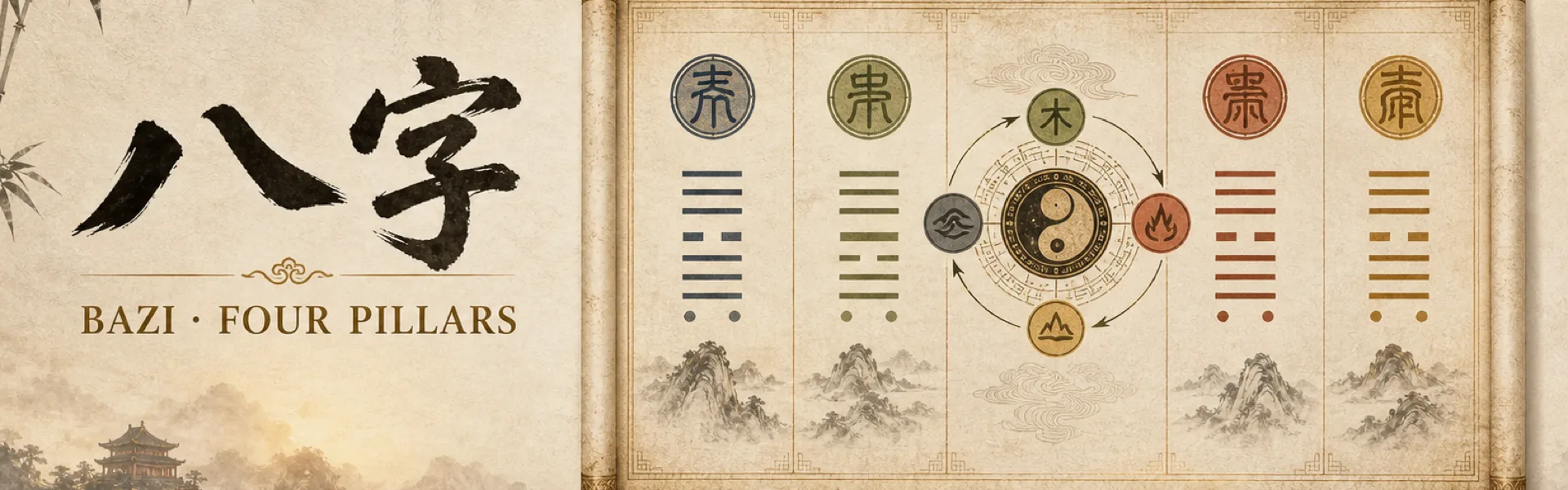
This introduction explains what the eight characters are, how the craft divides into a mechanical half and an interpretive half, what the system claims, what it assumes, and how to read its literature without being misled in either direction. The pages that follow take each part in turn.
The names, and what they tell you
Three names are in use and each points at a different aspect. BaZi (八字), eight characters, refers to the data. Si Zhu (四柱), four pillars, refers to the arrangement of that data into four vertical columns, one each for the year, month, day and hour of birth. Ziping (子平) refers to the method, and is a personal name — the system’s decisive reform is credited to Xu Ziping, so the whole art is often called Ziping shu, the Ziping technique. In older bibliographies you will also meet the broader heading of ming (命), fate, which covers this art and its relatives.
The plainest of these is four pillars, because it describes the object on the page. Each pillar consists of one heavenly stem above and one earthly branch below, drawn from the sixty-term cycle explained in the Ganzhi pages of this section. Four pillars of two characters each gives eight characters, and there the name comes from.
What the system actually is
It is worth being clear at the start that BaZi is a calendrical art, not an astronomical one. This surprises people who arrive expecting something like Western astrology. No planet is observed, no position in the sky is calculated, and nothing is measured against the stars. The practitioner takes a date and a time, converts them through the traditional calendar into eight characters, and then reasons entirely about those characters — their five-phase associations, whether they generate or restrain one another, which are abundant and which absent.
The whole system is therefore combinatorial. It operates on a code derived from a date, and its rules are rules about the code. This has one consequence worth registering immediately, because it is arithmetic rather than opinion: the number of possible charts is finite and not very large. Sixty possibilities for the year pillar, twelve for the month, sixty for the day and twelve for the hour give about five hundred and eighteen thousand distinct charts in total. Set against a world population in the billions, that means millions of living people share any given chart exactly. What a practitioner does with that fact is the single most useful question you can ask about how they understand their own art.
The craft has two halves
Nothing about BaZi is intelligible until this division is clear, because the two halves have completely different characters.
The first half is casting the chart, pai pan (排盘). This is calendar conversion, and it is arithmetic. Given an accurate date, time and place of birth, the eight characters follow by definite rules, and any two competent practitioners will produce identical results. There is nothing mystical about this step and essentially nothing to disagree about; software does it instantly and correctly. Where errors occur they are ordinary errors — a wrong time zone, a forgotten daylight-saving adjustment, a birth near midnight or near the start of a solar term.
The second half is interpreting the chart, jie pan (解盘). This is not arithmetic at all. It requires judging which phases are strong or weak, which of the eight characters help the Day Master and which hinder it, how the relationships interact, and what any of it means for a life. Here the classical texts offer principles that conflict, practitioners of different lineages reach different conclusions from the same eight characters, and skill is a matter of experience and interpretive sense. Presenting the certainty of the first half as though it extended to the second is the commonest way BaZi is misrepresented, and it is done by enthusiasts and debunkers alike.
The Day Master, and why it matters
One of the eight characters carries more weight than the others: the stem of the day pillar, called the Day Master (日主) or day source. It stands for the person whose chart it is. Everything else in the chart is read in relation to it — supporting it, draining it, controlling it, being controlled by it.
This is not a small technical detail but the hinge of the whole system, and it is a historical development rather than an original feature. Earlier fate reckoning centred on the year, which is what the familiar twelve animals still do. Moving the centre to the day is what turned a broad classification into something capable of distinguishing individuals, and it is the reform that separates BaZi from what came before it.
The one assumption
Strip away the vocabulary and a single premise remains: that the calendrical designation of the moment you were born corresponds to the shape of your life. Not that it causes it — the literature is generally careful not to claim mechanism — but that the two correspond, so that reading one tells you about the other.
This is correlative thinking, the assumption running through all the Chinese metaphysical arts, and it is nowhere argued for in the BaZi literature. The manuals begin from it. That is worth stating plainly, because a reader can follow hundreds of pages of intricate and internally consistent reasoning without ever being shown a reason to accept the premise on which all of it rests. The consistency is real; it is simply consistency within a system, which is a different thing from evidence about the world.
What it claims, and what it does not
The better classical writing is more modest than popular practice. It describes tendencies, capacities, difficult periods and favourable ones, the kind of temperament a person brings and the sort of circumstances that suit it. It does not, in its serious form, claim to name events or dates.
There is also a strong current in the literature insisting that a chart is not a sentence. The stock phrase is that the superior person creates his own fate; knowing a tendency is supposed to help you work with it rather than tell you it is fixed. Whether that position is fully consistent with the rest of the theory is a fair question, but it is genuinely there in the sources and is not a modern softening. Practice that promises specific events on specific dates has departed from the tradition it invokes.
Where it sits among the Chinese arts
In the traditional grouping of five arts, BaZi belongs to ming, the reckoning of fate, alongside its main rival Zi Wei Dou Shu. The two are worth comparing because the contrast is instructive. BaZi uses eight characters and reasons through the five phases; Zi Wei Dou Shu places named stars in twelve palaces and reasons through their meanings. BaZi is austere and analytical, Zi Wei Dou Shu pictorial and detailed. Both take the same birth data as input, both have long textual traditions, and they frequently disagree. No accepted procedure exists for deciding between them when they do, which tells you something about the epistemic situation of the whole field.
Is BaZi Taoist?
No, not distinctively. It is Chinese rather than Taoist. It uses the stems and branches, yin and yang, and the five phases, all of which are shared intellectual property across Chinese thought and none of which belongs to Taoism in particular. Its practitioners have included Taoist priests, Buddhist monks, Confucian scholars, and secular professionals with no religious commitment whatever, and its principal classics were written by literati rather than clergy.
There is a genuine connection worth stating accurately: BaZi and Taoist practice draw on the same cosmological vocabulary, so they sit together comfortably and often appear in the same households. But an art of fate calculation is in some tension with the Taoist emphasis on spontaneity and on not grasping at outcomes, and some Taoist writers have said so. Treating BaZi as a Taoist teaching misdescribes both.
Its real place in society
Historically this was a service occupation, and an ordinary one. Charts were consulted at the points where families made irreversible decisions: marriage above all, since compatibility of charts was routinely checked before a match, and also the timing of ventures, the naming of children, and the assessment of a young person’s prospects. Professional practitioners worked in market towns alongside letter writers and scribes, and the trade had recognised handbooks.
Its social function was partly to supply a neutral third party. A family that wished to decline a marriage proposal without giving offence could cite an unfavourable chart comparison, which was a face-saving mechanism nobody had to admit was one. That use of the art tells you as much about why it lasted as any of its theory does.
Common misunderstandings
Four are worth clearing up at once. BaZi is not the twelve-animal zodiac; that is one character out of eight, and treating the animal year as a personality system is a popular simplification that serious practice does not accept. It is not astrology in the Western sense, since it observes nothing in the sky. It does not use the ordinary lunar calendar, but a solar reckoning in which the year turns at the beginning of spring in early February and the months turn at the solar terms, which is why converted dates often look wrong to people expecting lunar New Year. And it is not a single agreed system but a family of competing lineages whose readings of the same chart may differ substantially.
Reading the sources critically
Three questions will orient you in almost any BaZi text. Is this passage about casting the chart or interpreting it — that is, is the claim arithmetical or judgemental? Which lineage or classic is it following, and does it acknowledge that others exist and disagree? And does it distinguish tendency from event, or does it slide into naming outcomes?
A source that never marks the boundary between calculation and interpretation, or that presents one lineage’s rules as simply the rules, is unreliable even where its individual observations are shrewd. It is also worth knowing that the classics are terse, often in verse, and were written for students who had a teacher; and that a good deal of what circulates now as ancient doctrine was systematised in the twentieth century, particularly through teaching lineages in Hong Kong and Taiwan.
What this section covers
The pages that follow take the subject in order. One traces the history, from the year-centred methods that preceded the system through Xu Ziping’s reform to its codification in the Ming. One shows how a chart is actually built, including the calendar problem and the stems hidden inside the branches. One explains the Day Master and the Ten Gods, the framework through which relationships in a chart are named. One deals with five-phase balance and how a chart is read as a whole. One covers the luck pillars and annual influences, which is how the system handles time. One offers an honest assessment of what the art can and cannot do. A final page lists sources in Chinese and Western languages with a note on what each is good for.
Key points
- BaZi converts a birth date and time into eight characters in four pillars, and reasons only about those characters; nothing in the sky is observed.
- The craft splits into casting the chart, which is calendar arithmetic and uncontroversial, and interpreting it, which is judgement and heavily disputed.
- The Day Master, the stem of the day pillar, represents the person and is the reference point for everything else; centring the day rather than the year was the system’s decisive reform.
- Only about half a million distinct charts exist, so millions of living people share any given one exactly.
- Its single premise is that the calendrical designation of a birth moment corresponds to the shape of a life; the literature assumes this rather than arguing it.
- It is Chinese rather than Taoist, it is not the twelve-animal zodiac, and it does not use the ordinary lunar calendar.