A path into the reading
Baguazhang: Circle Walking, Palm Changes and Movement
How a nineteenth-century martial art uses circular stepping, changing angles and open-palm methods—and what its early sources can establish
Start here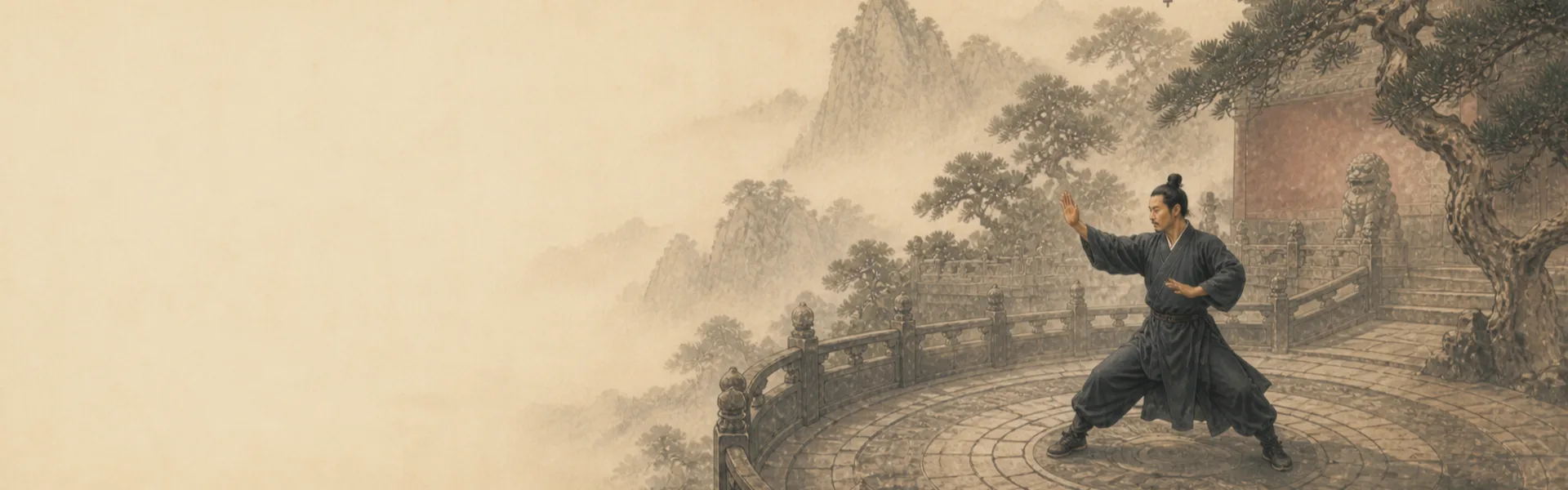
01 Find your bearings
Origins and History of Baguazhang: Dong Haichuan and the Record
What late-Qing memorials, early print and lineage testimony can establish—and where the evidence still stops
Explore this section
02 Explore the subject
Baguazhang Principles: Turning, Angling and Continuous Change
A practical guide to spiralling cues, changing position, partner tasks and the limits of movement-based tactics
Explore this sectionGo further
Deeper reading
- Origins and History of Baguazhang: Dong Haichuan and the RecordWhat late-Qing memorials, early print and lineage testimony can establish—and where the evidence still stops
- Circle Walking and Palm Changes in BaguazhangA practical guide to circle size, stepping, direction changes, partner progressions and adaptable training volume
- Baguazhang and the Yijing: History, Diagrams and PracticeHow trigram language entered printed curricula—and how to use it without confusing interpretation with origin
- Baguazhang Principles: Turning, Angling and Continuous ChangeA practical guide to spiralling cues, changing position, partner tasks and the limits of movement-based tactics
- Baguazhang Sources and Reading PathsHow to use memorials, Republican-era manuals, lineage testimony, scholarship and living-heritage records without asking one source to do every job
The full guide
What should I know before reading further?
Baguazhang is a late-Qing Chinese martial art recognised by circular stepping, frequent changes of direction and methods organised around the open palm. “Internal” is a historical family label here, not a promise of effortless power. Schools use the circle differently, but all ask a practical question: can you keep structure and awareness while your feet, angle and facing change?
Read more The complete guide
Baguazhang is a late-Qing Chinese martial art recognised by circular stepping, frequent changes of direction and methods organised around the open palm. “Internal” is a historical family label here, not a promise of effortless power. Schools use the circle differently, but all ask a practical question: can you keep structure and awareness while your feet, angle and facing change?
This gateway separates dated evidence from lineage memory. It introduces Dong Haichuan, circle walking, palm changes, the name “Eight Trigram Palm” and the diversity of later branches. The five child pages then take those subjects further.
What Baguazhang is
The name baguazhang (八卦掌) means “Eight Trigram Palm.” The most visible practice is walking around a centre while holding or changing an upper-body posture. Yet the art is not simply “walking in circles.” Straight entries, turns, pivots, strikes, controls, throws, weapons and partner drills appear in different proportions across schools.
It helps to distinguish shared features from local curriculum. Circular travel, angle changes and palm-led methods are widely recognisable; a particular set of eight palms, its names and its applications may belong to one branch. China’s national intangible-cultural-heritage record documents Baguazhang as a living traditional sport with multiple transmitted styles. That record is evidence of present-day heritage recognition, not by itself proof for every origin story it preserves.
Dong Haichuan and the earliest documented generation
Most surviving lineages place Dong Haichuan at the beginning of their public transmission. Late-Qing memorial inscriptions and accounts from the next generations connect him with teaching in Beijing and name disciples whose branches continued. It is therefore safer to call Dong the earliest well-documented transmitter than to claim that every component of the art began with one moment of invention.
A memorial stele is valuable because it is dated and close to the people it commemorates. It is also an act of remembrance made by disciples. It can establish names, relationships and what a community wished to record; it cannot independently prove every biographical or technical detail repeated later. Scholarship on martial lineages, including Jeff Takacs’s study of kinship, ritual and legitimacy, is a reminder to read such records both as evidence and as community-making.
What remains uncertain about earlier origins
Accounts of Dong’s earlier training describe travel, mountain teachers or religious adepts, but names, places and sequences vary as the stories are retold. No securely identified earlier manual or independent teacher record currently supplies a complete pre-Dong Baguazhang curriculum. The responsible conclusion is limited: Dong may have drawn on skills already known to him, but the surviving evidence does not let us reconstruct a single hidden predecessor.
Daoist ritual includes forms of processional and circular movement, and the comparison deserves respectful study. Resemblance is not a transmission document, however. This site therefore presents religious interpretations as traditions and hypotheses unless a dated source establishes the connection. Peter Lorge’s history of Chinese martial arts offers the wider method: physical practices should be located in their social and documentary setting, not detached from it by a single legend.
Circle walking as a training method
In a basic circle-walking drill, a practitioner travels around a chosen centre, maintains a posture and changes direction through a taught transition. Circle size, height, foot placement, gaze and torso orientation vary by school and training stage. Those details matter: changing one variable changes the task.
The drill can organise repeatable practice of balance, continuous stepping, turning and coordination between the lower and upper body. It does not automatically produce endurance, fighting ability or a particular body mechanic. Those outcomes depend on duration, intensity, instruction and the other work surrounding the circle. Beginners benefit from a manageable stance and clean steps before adding speed, low postures or complex changes; pain is not a measure of authenticity.
Palm changes, stepping and partner application
A palm change joins one direction of travel to another. Some curricula teach a named core of eight; others count, group or perform their changes differently. “Eight” should not be mistaken for a universal catalogue. A change can be studied as a solo coordination pattern and then examined through specific partner tasks such as entering, turning, redirecting or controlling space.
Application requires a progression. First agree on the line, speed and response; then vary timing and resistance without abandoning control. A beautiful solo change is not proof of a throw or strike, and a cooperative demonstration is not proof of performance under pressure. Contact, joint work and takedowns require consent, safe surfaces and stopping rules. Baguazhang offers movement problems to train, not guaranteed solutions to assault or multiple opponents.
The name “Eight Trigram Palm” and the Yijing
The eight trigrams of the Yijing provide a rich language of direction, relation and change. Baguazhang teachers have used that language to name, arrange and interpret practice. By the early Republican period it was plainly present in printed teaching: the National Library of China’s 1921 scan of Sun Lutang’s Baguáquán xué organises chapters through cosmological and trigram categories.
That dated witness shows what one influential teacher published by 1921; it does not settle when every correspondence began or make one scheme binding on all branches. The framework may function as a mnemonic, a way to compare changes, a philosophy of adaptation or a lineage-specific map. Readers should ask what a correspondence changes in actual practice and which text or teacher defines it.
Lineages differ without one standard form
Branches associated with early students and later teachers differ in palm shape, stepping, posture, sequence, terminology and emphasis. Some accounts explain the variety through Dong adapting instruction to experienced students. This is a meaningful lineage memory, but it should not be expanded into a claim that every difference was deliberately designed by him.
Variation need not mean corruption, and age need not prove superiority. Compare a method by identifying its source, purpose and test: who teaches it, what problem does it address, and how is improvement assessed? A lineage name locates a relationship; it does not replace observation. Wudang communities practise and interpret Baguazhang today, while the clearest early documentary horizon remains the art’s late-Qing transmission in Beijing.
Choose the next page
Use the child pages as separate reading paths. Their French editions will appear only after each has been independently sourced and reviewed:
Origins and History examines Dong Haichuan, memorial inscriptions and the limits of later narratives.
Circle Walking and Palm Changes breaks down variables, progressions and common training errors.
Baguazhang and the Yijing distinguishes early printed evidence from later symbolic systems.
Principles studies spiralling, evasion and continuous change as testable movement ideas.
Key Sources and Further Reading identifies editions, translations and research questions.
For a method that applies across traditions, begin with the guide to evaluating internal-arts sources. Then return to the Baguazhang path that matches your question.
Recommended next page
Where next?
Circle Walking and Palm Changes in BaguazhangA practical guide to circle size, stepping, direction changes, partner progressions and adaptable training volumeA few alternatives