A path into the reading
Chinese Calligraphy: Scripts, Materials and Ways of Looking
Read the written words and the brushwork together, from script families to a first encounter with a historical work.
Start here
01 Find your bearings
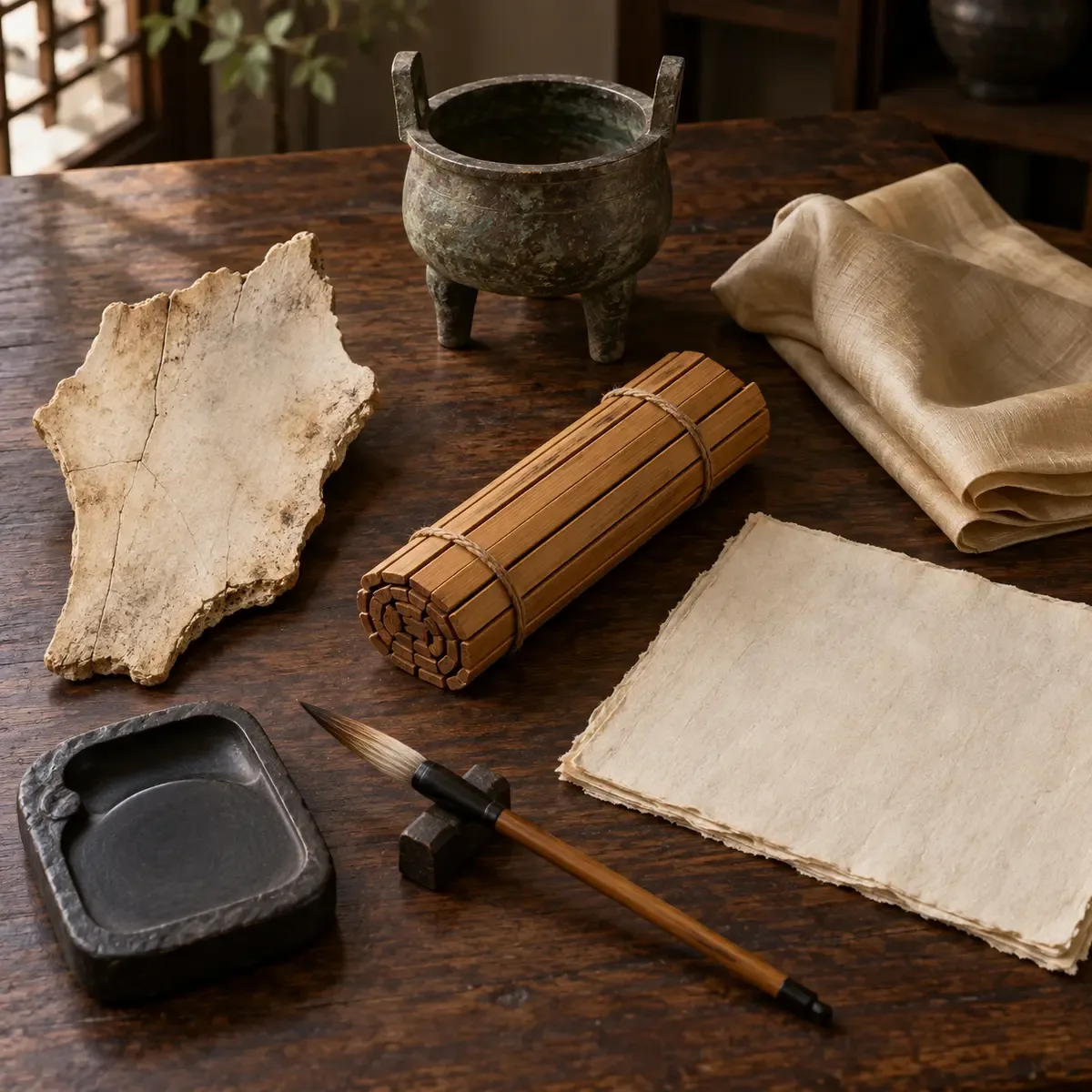
Origins and History of Chinese Calligraphy
From early inscriptions to brush writing, copies and rubbings
Explore this section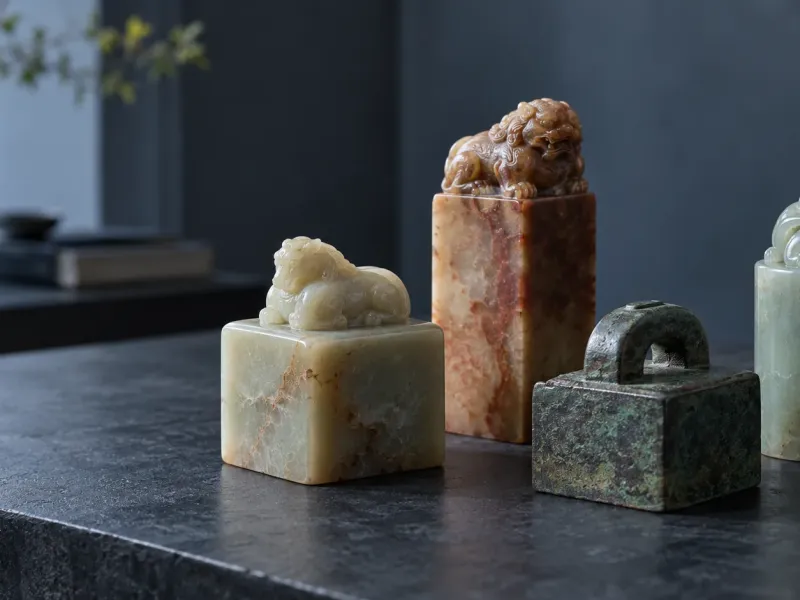
02 Explore the subject
Chinese Seals and Seal Carving: Script, Surface and Impression
A practical guide to the seal as object, carved matrix and printed mark—and to what an impression can and cannot prove.
Explore this section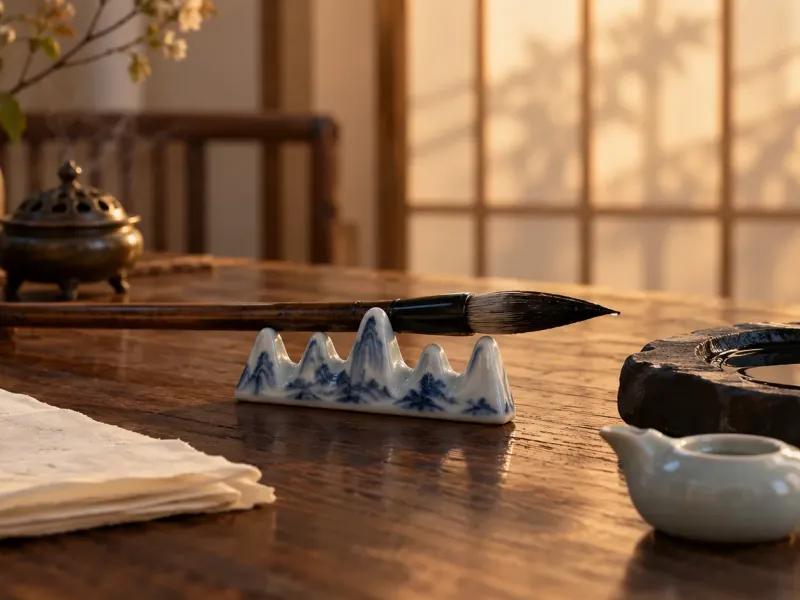
03 Keep reading
Chinese Brush Rests: Mountains, Materials and the Scholar’s Desk
See how a small desk tool held wet brushes, became a miniature landscape, and can be read through form, material and museum evidence.
Explore this sectionGo further
Deeper reading
- Origins and History of Chinese CalligraphyFrom early inscriptions to brush writing, copies and rubbings
- The Five Script Styles in Chinese CalligraphySeal, clerical, regular, running and cursive as living script families
- Calligraphy and Taoist Cultivation: Text, Attention and PracticeReligious writing, philosophical reflection and an attentive approach to the brush
- The Four Treasures of the Study: Choosing and Using Calligraphy MaterialsUnderstand brush, ink, paper and inkstone through careful use and simple comparisons
- Chinese Calligraphy Brushwork: Reading and Practising the Living LineFrom contact and movement to character structure, spacing and a whole page
- Chinese Calligraphy Masters and Reading PathsHow to choose works, read catalogue records and build a useful study route
- Chinese Seals and Seal Carving: Script, Surface and ImpressionA practical guide to the seal as object, carved matrix and printed mark—and to what an impression can and cannot prove.
- Chinese Ink Rubbings: Stone, Paper and the Life of CalligraphyHow carved surfaces become portable ink impressions—and how to read a rubbing as a dated object rather than a transparent copy.
- Chinese Inkstones: Stone, Carving and the Scholar’s DeskLearn to read an inkstone through its working surface, material, carving, inscriptions, case and documented history.
- Chinese Inksticks: Soot, Moulds and the Scholar’s DeskFollow solid ink from carbon and glue to moulded image, inscribed object, fitted box and documented collection history.
- Chinese Calligraphy Paper: Xuan, Sizing and the Life of a SheetLearn how fibres, sizing, brushwork and mounting shape a sheet, then use a six-pass method to read museum works without guessing.
- Chinese Calligraphy Brushes: Hair, Handle and the Working PointSee how hair bundles, construction, handles and wear shape a brush, then use a six-pass method to read museum examples without guessing.
- Chinese Brush Rests: Mountains, Materials and the Scholar’s DeskSee how a small desk tool held wet brushes, became a miniature landscape, and can be read through form, material and museum evidence.
- Chinese Water Droppers: Flow, Form and the Scholar’s DeskHow small vessels controlled inkstone water and became ceramic, bronze and sculptural objects of the writing desk
- Chinese Brush Pots: Function, Material and the Scholar’s DeskHow an upright container for brushes became a surface for bamboo carving, porcelain painting, landscape and learned collecting
- Chinese Brush Washers: Water, Form and the Scholar’s DeskHow a vessel for rinsing brushes became a field for glaze, grain, carved stone and learned looking
- Chinese Paperweights: Form, Material and the Scholar’s DeskHow bars, animals and hardstone forms held paper, furnished the writing table and became objects of close looking
The full guide
What should I know before reading further?
Chinese calligraphy, shufa, is an art of writing in which words and their visible form belong together. Brushwork, character structure, spacing and the choice of text all offer ways into a work. It can be appreciated without immediately understanding every character, but a transcription and translation often open an additional dimension.
Read more The complete guide
Chinese calligraphy, shufa, is an art of writing in which words and their visible form belong together. Brushwork, character structure, spacing and the choice of text all offer ways into a work. It can be appreciated without immediately understanding every character, but a transcription and translation often open an additional dimension.
This overview introduces script families, materials, formats and habits of looking. It also separates historical ideas about expressive writing from claims that handwriting can reliably diagnose a person’s character. The aim is an informed encounter with particular works, not a ranking of cultures or a promise of rapid mastery.
1. Begin with the work’s identity
Before judging a line, read the label. Who is the work attributed to? What is its date, material and format? Is it an original brush-written sheet, a copy, a rubbing or a modern reproduction? These questions determine what kind of evidence lies before you.
Next ask what has been written: a poem, letter, dedication or other text. Its words may interact with the occasion and presentation. Looking only for attractive shapes can miss this relationship, just as reading a transcription alone can miss the arrangement on the page.
2. Expression is not a personality test
Historical writing about calligraphy often uses comparisons with bodies, movement and natural forces. Such language helps explain how a line was valued: firm or yielding, concentrated or expansive. It belongs to the history of interpretation rather than a scientific test of the writer.
A measured arrangement does not establish moral virtue, and a restless line does not prove an unstable temperament. Describe what you can see before drawing conclusions about a life. Even an expressive letter is also shaped by learned conventions, materials and its purpose.
3. Five script families, not five successive replacements
A common introductory grouping distinguishes seal script (zhuanshu), clerical script (lishu), regular script (kaishu), running script (xingshu) and cursive script (caoshu). These names identify broad families with internal variation, not a simple ladder in which each new script erased the last.
Compare how clearly strokes remain separated, how character components are arranged and how forms are abbreviated or linked. Cursive writing has conventions; it is not permission to invent arbitrary marks. Recognising a script family and reading a particular writer’s hand are related but different skills.
4. Look from the stroke to the whole surface
Start with a small area. Notice changes in width, dark and pale ink, sharp or rounded turns and the spaces enclosed by strokes. Then step back to compare character size, distances within a column and the relationship between written and unwritten areas.
Keep observation distinct from reconstruction. A dry trace can involve ink load and the writing surface as well as movement. A still image cannot by itself tell you the exact speed, pressure or stroke sequence. Use a documented model or demonstration when those technical details matter.
5. Materials work together
Brush, ink, paper and inkstone are conventionally called the Four Treasures of the Study. They are useful to consider as a working relationship: a flexible brush carries ink to a surface whose response affects the resulting edge and spread.
For a first practice, seek compatible, usable materials rather than prestigious names. Try a small mark on a spare piece of the same paper before beginning. Notice how quickly it spreads and dries. A change of paper can change the result, so do not attribute every difference to your hand.
6. Format changes the encounter
A hanging scroll, handscroll, album leaf and fan offer different spaces for writing and viewing. Ask how much of the work a viewer would encounter at once, and how its shape affects the arrangement. A screen photograph may flatten these differences.
The example below is a round fan mounted as an album leaf, rather than a passage cropped from a rectangular page. Its rounded support is part of what you are looking at. Retaining the complete image helps preserve that relationship between writing and format.
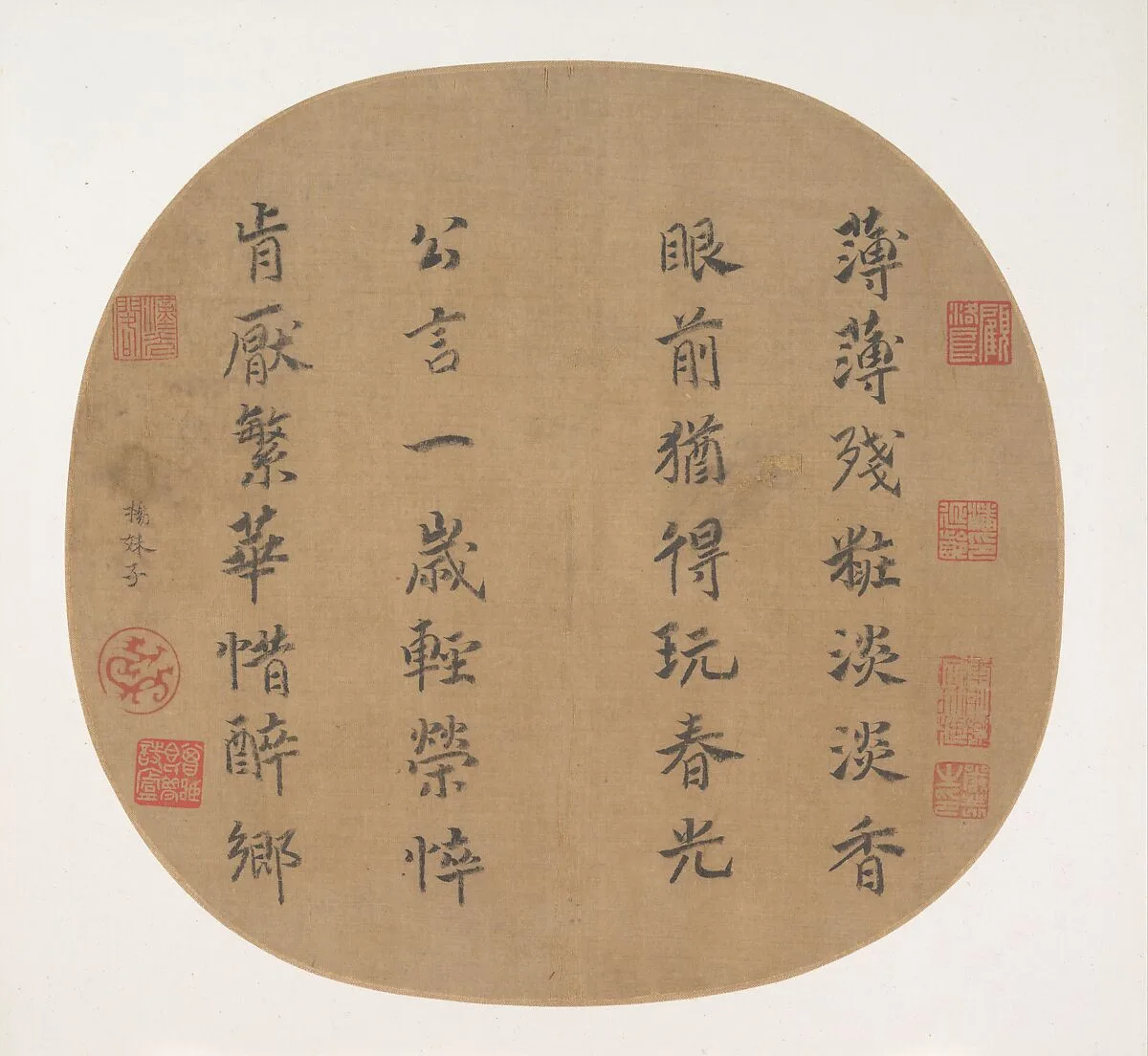
Empress Yang Meizi, Quatrain on spring’s radiance, early 13th century; ink on silk, round fan mounted as an album leaf. The Metropolitan Museum of Art, 1989.363.12, Bequest of John M. Crawford Jr., 1988. Public-domain image (CC0); converted to WebP without cropping. Museum source and credit
7. A historical work, not a generated script sample
The museum identifies this work as Empress Yang Meizi’s Quatrain on spring’s radiance, an early-thirteenth-century work in ink on silk. The object number and source in the caption make it possible to distinguish this particular work from a generic illustration.
Look at the four columns, their placement within the rounded field and the smaller red impressions. Then consult the museum record for the text and its interpretation. The visible arrangement offers one starting point; it does not establish a universal layout rule or the writer’s state of mind.
8. Copies and later additions need labels
A copy can be an important witness to how an earlier model was transmitted without being the earlier writer’s own hand. A rubbing records an inscribed surface through another process. Record the kind of object and the stated attribution rather than treating every reproduction as an original.
Seals and later inscriptions can add evidence about collecting and interpretation, but they do not automatically authenticate a work. Ask who added them, when and on what basis that identification is made. Where the record remains uncertain, keep the uncertainty visible.
9. Learn through a small, observable task
Choose a clearly identified model with guidance suitable for your level. Begin with a short passage or a few characters, comparing their proportions and spacing. If you do not read Chinese, obtain the transcription and meaning rather than copying an unidentified internet image.
Use a comfortable working position, avoid gripping with unnecessary force and take breaks when needed. Compare one feature at a time and ask a qualified teacher about movement that a picture cannot explain. Improvement has no fixed timetable, and repeated copying is more informative when you know what you are examining.
10. Keep religious context specific
For a work encountered at a Daoist site, ask about its text, author, use and setting before calling it a spiritual exercise. Shared words such as attention or naturalness do not make every act of calligraphy a single religious practice.
Where writing has a ritual function, that function needs its own historical and religious explanation. It should not be reduced to visual style or offered as a casual exercise copied from a photograph. This introductory guide concerns reading and looking, not ritual instruction or claims of spiritual attainment.
11. Choose the next question
The calligraphy section is organised around six questions: origins and history; the five script families; materials; brush technique; Daoist cultivation; and major figures and further study. Choose according to the question that arose from looking at a work, rather than assuming every reader needs the same sequence.
For the relationship between written language and poetic reading, continue to Chinese Poetry and Literature. The Literati Arts overview places calligraphy beside related arts while leaving room for the distinct methods and histories of each.
Recommended next page
Where next?
The Five Script Styles in Chinese CalligraphySeal, clerical, regular, running and cursive as living script familiesA few alternatives