Tea Ceremony

茶道

Tea in China is an ordinary daily drink, a major agricultural commodity, a subject of connoisseurship, a component of ritual and hospitality, and a practice some people treat as a form of cultivation. All of these are real, and they do not sit comfortably under a single heading.

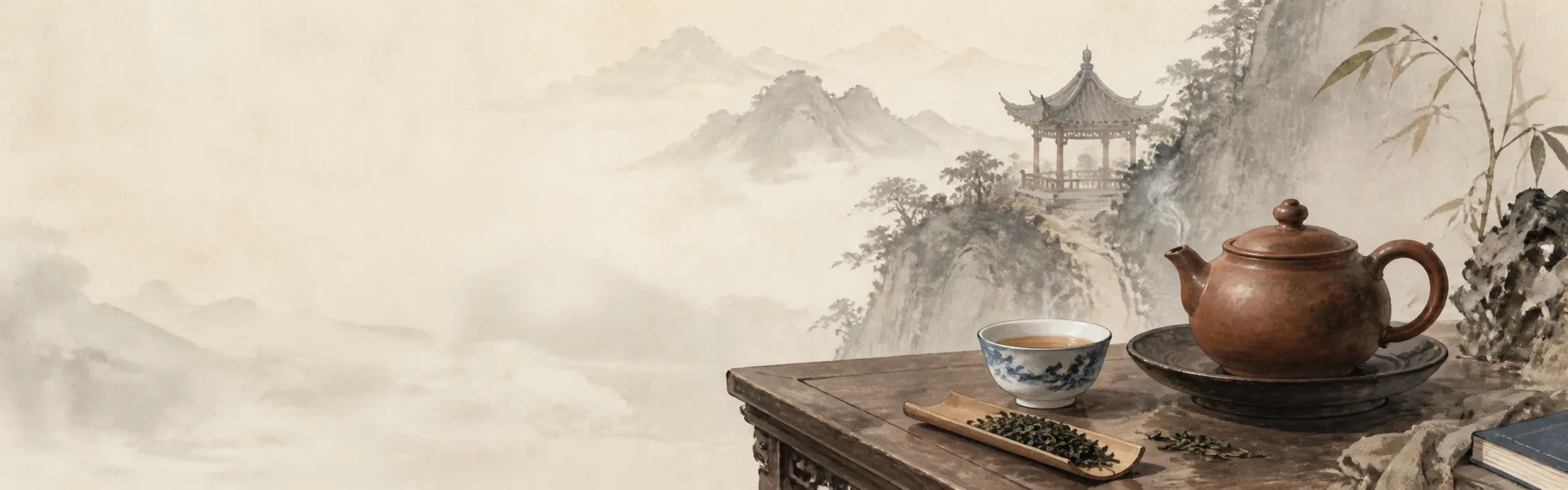
Clay teapot, porcelain cup and loose tea overlooking a misty mountain pavilion

This section covers the plant and its processing, the history, the methods of preparation, the connection with Taoist and Buddhist practice, and the difficult question of how much of what is presented today as ancient tradition actually is.

A note about the words

The English phrase tea ceremony is misleading and it is worth clearing up at the start. It carries associations from the Japanese practice, which is a highly codified ritual with a fixed sequence, a specific architecture and a formal training lineage. Chinese tea practice is not that.

The Chinese terms are different in emphasis. One means simply the art or skill of tea, and refers to competent preparation. Another, usually rendered the way of tea, is a broader and vaguer term implying that tea is connected to cultivation and to a way of living. The two are often used interchangeably in commercial contexts, which does not help.

What you will actually encounter in China ranges from a jar of leaves topped up with hot water on a desk all day, to a careful multi-infusion session with small pots and cups, to a staged performance for tourists. Only the middle of these has much to do with what this section describes.

One plant, six kinds of tea

Nearly all tea comes from a single species, Camellia sinensis, in two main varieties: a small-leaf variety associated with China and a large-leaf variety associated with Assam and southwestern China. Herbal infusions such as chrysanthemum are not tea in this sense, whatever the packaging says.

The differences between green, white, yellow, oolong, black and dark tea are produced by processing, not by different plants. The critical variable is oxidation, an enzymatic process that begins when the leaf is bruised or broken and is halted by heat. Green tea is heated early to stop it, black tea is allowed to oxidise fully, and oolong sits in between across a wide range. Dark tea, including pu'er, undergoes microbial fermentation, which is a genuinely different process often confused with oxidation.

Understanding this one point explains most of what is otherwise confusing about tea, including why the same garden can produce several different teas and why the Chinese and English colour names do not match.

How tea is prepared

Three broad approaches are in use and each suits different teas. The simplest is leaves loose in a tall glass or a lidded jar, topped up with hot water and drunk as it cools, which is how most green tea is drunk in China every day. The second uses a lidded bowl, a versatile vessel that works for almost anything and is easier than it looks.

The third is the small-pot method associated with Fujian, Guangdong and Taiwan, which uses a high leaf-to-water ratio, a small vessel and many very short infusions, often ten or more from the same leaves. This method is what most people mean by Chinese tea practice, and it exists because oolong and aged dark teas reveal themselves across successive infusions in a way a single mug cannot show.

The historical outline

Tea was drunk in southwestern China long before it was written about. It became widespread during the Tang, when Lu Yu's classic on tea was written in the eighth century, and the method then was to boil powdered tea, often with salt. The Song whisked powdered tea in bowls, judged the foam, and held competitions, and it is this method that was transmitted to Japan and preserved there.

The decisive break came in the Ming, when the imperial court ended the tribute of compressed cakes and loose-leaf tea steeped in hot water became standard. Almost everything about modern Chinese tea practice, including the teapot, dates from this change. This matters because it means the Chinese and Japanese traditions diverged around eight hundred years ago and are not variants of one thing.

Tea, Buddhism and Taoism

The Buddhist connection is the better documented. Monasteries grew, processed and drank tea, monks used it to stay awake through long sittings, and monastic tea drinking had its own regulations. Several famous teas originate at temple sites. The saying that tea and Chan have one taste is much quoted, and it is a Chan Buddhist saying rather than a Taoist one.

Tea has a meaningful place in Taoist cultural life. Early references associate it with longevity practices and pharmacological literature; Taoist establishments in tea-growing mountains cultivated it; and qualities valued in tea culture — clarity, moderation and close attention to the present moment — align closely with Taoist priorities. Across different communities, tea preparation developed as a practice compatible with Taoist values, with its forms and meanings shaped by particular places, teachers and periods.

How old is the modern practice?

This is the point where honesty is most useful. The small-pot method has documented roots in the Ming and Qing in southern Fujian and eastern Guangdong, where it was a regional custom rather than a national tradition. Much of what is now presented as classical Chinese tea ceremony, including the choreographed sequences, the specialised implements, the fixed vocabulary and the performance format, was developed or heavily elaborated in Taiwan from the 1970s onward and spread to the mainland from the 1980s.

This is not a criticism. Traditions are made, and a practice can be worthwhile without being old. But it is worth knowing that a demonstration described as a thousand-year-old ritual is usually a few decades old in its present form, resting on genuinely older regional habits.

Current Tea Arts Programmes

The programmes below come directly from the Events & Courses directory. Dates, availability and registration information are maintained on each event page.

The health question

Tea contains caffeine, polyphenols including catechins, and the amino acid theanine. The combination of caffeine and theanine plausibly explains the commonly reported effect of alertness without agitation, and this is among the better supported claims.

Beyond that, the evidence thins quickly. Observational studies associate regular tea drinking with modest cardiovascular benefits, but the effect sizes are small and confounding is difficult to exclude. Claims about weight loss, detoxification, cancer prevention and specific benefits of particular teas are mostly unsupported or rest on laboratory work that has not translated. There are also real cautions: very hot drinks of any kind are associated with oesophageal risk, tea inhibits non-heme iron absorption, and strong tea on an empty stomach makes some people unwell.

Tea as an economic and political fact

It is easy to discuss tea entirely in terms of aesthetics and forget that it was for centuries one of the most important commodities in Asia. Tea was exchanged for horses with peoples on China's western frontiers under a state-run system, and the trade routes carrying compressed tea into Tibet and Central Asia shaped the economies of whole regions.

From the seventeenth century the export trade to Europe grew enormous, and the resulting trade imbalance was one of the direct causes of the opium trade and the wars that followed. The theft of tea plants and processing knowledge from China and their transplantation to British India in the nineteenth century is one of the better documented cases of industrial espionage in history.

Keeping this in view is useful because it corrects the impression that tea is essentially a contemplative subject. For most of its history it was a crop, a tax base, a currency of exchange and a strategic good, and the aesthetic tradition existed alongside all of that rather than instead of it.

What the practice actually offers

Set aside the health claims and the historical inflation and something straightforward remains. Preparing tea attentively is a short, repeatable activity with a clear structure, requiring you to notice temperature, timing, smell and taste. It produces immediate feedback: brew it badly and you can tell.

It also creates a social form. Serving tea to someone gives a conversation a shape and a set of pauses, and much of the value people find in it is this rather than anything internal. That is worth saying plainly, because a great deal of writing on the subject implies a solitary meditative practice, while in China tea is overwhelmingly social.

Starting out

The practical entry point is modest. Buy a lidded bowl and one tea you like, use water below boiling for green tea and fully boiling for dark and roasted teas, and use more leaf and shorter times than seem reasonable. Pay attention to how the same leaves change across infusions, since that is the thing the method exists to reveal.

Avoid elaborate sets at the start. The equipment is inexpensive at the useful end and extremely expensive at the collecting end, and the difference between them affects the drinker's satisfaction far more than the tea.

What the pages beneath this cover

There are six pages in this section. Read them in order if you want the background; go straight to the utensils page if you only want to brew a decent cup.

Origins and History of Chinese Tea Culture begins with tea as medicine and as food, then follows three genuine breaks in practice: boiling in the Tang, whisking powdered tea in the Song, and steeping loose leaf from the Ming onward. The method most people now think of as timeless is roughly six hundred years old.

The Way of Tea deals with a word that causes confusion. What Chinese means by chadao, what Japanese means by its own tea ceremony, and what English speakers picture when they hear the phrase are three different things. The page separates them and explains why Chinese writers were for a long time reluctant to call drinking tea a way at all.

Types of Tea and Their Character explains that the six categories are defined by how far the leaf is oxidised and whether it is fermented, not by region and not by plant variety. Once that is clear, the names on a shop shelf stop being arbitrary.

Utensils and the Gongfu Method is the practical page: choosing between a lidded bowl and a clay pot, water temperature, leaf quantity, steeping times, and why many short infusions in a small vessel produce something a single large pot cannot.

Tea, Meditation and Taoist Practice asks what the connection actually amounts to. It stays with three concrete things: the practical use of tea by Tang and Song monks and priests to stay awake, the resemblance between attention training and a fixed brewing sequence, and which parts of the standard account were added later.

Further Reading and Practice covers buying and storing tea, judging freshness and quality, and which books in Chinese and English are worth the time.

Key points

  • The English phrase tea ceremony imports Japanese associations that do not fit Chinese practice, which is far less codified.

  • All true tea comes from one species, and the six categories are produced by processing, principally by how far oxidation is allowed to go.

  • Loose-leaf steeping became standard only in the Ming, which is when the Chinese and Japanese traditions decisively diverged.

  • Taoist communities have long cultivated, prepared and offered tea, and tea culture’s emphasis on clarity, moderation and attentive presence aligns closely with Taoist values.

  • Much of what is presented as ancient tea ceremony was elaborated in Taiwan from the 1970s onward, resting on older southern regional customs.

  • The best-supported health claim concerns alertness without agitation from caffeine combined with theanine; most other claims are weak or unsupported.