A path into the reading
The Hetu, Luoshu and Nine Palaces in Chinese Cosmology
River Chart, magic square and nine-part spatial grid—what they are and when they appeared
Start here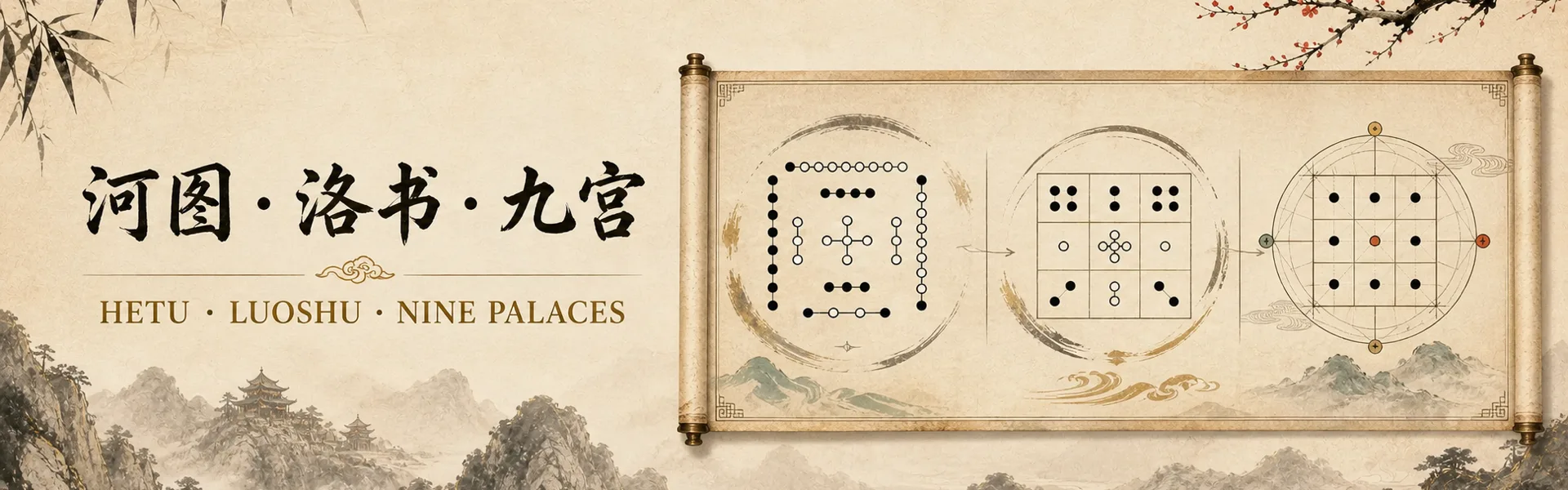
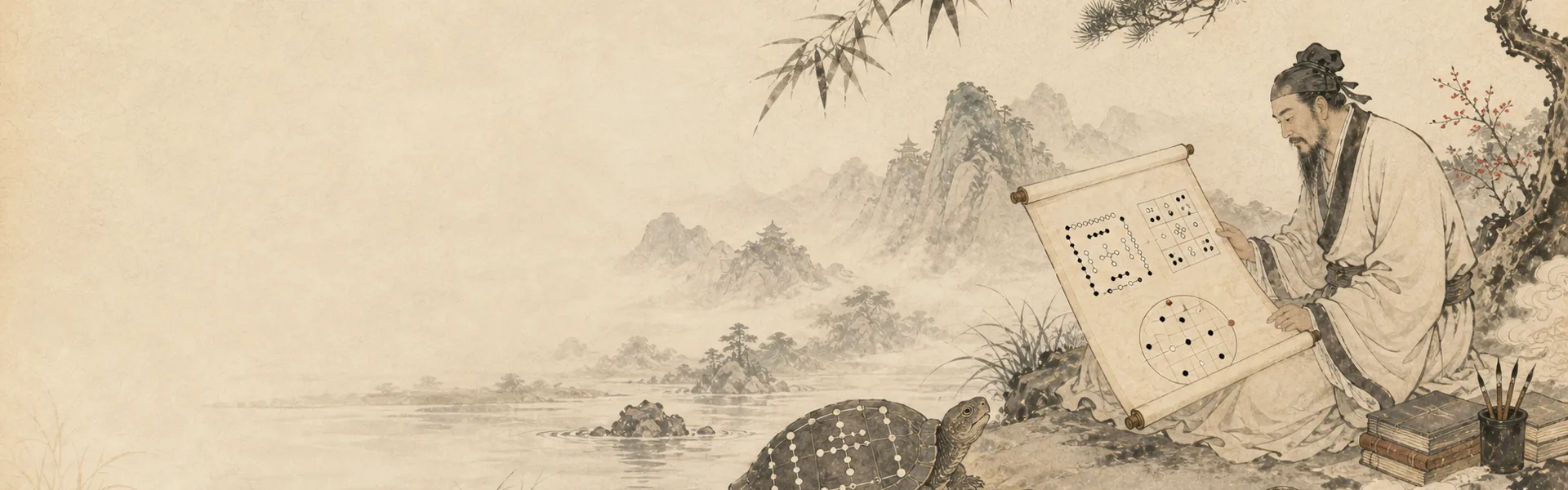
01 Find your bearings
Origins and History of the Hetu and Luoshu Diagrams
From ancient names and foundation myths to Song diagrams and Qing textual research
Explore this section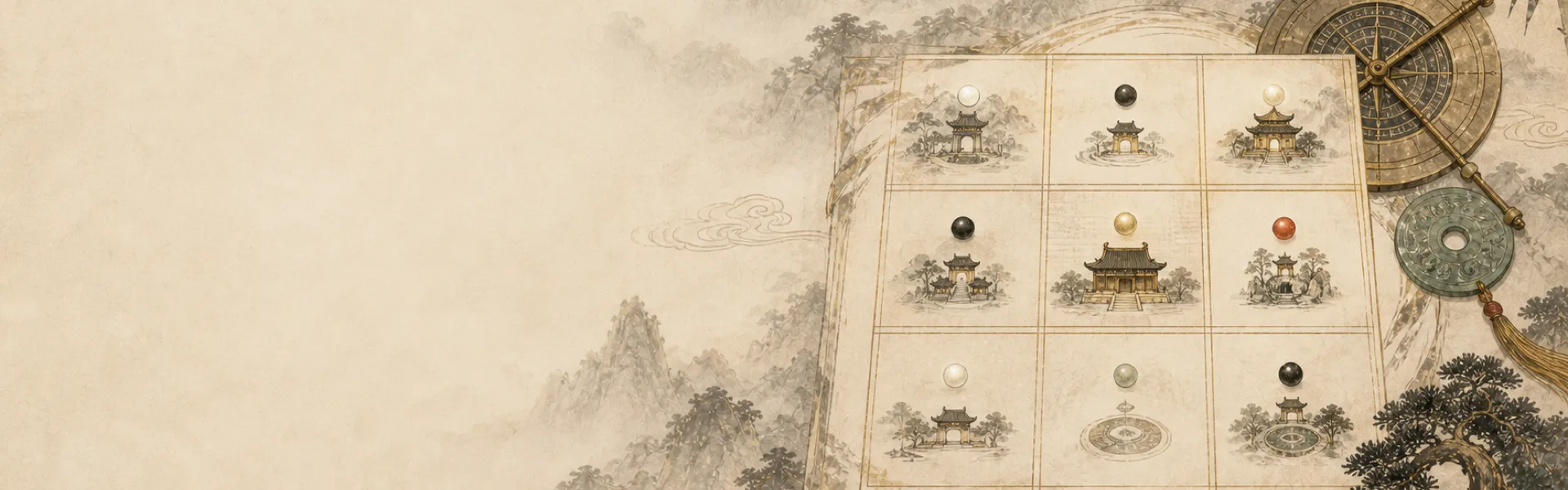
02 Explore the subject
The Nine Palaces (Jiugong): Directions, Time Cycles and Traditional Uses
How the Luoshu grid became a spatial and temporal framework for feng shui, Qimen and other arts
Explore this section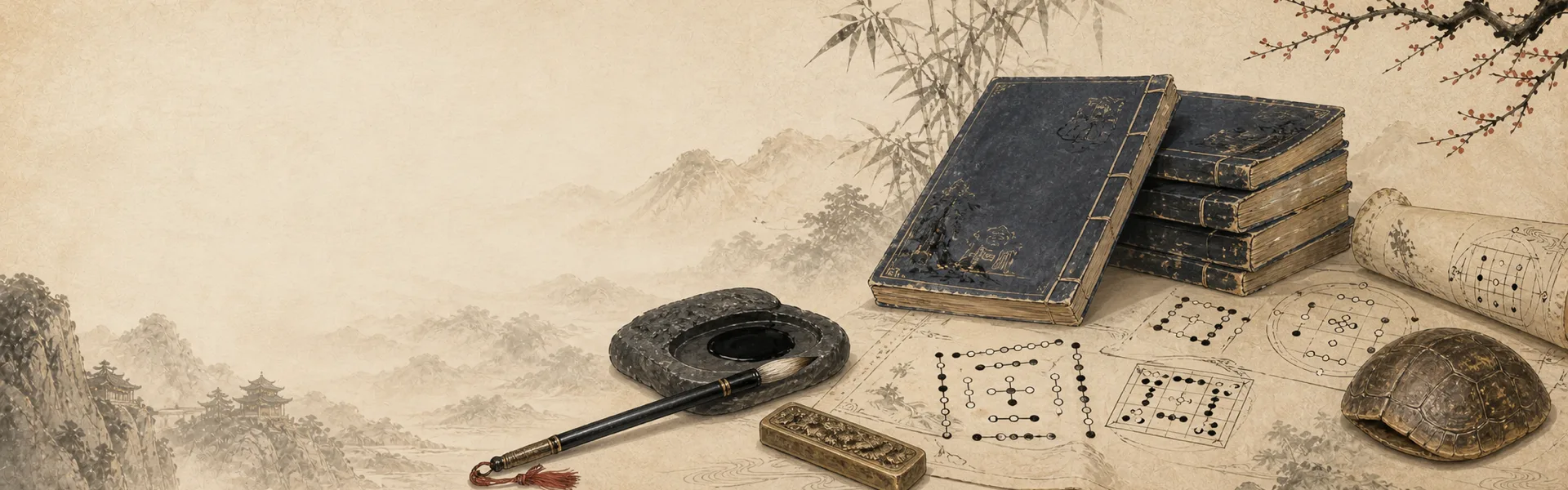
03 Keep reading
Hetu, Luoshu and Nine Palaces: Primary Sources and Further Reading
Classical references, Song diagrams, Qing textual criticism and mathematical studies
Explore this sectionGo further
Deeper reading
- Origins and History of the Hetu and Luoshu DiagramsFrom ancient names and foundation myths to Song diagrams and Qing textual research
- The Hetu River Chart: Numbers, Directions and the Five PhasesHow the Song diagram pairs yin and yang numbers around a five-part cosmological pattern
- The Luoshu Magic Square: Numbers, Structure and Cultural MeaningWhy every row, column and diagonal totals fifteen—and how the grid entered Chinese cosmology
- The Nine Palaces (Jiugong): Directions, Time Cycles and Traditional UsesHow the Luoshu grid became a spatial and temporal framework for feng shui, Qimen and other arts
- Hetu, Luoshu and Nine Palaces in Practice TodayWhere the diagrams appear in feng shui, Wudang arts, design, apps and commercial claims
- How to Interpret the Hetu and Luoshu: Mathematics, History and SymbolismKeeping verifiable number patterns distinct from later cosmological meanings
- Hetu, Luoshu and Nine Palaces: Primary Sources and Further ReadingClassical references, Song diagrams, Qing textual criticism and mathematical studies
The full guide
What should I know before reading further?
The River Chart and the Luoshu are among the most reproduced diagrams in Chinese culture, appearing on temple walls, in feng shui manuals, on martial arts insignia and in the front matter of countless editions of the Yijing. They are also the subject of one of the clearest and best-documented cases of misdating in the whole Chinese tradition. This subcategory sets out what they are, where they came from, what is genuinely true about them, and what is not.
Read more The complete guide
The River Chart and the Luoshu are among the most reproduced diagrams in Chinese culture, appearing on temple walls, in feng shui manuals, on martial arts insignia and in the front matter of countless editions of the Yijing. They are also the subject of one of the clearest and best-documented cases of misdating in the whole Chinese tradition. This subcategory sets out what they are, where they came from, what is genuinely true about them, and what is not.
Three things, to be kept apart
This section deals with three related but distinct objects, and confusing them is the source of most of the muddle written about them.
The Hetu (河图), the River Chart, is a diagram of numbers: black and white dots forming five groups, arranged by direction, fifty-five dots in all.
The Luoshu (洛书) is a third-order magic square: the numbers one to nine placed in nine cells so that every row, column and diagonal sums to fifteen.
The Nine Palaces (九宫) is the framework produced when those nine numbers are set into a three-by-three grid, giving a centre plus the four cardinal and four intercardinal positions. It became the shared substrate of Flying Star feng shui, Qimen Dunjia, date selection and the design of ritual halls.
The first two are diagrams; the third is a use. Holding that distinction makes the rest of this section considerably easier.
The most important single fact: old names, late diagrams
The names are genuinely ancient. The Book of Documents lists the River Chart among the royal treasures, and the Great Treatise of the Yijing contains the line that the river put forth a chart and the Luo put forth a writing, and the sages took them as models.
But the two dot diagrams printed in every modern book were produced in the Northern Song, and it was Zhu Xi in the Southern Song who fixed which of them was to be called the Hetu and which the Luoshu.
This is not a modern revisionist claim. Qing evidential scholars — Huang Zongxi, Mao Qiling and above all Hu Wei — established it by textual research centuries ago, and it has not been seriously contested since.
The first thing to fix in mind is therefore the gap between the names and the pictures. What the ancient texts were referring to, nobody knows. What we hold in our hands is a Song reconstruction. Any book that presents these diagrams as documents from high antiquity is either uninformed or not being straight with the reader.
But the magic square itself really is old
The other half has to be said too, or one lands in the opposite error of dismissing everything as a Song invention.
The three-by-three numerical arrangement appears in Han texts. The Da Dai Liji chapter on the Bright Hall gives the sequence two-nine-four, seven-five-three, six-one-eight. The Huangdi Neijing, in the Lingshu chapter on the nine palaces and eight winds, opens by listing the positions and numbers of the nine palaces.
So the arrangement was in use by the Han or earlier — it simply was not called the Luoshu then. The name was attached later to something that already existed. The diagrams are late; the numbers are not.
One layer of it is real mathematics
The Luoshu is a provable mathematical object, and this deserves to be stated plainly because it is the part that never gets the attention it merits.
Placing one to nine in a three-by-three grid so that all rows, columns and diagonals sum equally has exactly one solution up to rotation and reflection — eight arrangements in total, all the same square viewed differently.
That the centre must be five can be proved in two lines of arithmetic: the total of one through nine is forty-five, so each row sums to fifteen, and considering the three lines through the centre forces the central value.
More interesting still, the fact that the odd numbers fall in the cardinal positions and the even numbers in the corners was not designed by anyone. It is the only possible outcome given the constraint.
This layer is hard, and it has nothing to do with belief. The distinction this section returns to repeatedly is between that mathematical necessity and the cosmological interpretation built on top of it — which is an entirely different kind of claim.
Why it has been used for a thousand years
The three-by-three grid is remarkably serviceable. It supplies a centre and eight directions at once. It is small enough to memorise and rich enough to carry directions, seasons, trigrams, phases, colours and years.
The nine provinces of the empire, the well-field land system, the Bright Hall, the layout of capital cities, the Purple-White nine stars, the three cycles and nine periods of feng shui, and the entire board of Qimen Dunjia all run on this one framework.
A convenient classificatory template gets borrowed repeatedly, and that is the real reason for its spread — not that it discloses the structure of heaven and earth. This point generalises well beyond the present subject.
It connects to a great deal else
Taken alone these three items can seem abstract. Once one knows where they lead, they turn out to be unavoidable.
In feng shui, Flying Star, the Purple-White stars and the three-cycles-nine-periods scheme all use the Luoshu palaces. In date selection, the nine stars on duty do the same. The whole board of Qimen Dunjia is a nine-palace grid.
In Chinese medicine, the numerical correlations of the five phases derive from the generative numbers of the Hetu, and a reader of the Neijing or of pharmacological commentary meets them constantly. The internal alchemy diagrams and the Taoist chart-and-writing tradition share a source with Song River-Chart learning.
Even the martial arts connect: the circle walking of Baguazhang and the nine-palace stepping of the internal styles use this same directional framework.
This subcategory is short, but it is a key to several other parts of this site.
Why this case is worth studying
Of everything on this site, the River Chart and the Luoshu may be the most instructive single case, and not because of anything the diagrams do.
What makes them valuable is that the Chinese tradition corrected itself here, in public, using its own methods, and the correction stuck. Huang Zongxi, Mao Qiling and Hu Wei did not have access to Western science; they had philology, careful reading, and a refusal to accept an attribution merely because it was old and respectable. They traced when each diagram first appeared, who had drawn it, and what earlier texts had and had not said — and they concluded that a revered element of Song cosmology was a recent construction.
This matters for two reasons. It is direct evidence against the idea that critical scrutiny of tradition is a foreign import, an idea that appears repeatedly in popular writing about Chinese thought and is simply false. And it supplies a model: the questions Hu Wei asked are exactly the questions worth asking about every other claim in this section — when does this first appear, who first wrote it down, and does the earlier evidence actually say what it is claimed to say.
It is worth noting what did not happen. The diagrams were not withdrawn. They remain in print, on temple walls, and at the front of editions of the Yijing, usually with the old attribution intact. Being shown to be late did not make them less useful or less loved, which is itself worth understanding: these objects were never really doing the work their origin story claimed for them.
How to read this section
Three questions are worth keeping separate as you read, because sources routinely answer one while appearing to answer another.
Is the mathematics correct? Yes, demonstrably, and it can be checked in a few minutes with pencil and paper.
Is the history as usually told correct? No. The diagrams are Song, the names are ancient, and the connection between them is unknown.
Do the cosmological correspondences built on the grid describe anything real? There is no evidence that they do, and the pages that follow say so where it is relevant.
Keeping these apart allows a reader to admire the square, enjoy the history, and decline the metaphysics, all without contradiction.
What this section contains
Seven pages follow. Origins and history treats the gap between the names and the diagrams, and the conclusions of Qing evidential scholarship. The Hetu covers the generative numbers of the five phases and where they are used. The Luoshu covers the mathematical properties of the square and its pairing with the Later Heaven trigrams. The Nine Palaces covers the framework's practical use in architecture, medicine and the divinatory arts. The diagrams in practice today describes where they now appear. How to interpret the Hetu and Luoshu keeps the mathematics, the history and the symbolism apart. Key sources lists what can be consulted.
Key points
- The Hetu is a fifty-five-dot number diagram; the Luoshu is a third-order magic square; the Nine Palaces is the grid framework built from it.
- The names are ancient, appearing in the Book of Documents and the Great Treatise, but the diagrams themselves are Northern Song.
- Zhu Xi fixed which diagram bore which name; Qing scholars including Hu Wei established the late dating by textual evidence.
- The three-by-three arrangement itself is genuinely old, appearing in Han texts before the name Luoshu was attached to it.
- The magic square is a provable mathematical object with exactly one solution up to rotation and reflection.
- That the centre is five, and that odd numbers occupy the cardinal positions, are necessary consequences, not design choices.
- Its longevity is due to being a convenient classificatory template, not to disclosing any structure of the cosmos.
- The framework underlies Flying Star feng shui, Qimen Dunjia, date selection, the Bright Hall, and nine-palace stepping in martial arts.
- The mathematics is sound, the usual history is wrong, and the cosmological correspondences are unsupported — three separate judgements.
- Keeping those three apart lets a reader appreciate the square without accepting the metaphysics.
Recommended next page
Where next?
The Hetu River Chart: Numbers, Directions and the Five PhasesHow the Song diagram pairs yin and yang numbers around a five-part cosmological patternA few alternatives