A path into the reading
The Eight Immortals: Origins, Symbols and Taoist Legends
How a Ming-era group of eight became a lasting image of transcendence across class, age, gender and respectability
Start here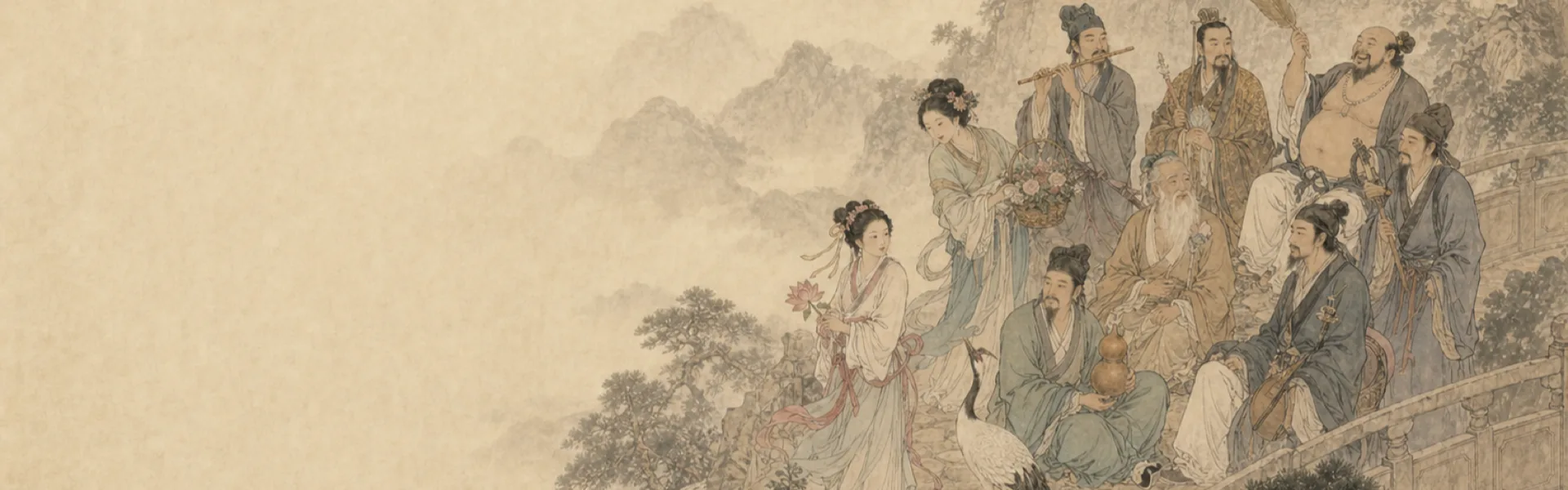
01 Find your bearings
Lü Dongbin: Scholar Immortal, Quanzhen Patriarch and Sword Bearer
Why Lü is worshipped independently, how his cult grew, and what the dream, sword and internal-alchemy lineage mean
Explore this section
02 Explore the subject
Han Xiangzi and Lan Caihe: Music, Flowers and Ambiguous Identity
How Han Yu’s historical grandnephew became a flute-playing immortal, and why Lan Caihe resists fixed age, class and gender
Explore this sectionGo further
Deeper reading
- Lü Dongbin: Scholar Immortal, Quanzhen Patriarch and Sword BearerWhy Lü is worshipped independently, how his cult grew, and what the dream, sword and internal-alchemy lineage mean
- Zhang Guolao: Tang Recluse and Backward-Riding ImmortalWhat the Tang histories record about Zhang Guo, how the legends grew, and what his backward donkey signifies
- He Xiangu: The Woman Immortal of the EightHow several local traditions formed one composite figure, and what her place reveals about women in Taoism
- Han Xiangzi and Lan Caihe: Music, Flowers and Ambiguous IdentityHow Han Yu’s historical grandnephew became a flute-playing immortal, and why Lan Caihe resists fixed age, class and gender
- Cao Guojiu and Li Tieguai: Privilege, Poverty and the Immortal BodyWhy an imperial relative and a lame beggar stand together, and what their stories say about complicity, appearance and identity
- Zhongli Quan: Teacher of Lü Dongbin and Patriarch of Internal AlchemyHow a frequently misread name, teacher-disciple legends and Quanzhen genealogy made Zhongli a founding authority
The full guide
What should I know before reading further?
The Eight Immortals are the most recognisable figures in Chinese popular religion after the major gods, and they are the part of Taoism most likely to reach you without your noticing — on porcelain, embroidery, temple carving, opera stages, restaurant signs and birthday gifts. They are also the clearest case on this site of material that is legend rather than history, and worth using to establish how legend can be taken seriously without being mistaken for record.
Read more The complete guide
The Eight Immortals are the most recognisable figures in Chinese popular religion after the major gods, and they are the part of Taoism most likely to reach you without your noticing — on porcelain, embroidery, temple carving, opera stages, restaurant signs and birthday gifts. They are also the clearest case on this site of material that is legend rather than history, and worth using to establish how legend can be taken seriously without being mistaken for record.
Who Are the Eight Immortals, and Why Are There Eight?
The standard group is Lü Dongbin, Zhongli Quan, Zhang Guolao, He Xiangu, Han Xiangzi, Lan Caihe, Cao Guojiu and Li Tieguai. They are not a family, a lineage or a committee. They are a set — assembled over centuries and broadly standardised in the Ming dynasty. The familiar group has remained the dominant form since.
The number is not accidental. Eight carries structural weight in Chinese thought: eight trigrams, eight directions, eight festivals of the year. A set of eight reads as complete in the way a set of seven does in some other traditions. So the group is best understood as a deliberately balanced arrangement rather than a list of the eight most eminent immortals, of whom there are thousands.
The balance is the interesting part. The eight include an old man and a youth, a woman, a scholar-official, a beggar with a disability, a court-connected aristocrat, a musician and a figure of ambiguous gender. Rich and poor, learned and illiterate, respectable and disreputable are all present. The claim being made is not subtle: transcendence is not restricted by class, sex, age, education, appearance or respectability. For a society as stratified as imperial China, that was a substantial statement, and it is a large part of why the group became so popular.
How the Eight Immortals Became a Group
Several of the eight have some historical basis. Lü Dongbin is associated with the Tang dynasty and became the object of an enormous cult; Zhongli Quan is placed earlier still; Cao Guojiu is linked to a Song family; Zhang Guolao appears in Tang records. Others, notably Lan Caihe and Li Tieguai, look entirely legendary.
But the group as a group is a late assembly. Individual figures accumulated stories for centuries, appeared together in varying combinations, and were only standardised as a set of eight in the Ming — largely through drama and popular literature rather than through any temple or clerical decision. Opera did more to fix the roster than scripture did.
This is a useful thing to know because it reverses the intuitive assumption. People often imagine an ancient octet whose stories were later elaborated. What actually happened is that the stories came first, separately, and the octet was assembled from them afterwards.
How to Identify the Eight Immortals by Their Objects
Chinese religious art identifies figures by attribute, and once you know the eight objects you can read almost any depiction, including ones where the figures themselves are omitted and only the emblems appear — an extremely common decorative convention.
Lü Dongbin carries a sword. Zhongli Quan carries a fan. Zhang Guolao has a drum made from a tube of bamboo and rides a donkey, frequently backwards. He Xiangu holds a lotus. Han Xiangzi plays a flute. Lan Caihe carries a basket of flowers. Cao Guojiu holds a court tablet. Li Tieguai leans on an iron crutch and carries a gourd.
The objects are not arbitrary decoration; several are instruments of the figure's particular power, and the gourd in particular signals medicine. Individual pages in this section explain each figure's story and attributes in detail.
Where the Eight Immortals Appear in Chinese Culture
Rarely as the main deities of a hall. They are not usually the object of major petitions, and a temple's principal hall belongs to gods with formal offices — which the Eight Immortals, for the most part, do not hold. Their place is elsewhere and it is everywhere: carved on beams and door panels, painted on side-hall walls, embroidered, moulded onto roof ridges, and reproduced endlessly on domestic objects.
They are strongly associated with longevity and with birthdays, which is why they turn up on gifts. They are also opera staples, and much of what an ordinary Chinese audience knows about them comes from the stage rather than from any religious source.
There are exceptions. Lü Dongbin in particular is a serious object of worship, has his own temples, and is treated within the tradition as a patriarch of internal alchemy — a substantially weightier role than his membership of a decorative octet suggests.
Why the Eight Immortals Became So Popular
Of all the figures the tradition produced, this set became by far the most widely reproduced, appearing on furniture, porcelain, embroidery, birthday gifts and shop signs in quantities that no other religious grouping approaches. That is a fact about culture rather than about religion, and it has explanations worth setting out.
The first is that the group is socially comprehensive. Its members include an official, a scholar, a soldier, a beggar, a woman, an old man and a youth. Between them they cover most of the positions available in traditional society, which means almost anyone looking at them can find a point of entry. A pantheon of dignified officials offers no such thing. This set is deliberately mixed, and the mixture is the message: the transition it depicts is not restricted to any one kind of person.
The second is that they are legible without literacy. Each figure carries a distinct object, and the objects are simple shapes that survive being carved small, painted quickly or embroidered coarsely. A craftsman could render the whole group recognisably on a chair back. This made them ideal decorative subject matter, and decorative reproduction then reinforced recognition, which encouraged further reproduction.
The third is that they arrived with stories that were entertaining rather than solemn. Several members behave badly: they drink, they play tricks, they embarrass the pompous, they refuse to take rank seriously. This material moved easily into opera and popular fiction, and opera did more than any temple to make them universally known. A figure that works on a stage will be known by people who never read a religious text.
The fourth is that they became associated with occasions rather than with doctrine — birthdays, weddings, longevity, general good fortune. A group you give as a gift is a group that circulates. Religious content did not have to be understood for the image to be wanted, and over time the image became somewhat detached from the religion, which is why you will meet them in secular contexts where nobody present would describe themselves as a worshipper.
None of this makes them unimportant religiously. They do appear in temples, they are the subject of genuine devotion, and the biographies belong to a serious tradition. But their fame is disproportionate to their doctrinal weight, and understanding why explains something general: in China, the religious figures that became most widely known are usually the ones that were most useful to storytellers and craftsmen, not the ones highest in the celestial hierarchy. The Three Pure Ones sit at the top of the structure and almost nobody outside a temple could describe them.
The Eight Immortals within the Wider World of Taoist Legend
The Eight Immortals are the best-known cluster but far from the whole of it. The literature of immortals is vast: collections of biographies of transcendents, stories of hermits and alchemists, tales of encounters on mountains, and accounts of people who vanished, left an empty coffin, or were seen years later by a traveller.
Certain motifs recur so consistently that they function as the genre's grammar. A poor or unpromising person receives instruction from a stranger. A test is administered and usually failed on the first attempt. Ordinary time and mountain time run differently, so a short absence turns out to have lasted decades. Wealth and office are offered and refused. A method is transmitted only after the recipient has demonstrated something other than intelligence.
Read as reporting, these stories are worthless. Read as a statement of values, they are precise. They tell you that the tradition rated persistence over cleverness, was deeply suspicious of status, and believed that the decisive event in a life could be an unplanned encounter with someone who did not look important.
Why Zhenwu Is Different from the Eight Immortals
Wudang's own principal deity is worth contrasting here, because he shows a different pathway. Zhenwu did not begin as a person at all. He began as Xuanwu, the emblem of the north, which is why the decisive marker in his images is a tortoise entwined with a snake at his feet.
His biography — a prince who renounced a throne, cultivated on the mountain for decades, and attained transcendence on a cliff terrace — is much later than the emblem, and it grew in detail as the cult grew in political importance. So the direction of travel is the reverse of the usual hagiographic one: not a person who became a symbol, but a symbol that acquired a life story. Recognising that pattern makes both kinds of legend easier to read.
How to Read the Eight Immortals as History and Hagiography
The approach taken throughout this site is to keep the two registers separate and label them. Where something is attested by dated stone inscriptions, imperially sponsored gazetteers or documentary record, it is stated as history. Where it is hagiography, folk narrative or opera, it is called that.
What this site does not do is treat legend as embarrassing filler to be apologised for or quietly reduced to symbolism. These stories were told by real people, funded real buildings, shaped real behaviour and are still being told. The fact that Lan Caihe never existed does not make the figure unimportant; it locates the importance in a different place. Being clear about which place is the whole of the discipline required.
Key Points About the Eight Immortals
The eight are Lü Dongbin, Zhongli Quan, Zhang Guolao, He Xiangu, Han Xiangzi, Lan Caihe, Cao Guojiu and Li Tieguai.
Eight is a structurally complete number in Chinese thought, matching the trigrams and the directions. The group is a balanced set, not a ranking.
The set deliberately spans age, sex, class, education and respectability, making the point that transcendence is open to anyone.
Individual figures are old; the group is a Ming-dynasty assembly, standardised largely through drama rather than scripture.
Some members have a historical basis, notably Lü Dongbin and Zhang Guolao; others, such as Lan Caihe and Li Tieguai, appear wholly legendary.
Identification is by attribute: sword, fan, bamboo drum and donkey, lotus, flute, flower basket, court tablet, iron crutch and gourd.
They appear mostly as decoration and in opera rather than as principal deities of halls, and are strongly linked to longevity and birthdays.
Lü Dongbin is an exception, with his own temples and a serious role as a patriarch of internal alchemy.
The wider legend literature has recurring motifs: the unpromising student, the failed test, mountain time, refused office, transmission earned by character.
Zhenwu ran the opposite way — an emblem of the north that later acquired a biography, with the tortoise and snake as the trace of the earlier stage.
This site labels legend as legend and takes it seriously as evidence of what the tradition valued, not as a record of events.
Recommended next page
Where next?
Zhang Guolao: Tang Recluse and Backward-Riding ImmortalWhat the Tang histories record about Zhang Guo, how the legends grew, and what his backward donkey signifiesA few alternatives