A path into the reading
Chinese Herbal Medicine
Explore herbal traditions, questions of evidence and the precautions needed when considering a product or treatment.
Start here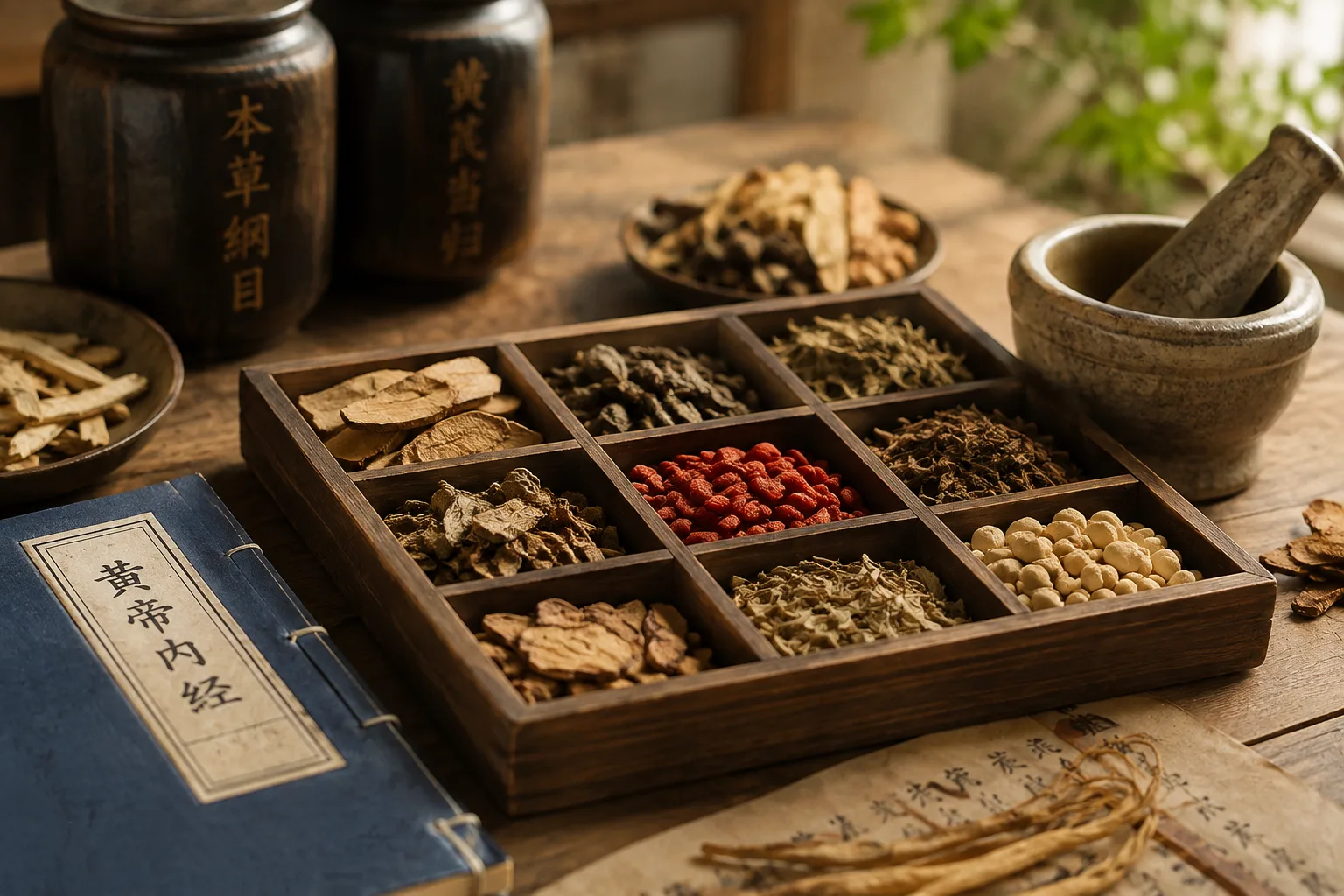
01 Find your bearings
Origins & Traditions of Chinese Herbal Medicine
Two thousand years told through its books, and what the artemisinin story really shows.
Explore this section
02 Explore the subject
Formulas & Preparation
How a prescription is built to check itself, and why processing and decoction methods matter.
Explore this sectionGo further
Deeper reading
- Origins & Traditions of Chinese Herbal MedicineTwo thousand years told through its books, and what the artemisinin story really shows.
- How Herbs Are UnderstoodNature, flavour, direction and channel: what this description system can do, and where its blind spot is.
- Herbs of the Wudang TraditionPlants of these mountains and of the Taoist tradition, with the warnings that belong beside them.
- Formulas & PreparationHow a prescription is built to check itself, and why processing and decoction methods matter.
- Safety & Responsible UseDocumented risks, established benefits and practical guidance for informed use
- Further Reading & Everyday PracticeWhere to start safely, how to judge a practitioner, and which books and standards to trust.
The full guide
What should I know before reading further?
Chinese herbal medicine is one of the oldest and most widely used branches of Chinese medicine. It brings a long, systematic tradition of observation and practice into conversation with modern pharmacology, toxicology, clinical evidence and quality regulation.
Read more The complete guide
Chinese herbal medicine is one of the oldest and most widely used branches of Chinese medicine. It brings a long, systematic tradition of observation and practice into conversation with modern pharmacology, toxicology, clinical evidence and quality regulation.
These pages place the tradition in context: more than two thousand years of accumulated practice containing historically important observation, pharmacologically active materials, inert ingredients, and substances now known to be hazardous. Careful assessment helps distinguish them while preserving what can be responsibly understood and studied.
What is meant by herbal medicine here
The Chinese term bencao, root and herb, is conventionally translated as materia medica, and the scope is wider than the English word herbal suggests. The pharmacopoeia includes plants, but also minerals, shells, insects, and animal parts. Cinnabar, which is mercury sulphide, appears in it. So does arsenic. So do a number of animal products whose use is now illegal under international agreement.
Most contemporary practice uses plants, and the animal and mineral components have contracted sharply, partly through regulation and partly through the conservation problems that certain traditional ingredients caused.
The scale of the tradition
The scale is worth grasping because it is often underestimated. Li Shizhen's Bencao Gangmu, completed in 1578 after nearly thirty years of work, catalogues around 1,900 substances and over 11,000 formulas. It is a serious work of natural history as well as pharmacology, and it corrects a number of errors in earlier sources by direct investigation.
Formula books are equally substantial. The tradition does not usually prescribe single herbs; it prescribes combinations, often of eight to fifteen ingredients, structured according to defined roles. This combinatorial approach is one of the tradition's genuine characteristics and one of the reasons it is difficult to study by conventional trial methods.
How the tradition classifies
Herbs are classified by properties that have nothing to do with chemistry: temperature, from hot through warm and neutral to cool and cold; flavour, in five categories that are partly literal and partly conventional; direction of action, whether a substance moves upward, downward, inward, or outward; and the channels or organ systems it is said to enter.
These categories are not arbitrary. They encode observed effects. A herb classified as hot generally produces sensations of warmth or increases metabolic activity. A herb described as descending often has effects on the digestive tract. The classification is a way of recording what a substance does, in a vocabulary available before anyone could describe why.
The limitation is equally clear. The system has no way to distinguish a substance that produces a subjective sensation from one that produces a physiological change, and no way to detect toxicity that appears only after prolonged use.
What modern pharmacology has found
A substantial number of traditional herbs contain compounds with demonstrable activity, and several have entered conventional medicine.
The best known is artemisinin, isolated from Artemisia annua in the 1970s by a Chinese research team who found the lead in a fourth-century text describing a treatment for intermittent fevers. It became a frontline antimalarial and the work received a Nobel Prize in 2015.
Ephedrine from ma huang is another, isolated in the 1880s and later widely used. Arsenic trioxide, a traditional preparation, is now standard treatment for a form of leukaemia.
These successes are genuine and significant. They also illustrate the pattern precisely: an active compound was identified, isolated, standardised, dosed, and tested. What entered medicine was the compound, not the traditional preparation or the theoretical framework around it.
Where the evidence stands overall
For most traditional formulas, high-quality evidence is absent rather than negative. Trials exist, but many are small, poorly controlled, or conducted in ways that make interpretation difficult. Reviews frequently conclude that better research is needed, which is accurate but unsatisfying.
Some areas have better support than others. There is reasonable evidence for certain herbal preparations in irritable bowel symptoms, in some skin conditions, and in relieving side effects of cancer treatment. There is essentially no credible evidence for herbal treatment of serious infectious disease, cancer, or organ failure.
The safety issues, stated plainly
This is where the tradition's optimism about itself needs correcting. Herbal medicine is not gentle because it is natural, and several categories of risk are documented.
Direct toxicity. Aristolochic acid, present in several traditional herbs, causes kidney failure and urinary tract cancer. This was established after a cluster of cases in Belgium in the 1990s and is now well documented. Several herbs cause liver injury, and herb-induced liver damage is a recognised clinical entity.
Herb-drug interactions. These are real and can be serious, particularly with anticoagulants, immunosuppressants, and drugs with narrow therapeutic windows. Patients frequently do not mention herbal use to their doctors, which makes these interactions harder to detect.
Contamination and adulteration. Products have repeatedly been found containing heavy metals, undeclared pharmaceuticals, or the wrong species entirely. This is a supply chain problem rather than a problem with the tradition, but it affects anyone using it.
Substitution. As with every traditional practice, the largest risk is someone with a treatable serious condition using herbs instead of effective treatment.
The problem of the individualised formula
Traditional practice prescribes individually, adjusting the formula to the particular pattern the patient presents and modifying it as they change. Practitioners often say this is why conventional trials cannot capture what the tradition does.
This argument has some force and a serious weakness. It has force because standardised-formula trials genuinely do not test the practice as it is performed. Its weakness is that it can be used to make the tradition unfalsifiable, since any negative trial can be dismissed as having tested the wrong thing.
Trial designs that allow individualised prescribing do exist and have been used. Where they have been run, results have generally been unremarkable. That is worth knowing, because the individualisation argument is usually presented as though it had never been tested.
Regulation, which varies enormously
The legal status of Chinese herbal medicine differs so much between countries that generalisation is impossible, and this affects safety directly.
In China, herbal medicine is integrated into the health system, practitioners are licensed, and products are regulated as medicines. In several European jurisdictions, practitioners are unregulated while products face restrictions on which species may be sold. In the United States, most products are marketed as dietary supplements, a category that requires no proof of efficacy and imposes limited quality requirements before sale.
The practical consequence is that the same product may be a regulated medicine in one country and an unregulated supplement in another, with correspondingly different guarantees about what is actually in the container. Anyone buying should know which situation applies to them.
Wudang and herbal knowledge
The Wudang range is genuinely rich in medicinal plants, and this is not a promotional claim. The mountains sit in a transitional climate zone with substantial biodiversity, and the region has a documented history of collecting and trading medicinal material.
Taoist communities on the mountain had practical reasons to know this material. Self-sufficient religious communities needed medical capability, and treating local people was a normal monastic function. Some Taoist priests were competent herbalists, and a few were notable physicians.
What is less well supported is the notion of a distinct Wudang herbal system with secret formulas. The knowledge was largely the standard tradition applied to locally available plants. Local emphasis is real; a separate system is not well evidenced.
How to approach this material
These pages explain the tradition and do not provide treatment. No formula, dosage, or self-treatment instruction appears anywhere in this section, and this is deliberate rather than an oversight.
If you want to use Chinese herbal medicine, the sensible route is a qualified practitioner in a jurisdiction with regulation, products from a supplier with tested quality control, and your doctor informed about what you are taking. If you take prescription medication, the last of these is not optional.
Key points
Chinese materia medica covers plants, minerals, and animal products, and is far larger in scope than the English word herbal suggests.
Traditional classification by temperature, flavour, direction, and channel records observed effects in a pre-chemical vocabulary.
Artemisinin, ephedrine, and arsenic trioxide show the tradition contains real pharmacology, but what entered medicine was the isolated compound.
For most formulas the evidence is absent rather than negative, and quality research remains limited.
Documented risks include aristolochic acid nephropathy, liver injury, drug interactions, and contamination.
The individualisation argument has been tested more often than is usually acknowledged, with unremarkable results.
Recommended next page
Where next?
How Herbs Are UnderstoodNature, flavour, direction and channel: what this description system can do, and where its blind spot is.A few alternatives