A path into the reading
Taiji
One sentence in an ancient commentary, and everything built on top of it
Start here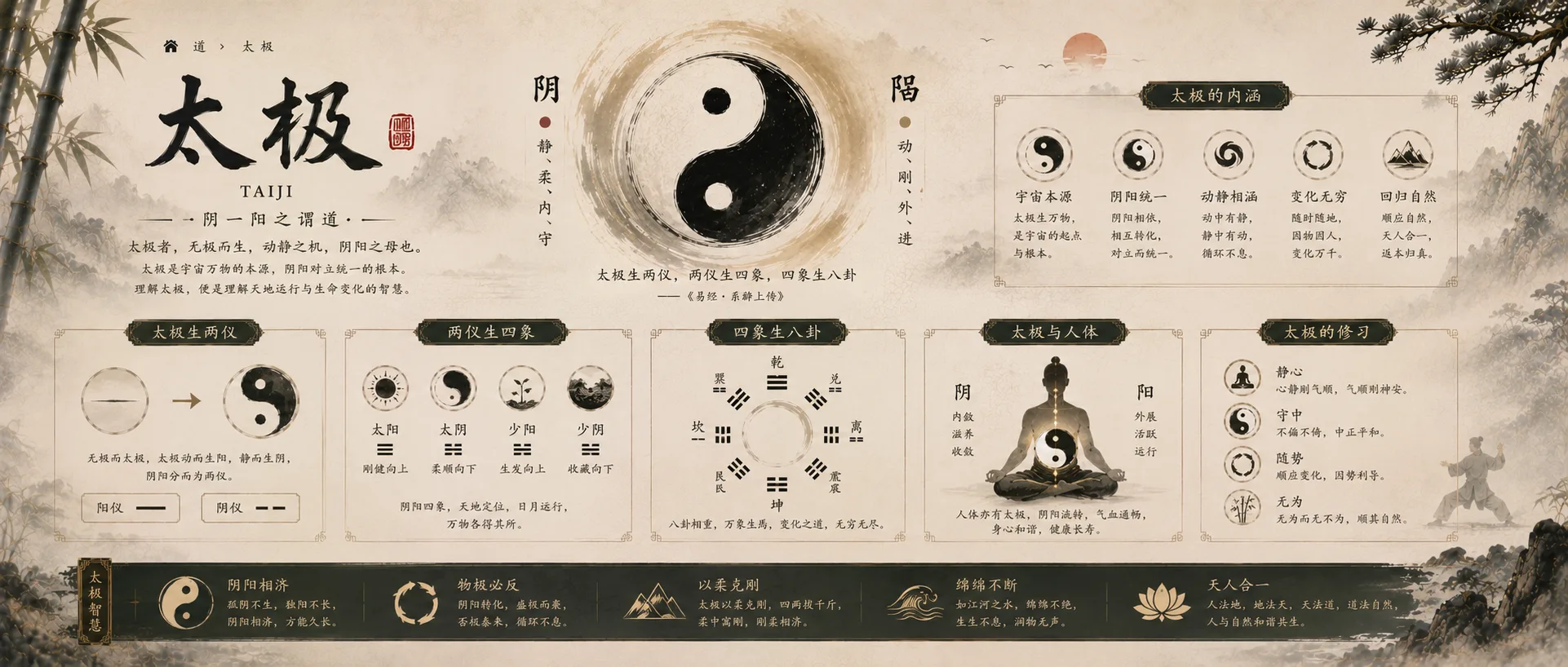
01 Find your bearings
Origins & Meaning of Taiji
The Supreme Ultimate: the term, its roots, and what it came to mean
Explore this section
02 Explore the subject
Yin and Yang within Taiji
How the one divides into two, and how the two remain one
Explore this section
03 Keep reading
Key Sources & Further Reading
Primary texts and reliable studies for exploring the Supreme Ultimate
Explore this sectionGo further
Deeper reading
- Origins & Meaning of TaijiThe Supreme Ultimate: the term, its roots, and what it came to mean
- The Taiji Diagram (Taijitu)A living symbol of yin-yang movement, relationship and transformation
- Taiji, Wuji & CosmologyThe Limitless, the Supreme Ultimate, and how the cosmos unfolds from unity
- Yin and Yang within TaijiHow the one divides into two, and how the two remain one
- Taiji in Neo-Confucian & Taoist ThoughtHow philosophers of two great traditions made Taiji their own
- Taiji and Internal Martial PracticeHow the cosmological principle became the soul of an internal martial art
- Key Sources & Further ReadingPrimary texts and reliable studies for exploring the Supreme Ultimate
The full guide
What should I know before reading further?
The word taiji occurs once in the classical source that made it famous. One sentence, in one of the commentaries appended to the Book of Changes, states that the Changes has a taiji, and that from it the two modes are produced. That is the whole of the textual foundation. Everything else — the cosmological schemes, the diagrams, the metaphysical debates that occupied Chinese philosophy for centuries, the name of a martial art now practised worldwide — was built on top of it.
Read more The complete guide
The word taiji occurs once in the classical source that made it famous. One sentence, in one of the commentaries appended to the Book of Changes, states that the Changes has a taiji, and that from it the two modes are produced. That is the whole of the textual foundation. Everything else — the cosmological schemes, the diagrams, the metaphysical debates that occupied Chinese philosophy for centuries, the name of a martial art now practised worldwide — was built on top of it.
This section explains what the word means, what was built on it, when each part was built, and which of the things now attached to it are old and which are recent. That last question matters more than it sounds, because the single most recognisable symbol associated with the term is far younger than almost anyone assumes.
What the two characters mean
Neither character is mysterious on its own.
The first means great, utmost, or extreme in the sense of the highest degree. The second originally meant the ridgepole of a building — the horizontal beam at the very top from which the roof is hung — and from that came to mean an extremity, a limit, a pole in the sense of the pole of the earth or of a magnet.
So the compound means something like the utmost limit, or the supreme pole. The conventional English rendering, Supreme Ultimate, is an accurate calque and a slightly unfortunate one, because it sounds like a title for a being and the Chinese does not. A less impressive but more useful gloss is: the furthest point back you can go, the limiting condition.
The architectural origin of the second character is worth keeping in mind. A ridgepole is not a source or a creator; it is the highest structural member, the thing from which everything else hangs. That is closer to how the term is used than any notion of a first cause.
How one sentence carried so much
A reader may reasonably ask how a single clause became the foundation of a major strand of Chinese metaphysics. The answer is characteristic of the tradition and worth understanding, because the same pattern recurs elsewhere.
Chinese philosophy after the classical period was largely conducted as commentary. A thinker with a new position did not announce it as new; he presented it as the correct reading of a canonical text. A short, ambiguous, prestigious sentence is therefore extremely valuable: it is authoritative enough to be worth arguing over and vague enough to accommodate the argument.
The sentence in question is ideal for the purpose. It says that something exists prior to the division into two, and it says nothing whatever about what that something is, whether it is a thing or a state, whether it is prior in time or only in logic, or whether anything lies behind it in turn. Every one of those gaps became a controversy.
What this section covers
The pages that follow take the topic in order, and each can be read alone.
- Origins and meaning of the term — the source sentence, the earlier uses of both characters, and how the compound acquired its later weight.
- The diagram — the familiar interlocking symbol, what its features are meant to convey, and the surprising lateness of its appearance.
- Taiji, wuji and cosmology — the generative scheme running from an undifferentiated condition to the multiplicity of things, and how that scheme was assembled from separate sources.
- Yin and yang within taiji — how the one is said to divide into two while remaining one, and the practical question of how anything is judged to be yin or yang.
- Taiji in Neo-Confucian and Taoist thought — why two traditions with different aims both needed this term, and what each did with it.
- Taiji and internal martial practice — how a cosmological term became the name of a martial art, and when.
- Sources and further reading — the primary texts and the studies worth consulting.
Three different things get called taiji
A great deal of confusion in English comes from the fact that the same word is used for three quite different things, and context is often the only guide.
The first is the metaphysical term: the limiting condition prior to differentiation, as discussed in the commentaries and in later philosophy. This is the original use and the subject of most of this section.
The second is the diagram: the round symbol divided into interlocking dark and light halves, each containing a spot of the other. In Chinese this is normally called the taiji diagram, and in English it is usually just called the yin-yang symbol.
The third is the martial art, whose full name means the boxing of the taiji, generally written taijiquan and often shortened in English to tai chi. When an English speaker says they do tai chi they mean the third, which has no direct connection to the first beyond the borrowed name.
Keeping these apart solves most of the problems people have with the topic. A sentence that is true of one is frequently false of the others.
The diagram is much younger than the idea
This point is worth putting early because it is so widely misreported.
The symbol of two interlocking teardrop shapes, one dark with a light dot and one light with a dark dot, is treated in popular writing as immemorially ancient — often illustrated alongside discussions of the Tao Te Ching, which is roughly two thousand years older. In fact this particular design cannot be traced back further than the Song period at the earliest, and it became widespread only from around the Ming. It is a late diagrammatic invention.
Compounding the confusion, the diagram produced by the eleventh-century philosopher whose short essay made the term central to Chinese metaphysics is not this symbol at all. His chart is a vertical arrangement of circles and segments, describing a sequence of generation. The interlocking circle is a different object with a different history.
None of this makes the symbol less interesting, and it certainly does not make it inauthentic. It does mean that using it to illustrate anything before the Song is an anachronism.
Where wuji comes in
The companion term, meaning the limitless or that which has no pole, has an independent history and was joined to taiji later.
It appears in the Tao Te Ching in a sense close to boundlessness. It appears in later Taoist writing for an undifferentiated condition. The eleventh-century essay that shaped the whole subsequent debate opens by relating the two terms in a formulation so compressed that it can be read in several incompatible ways: as saying that the limitless becomes the supreme pole, or that the supreme pole is itself limitless, or that the two are the same thing described differently.
That ambiguity produced one of the most famous disputes in Chinese philosophy, conducted by letter between two major thinkers, over whether the addition of a limitless prior term implied something outside or above the supreme pole. The dispute looks arid from outside and was not: what was at stake was whether the natural order is self-sufficient or depends on something beyond it.
Why two traditions both wanted the term
Taiji is one of the small number of technical terms that belongs equally to Taoist and to Confucian discourse, and the reason is instructive.
Confucian philosophers of the Song and after needed an account of the world that could compete with Buddhist metaphysics without borrowing from it. A term drawn from their own canonical classic, describing an ultimate that is not a god and not a mind, was exactly what was required, and they built an elaborate philosophy of pattern and material force around it.
Taoist writers needed technical vocabulary for describing stages of a process — cosmological in cosmology, physiological in internal alchemy — and a term naming the condition just prior to division was extremely useful. In alchemical texts it names a stage rather than an entity.
The result is that the same word carries different loads in different literatures. A reader who takes the Neo-Confucian sense into an alchemical text, or the reverse, will find both incoherent.
The martial art and the name
The art now called taijiquan was not always called that. The forms of boxing from which it developed went under other names, and the term taiji was applied to it comparatively recently, in the nineteenth century, at the point when a body of theoretical writing was attached to the practice.
The naming is not arbitrary. The theoretical texts use the vocabulary of yin and yang, of substantial and insubstantial, of continuous transformation, and of yielding as a method, and there is a genuine attempt to connect the movements to the cosmology. But the direction of the connection matters: a philosophical vocabulary was applied to an existing martial practice, not a martial practice deduced from a philosophy. Accounts that present the art as a physical enactment of an ancient metaphysics have the history backwards.
The art is treated at length in the martial arts section of this site. The page here deals only with the relation between the name and the concept.
What to be careful about
Four cautions cover most of the trouble.
Do not treat taiji as a being. It is not a god, not a mind, and not an agent, and sentences in which it wants or decides anything have left the tradition behind.
Do not assume the diagram is ancient, and do not use it to illustrate early texts.
Do not carry the martial sense into philosophical passages or the philosophical sense into martial ones.
And do not expect the tradition to agree with itself. The central questions — whether taiji is prior in time or only in logic, whether anything precedes it, whether it is one thing or the pattern of things — were disputed for centuries and never settled. A source that presents a single tidy answer is presenting one position as though it were the consensus.
Key points
- The term appears once in the classical source that made it important; everything else was built on that one clause.
- The characters mean utmost and ridgepole or pole, so the sense is a limiting condition rather than a creator.
- Three different things are called taiji: a metaphysical term, a diagram, and a martial art.
- The familiar interlocking symbol is a late diagram, not traceable before the Song and widespread only from the Ming.
- The pairing with wuji, the limitless, produced a major philosophical dispute about whether anything lies beyond the natural order.
- The martial art acquired the name in the nineteenth century; the philosophy was applied to the practice rather than the practice derived from the philosophy.
Recommended next page
Where next?
The Taiji Diagram (Taijitu)A living symbol of yin-yang movement, relationship and transformationA few alternatives