A path into the reading
Chinese Divination Arts: Methods, History and Responsible Use
From oracle bones and the Yijing to coins, temple lots and modern practice
Start here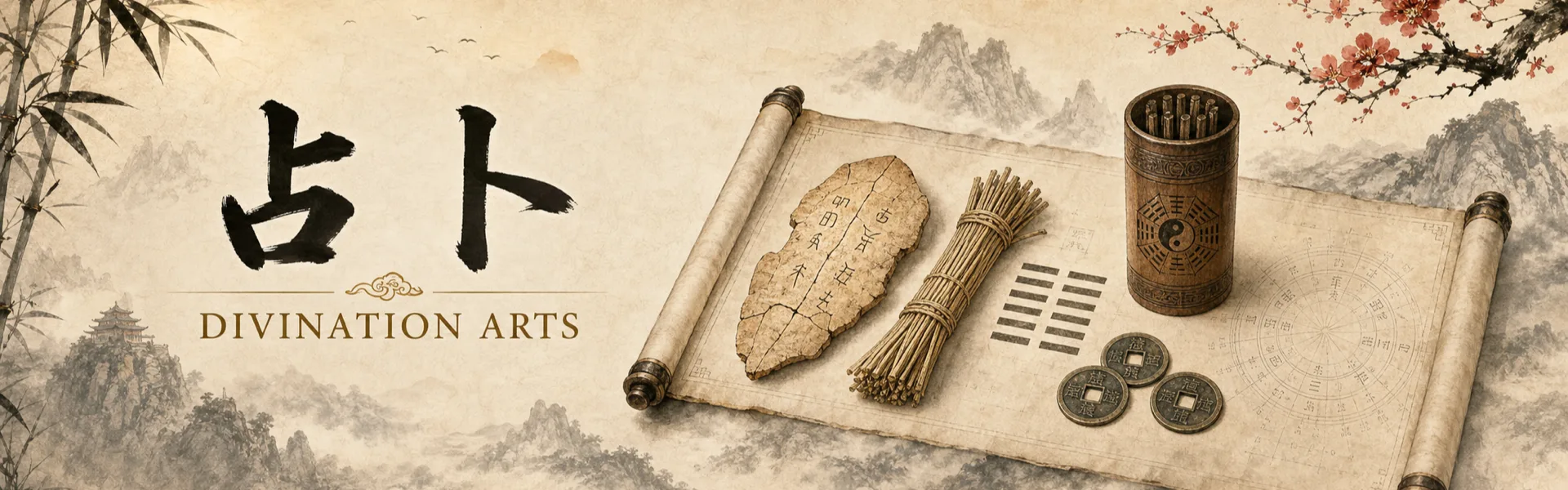
01 Find your bearings
Origins and History of Chinese Divination
From Neolithic bones and Shang royal records to the Yijing, temple practice and modern life
Explore this section
02 Explore the subject
Chinese Coin Divination and Temple Lots: Methods and Meaning
How three-coin hexagrams and temple fortune sticks became everyday forms of consultation
Explore this section
03 Keep reading
Chinese Divination: Primary Sources and Further Reading
Oracle-bone records, Yijing scholarship, transmitted manuals and modern research
Explore this sectionGo further
Deeper reading
- Origins and History of Chinese DivinationFrom Neolithic bones and Shang royal records to the Yijing, temple practice and modern life
- Chinese Oracle Bones and Turtle-Shell DivinationHow Shang kings prepared bones, read heat cracks and recorded questions in early Chinese writing
- The Yijing and Milfoil Divination: How Hexagrams Are Cast and ReadFrom yarrow-stalk counting and Zhou divination to the philosophical Book of Changes
- Chinese Coin Divination and Temple Lots: Methods and MeaningHow three-coin hexagrams and temple fortune sticks became everyday forms of consultation
- Chinese Divination in Practice Today: Consultations, Apps and RisksHow modern readings work, what software changes, and where clear boundaries are needed
- How to Use Chinese Divination ResponsiblyReflection, uncertainty, cultural meaning and the limits of prediction
- Chinese Divination: Primary Sources and Further ReadingOracle-bone records, Yijing scholarship, transmitted manuals and modern research
The full guide
What should I know before reading further?
Divination is the oldest of the arts described in this section, and in China it is older than writing — or rather, writing in China survives because of it. Where BaZi and Zi Wei calculate the shape of a whole life from a birth time, and date selection reads the quality of days, divination addresses a single specific question and returns a single answer. This subcategory covers the principal Chinese methods, their history, and what can honestly be said about them.
Read more The complete guide
Divination is the oldest of the arts described in this section, and in China it is older than writing — or rather, writing in China survives because of it. Where BaZi and Zi Wei calculate the shape of a whole life from a birth time, and date selection reads the quality of days, divination addresses a single specific question and returns a single answer. This subcategory covers the principal Chinese methods, their history, and what can honestly be said about them.
Bu and shi were originally two different things
Two words are usually translated together as "divination," and keeping them apart clarifies a great deal.
Bu (卜) means using turtle plastrons or animal bones: heat is applied, the material cracks, and the shape of the crack is judged. Shi (筮) means using milfoil stalks or bamboo counters, manipulated through a counting procedure that yields a hexagram.
The difference is not merely one of equipment. Bu reads a mark that nature produces, different every time, and everything depends on interpretation. Shi computes a symbol by a fixed procedure that any competent person would perform identically. The Zuozhuan preserves the judgement that "milfoil is inferior, the turtle superior," which shows both that the two were ranked against each other and that they ran in parallel for a long time.
This distinction runs through the entire history of the subject: on one side reading a trace, on the other calculating a symbol. Almost every method described in these pages is a variant of one or the other.
It asks a different kind of question
BaZi and Zi Wei work on the pattern of a whole life; their raw material is a birth time, and a person has only one of those. Divination works on a particular matter: whether this marriage should be agreed to, whether to make this journey, where a lost object is, when a sick person will recover.
Because the object is specific, divination can be performed at any time, repeatedly, and it comes with something the fate-calculation arts lack — an outcome that will arrive and can be compared against the prediction.
That feature deserves emphasis, because it sets up the central problem of the whole subject. Divination is structurally the most testable of all the divinatory arts, and it has not been tested. Three thousand years of continuous practice, on questions with checkable answers, produced no record of accuracy rates. The honest assessment page returns to why.
The methods are extraordinarily numerous
The number of Chinese divination methods is striking. Besides turtle and milfoil there is coin casting to build a hexagram, temple lot drawing, moon-block throwing, character analysis, dream interpretation, observation of vapours and weather, bird omens, bone scorching, and even divination by abacus beads. Above these sit the "three systems" — Taiyi, Qimen Dunjia and Liuren — each an elaborate specialist discipline in its own right.
They differ in their source of randomness, they differ in their interpretive apparatus, and they do not accept each other's conclusions.
The proliferation is itself worth noticing. A technique that genuinely read the future would not grow several dozen mutually incompatible versions inside a single culture, any more than arithmetic did. Variety on this scale is what one expects from a practice whose forms are shaped by what people find satisfying rather than by what works.
Randomness is doing the work
One structural observation covers nearly every method described here, and it is worth making early.
Each technique begins with a randomiser. Heat cracks a bone unpredictably. Dividing a bundle of stalks and counting the remainders produces an unpredictable number. Three coins land unpredictably. A bamboo cylinder is shaken until one stick falls out. The moon blocks tumble. The apparatus that generates the answer is, in every case, a device for producing an outcome nobody controls.
What follows the randomiser is interpretation, and that is where all the content lies. A hexagram is sixty-four possible outcomes; the situations people ask about are infinite; so the mapping from one to the other must be supplied by the reader. This is not a hostile description — practitioners say something similar when they insist that a hexagram must be read against the question.
Keeping this clear explains both the appeal and the limitation. A random prompt interpreted by a thoughtful person is a genuinely useful way to think, and it is not a way to obtain information about the future. The randomness guarantees that the answer contains nothing about the world; the interpretation guarantees that it will nonetheless feel apt.
Why the documentary record is so thick
China's divinatory record is unusually rich, for three reasons that have nothing to do with efficacy.
First, Shang divination was inscribed on turtle shell and bone, and those inscriptions constitute the earliest systematic body of Chinese writing that survives. A by-product of divination became the primary source for palaeography and for the earliest reconstructable Chinese history.
Second, the manual used for milfoil divination became the Zhouyi, was admitted to the canon as one of the Classics, and generated two thousand years of commentary, philosophy and image-and-number scholarship growing out of it.
Third, the state maintained official diviners. Divination was part of administrative procedure, so it left institutional records.
The consequence is that the early history of China cannot be studied without studying divination — not because it worked, but because it was carefully written down.
Three layers to keep apart
These pages distinguish three things throughout, and running them together is what makes discussion of the subject go wrong.
As historical material, its value is very high. The oracle bones and the Yijing are two of the keys to understanding Chinese civilisation, and no serious account of early China can omit them.
As an aid to decision-making, part of it can be explained. Formulating a question precisely, giving indecision a way out, and using an external procedure to break a deadlock are real benefits, and there is serious work in anthropology and decision theory on randomised choice — including the well-known case of Naskapi hunters whose scapulimancy effectively randomised their hunting grounds, preventing prey depletion and their own predictable patterns.
As prediction of the future, it has no evidential support. There is no need to be evasive about that, and saying it plainly does not diminish either of the first two.
A rule the tradition set for itself
The literature imposes conditions on when divination may properly be performed, and they are more interesting than they first appear.
The classical formulations hold that one does not divine without sincerity, does not divine about an improper matter, and does not divine when one is not genuinely in doubt. The Yijing itself contains the line that the first consultation informs, while asking repeatedly is importunate and will not be answered.
Read from inside the tradition, these are rules of reverence. Read from outside, they are doing something else as well, and both readings can be true at once.
The prohibition on re-asking removes exactly the procedure that would expose an unreliable method. If a person may cast repeatedly, they will notice that the answers vary; if they may cast only once, they will not. Similarly, the requirement of sincerity supplies a ready explanation for any failure — the questioner was not sincere enough.
There is a sound practical point buried here too, and it survives the criticism. Someone who consults repeatedly until an agreeable answer appears is not consulting at all; they are shopping, and they already know what they want. Noticing that you have re-cast three times is genuinely useful information — about yourself, and about a decision you have in fact already made.
From affairs of state to private matters
Who used divination changed considerably over time, and the trajectory is informative.
In the Shang the diviner-in-chief was the king, and the subjects were sacrifice, military campaigns, hunts and harvests — affairs of state, performed by an official apparatus and archived. Under the Zhou official diviners remained, but the Zuozhuan already shows ministers and nobles casting milfoil about their own marriages, inheritances and appointments. By the Ming and Qing, coin casting and lot drawing had spread everywhere, and divination had become thoroughly private: illness, money, marriage, lost property, asked and answered by anyone at all.
As the users descended the social scale, the methods simplified. The eighteen manipulations of the milfoil stalks contracted to six throws of three coins, and then to shaking one stick out of a bamboo cylinder in a temple. This trajectory tells you more about the nature of these arts than any theoretical argument: their form tracks demand, not discovery. A technique that was refined by finding out what worked would have changed in a different direction.
What this section contains
Seven pages follow. Origins and history runs from Neolithic bone scorching to the establishment of oracle-bone studies as a discipline. Oracle bones and turtle-shell divination explains how the Shang prepared the material, read the cracks and inscribed the records. The Yijing and milfoil divination describes how a hexagram is generated and how the book moved from manual to Classic. Coin divination and temple lots covers the two most widespread popular methods. Divination in practice today describes its present forms and what to watch for. An honest assessment addresses the question of efficacy directly. Key sources lists what can be consulted.
Key points
- Bu read cracks in heated bone or shell; shi computed a hexagram by counting stalks — reading a trace versus calculating a symbol.
- Divination addresses specific questions with checkable outcomes, unlike the fate-calculation arts.
- It is therefore structurally the most testable of these arts, and three thousand years of practice produced no accuracy record.
- Dozens of mutually incompatible methods exist; that proliferation is itself evidence about the nature of the practice.
- The record is thick because inscriptions became the earliest Chinese writing, the manual became a Classic, and the state kept archives.
- Its historical value is very high and entirely independent of whether it predicts anything.
- As a decision aid it has real functions: clarifying a question, breaking deadlock, and randomising choices where randomising helps.
- As prediction it has no evidential support, and saying so does not diminish the other two layers.
- Use shifted from kings asking about harvests to individuals asking about illness and money.
- As users descended, methods simplified — form tracked demand rather than discovery.
Recommended next page
Where next?
Chinese Oracle Bones and Turtle-Shell DivinationHow Shang kings prepared bones, read heat cracks and recorded questions in early Chinese writingA few alternatives