A path into the reading
Taoist Festivals and Rituals: Calendars, Offerings and Community Rites
Deity birthdays, lunar observances, purification, grand offerings and pilgrimage festivals
Start here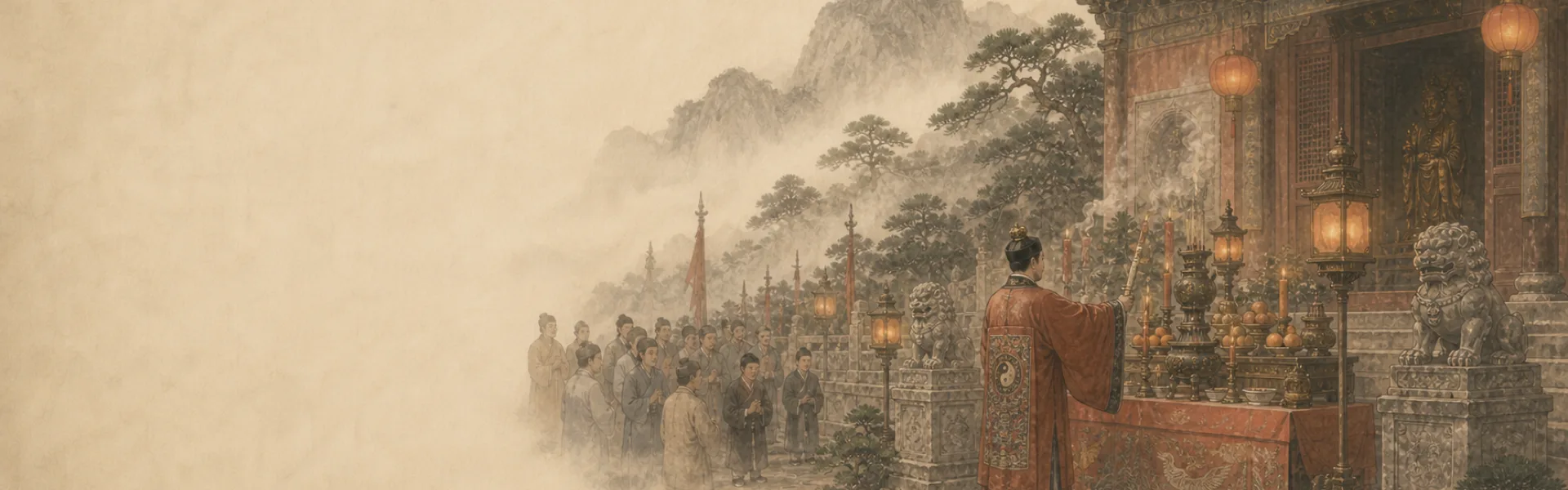
01 Find your bearings
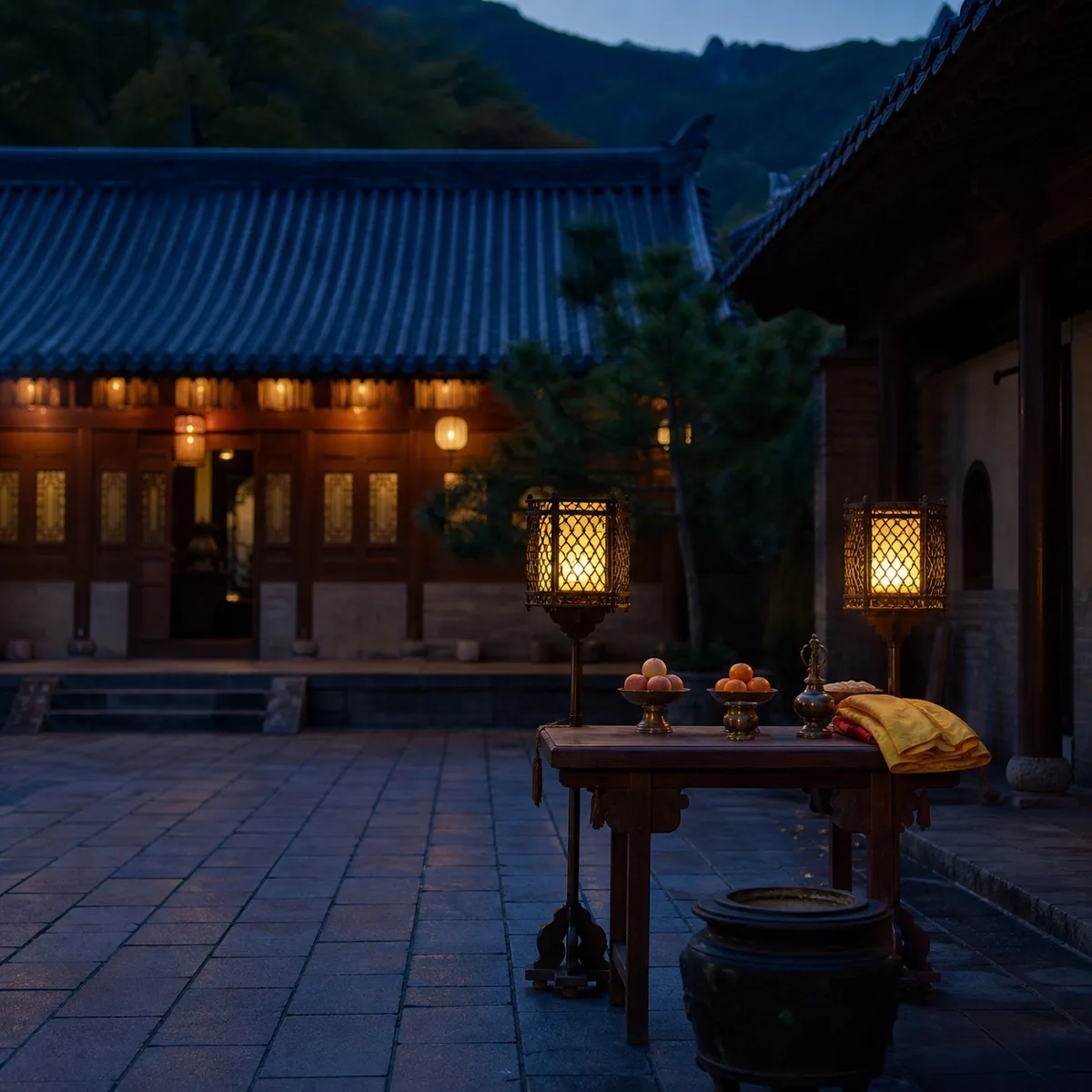
The Jade Emperor’s Birthday and Festivals of the Heavenly Court
Why the ninth day of the first lunar month matters, what deity birthdays mean, and how temples observe them
Explore this section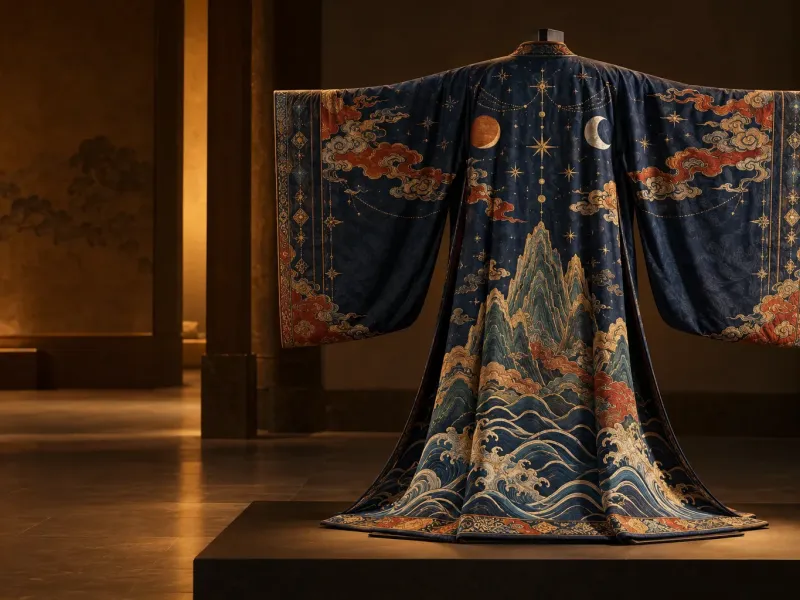
02 Explore the subject
Daoist Ritual Robes: Garment, Image and Ceremonial Role
How to distinguish robe types, read cosmological embroidery and return a museum textile to the movement and hierarchy of ritual
Explore this section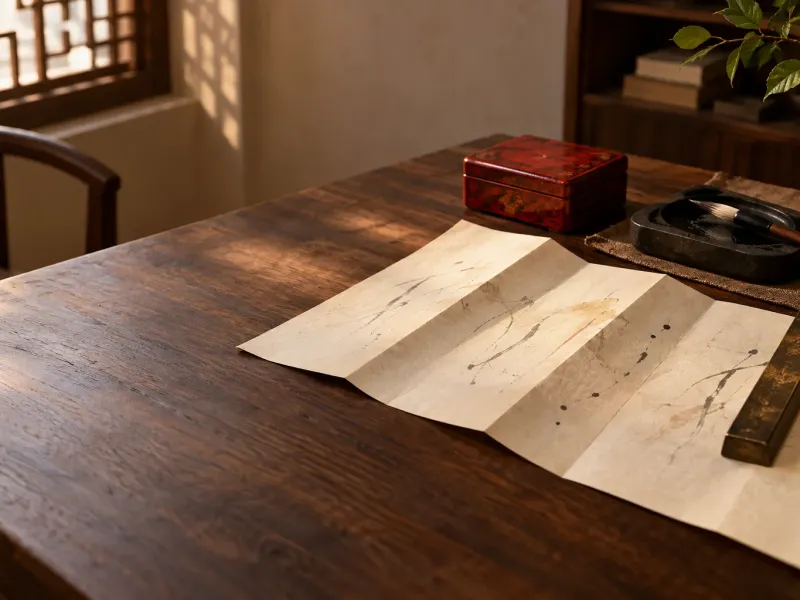
03 Keep reading
Daoist Petitions and Memorials: Writing to the Celestial Administration
Read ritual documents through genre, addressee, material form, performance and evidence.
Explore this sectionGo further
Deeper reading
- The Jade Emperor’s Birthday and Festivals of the Heavenly CourtWhy the ninth day of the first lunar month matters, what deity birthdays mean, and how temples observe them
- Zhongyuan Festival: Ghost Festival, the Earth Official and Universal SalvationWhy Taoist Zhongyuan and Buddhist Yulanpen share the seventh lunar month, and what universal salvation means
- Laozi’s Birthday: From the Sage Laozi to the Divine Lord LaoWhy the remembered philosopher, the Tao Te Ching and the deity Taishang Laojun must be distinguished
- Double Ninth Festival: Chongyang, Longevity and Respect for EldersWhy doubled yang once signalled danger, how protective customs evolved, and why the day now honours older people
- Jiao Rituals: Taoism’s Grand Community OfferingHow multi-day altar rites use clergy, music and documents to renew relations between a community and the sacred world
- Zhai Rituals: Taoist Purification, Fasting and PreparationHow abstinence, conduct, confession and ritual cleansing prepare a person or community for sacred work
- Taoist Temple Fairs and Seasonal PilgrimageWhy worship, markets, opera and social life gather around temple calendars and mountain pilgrimage seasons
- Daoist Ritual Robes: Garment, Image and Ceremonial RoleHow to distinguish robe types, read cosmological embroidery and return a museum textile to the movement and hierarchy of ritual
- The David Vases: A Daoist Offering and a Dated Porcelain LandmarkHow a pair of 1351 altar vases links a lay donor, a Daoist temple and the mature blue-and-white porcelain of Yuan-dynasty Jingdezhen
- Daoist Ritual Seals: Impression, Authority and the Work of DocumentsHow carved matrices, cinnabar impressions and transmitted authority turn a small object into part of a larger ritual system
- Daoist Ritual Music: Bells, Drums, Chant and Ceremonial TimeA listening guide to the voices, percussion, instrumental tunes and living transmission of Wudang temple music
- Daoist Lamp Rituals: Light, Cosmic Patterns and Ceremonial SpaceHow ordered flames, liturgical texts and ritual movement transform light into a ceremonial language
- Daoist Talismans: Script, Ritual Action and the Limits of LookingHow paper, signs, transmission and performance make a ritual document—and why appearance alone cannot decode it
- Daoist Mirrors: Reflection, Cosmology and Ritual EvidenceHow to read bronze, reflection, inscriptions, directional animals and evidence of ceremonial use
- Daoist Petitions and Memorials: Writing to the Celestial AdministrationRead ritual documents through genre, addressee, material form, performance and evidence.
- Daoist Registers (Lu): Rank, Transmission and Celestial AdministrationA historical guide to ritual registers, ordination, documentary authority and the limits of identifying a lu from appearance alone.
- Daoist Audience Tablets (Hu): Courtly Form and Ritual AddressA visual and historical guide to the hu, its courtly form, ritual use, and the evidence needed to distinguish an audience tablet from other Daoist implements.
- Daoist Crowns and Headscarves: Dress, Rank and Ritual ContextA visual and historical guide to guan and jin, ceremonial differentiation, Quanzhen identity, and the distinct meaning of the guanjin admission rite.
- Daoist Footwear: Cloth Shoes, Cloud Shoes and Ritual MovementA historical and visual guide to simple shoes, ceremonial cloud footwear, complete ritual dress, and the limits of reading rank or movement from an object.
The full guide
What should I know before reading further?
If you want to know what a religious tradition actually holds, look at what it does on which days. Doctrine can be selectively quoted; a calendar cannot. Taoism keeps a dense one — deity birthdays, seasonal offerings, rites for the dead, and large periodic ceremonies that can run for several days and involve a whole community. This part of the site explains how that calendar is put together and what the major ritual forms are for.
Read more The complete guide
If you want to know what a religious tradition actually holds, look at what it does on which days. Doctrine can be selectively quoted; a calendar cannot. Taoism keeps a dense one — deity birthdays, seasonal offerings, rites for the dead, and large periodic ceremonies that can run for several days and involve a whole community. This part of the site explains how that calendar is put together and what the major ritual forms are for.
The Taoist Ritual Calendar Is Lunar and Local
Two features cause most of the confusion. First, Taoist dates follow the traditional lunar calendar, so they move against the Gregorian year and cannot be given as fixed dates. A festival on the ninth day of the ninth lunar month falls somewhere in the autumn, and where exactly depends on the year. This site therefore gives lunar dates and does not attempt conversions, because a conversion table would be wrong within a year.
Second, and less often mentioned, the calendar is local. A temple's most important day is usually the birthday of its own principal deity, and that varies from temple to temple. A Mazu temple in Fujian and a Zhenwu temple in Hubei do not keep the same year. There is no single Taoist liturgical calendar in the way there is a single Christian one, and there is no authority that could impose one.
The practical consequence for a visitor is that you cannot plan around a national schedule. If a particular observance matters to you, the observance belongs to a particular temple, and you have to find out locally what that temple is doing. Anything written in advance, here or elsewhere, is a general guide at best.
Four Types of Days in the Taoist Ritual Calendar
The calendar is not a flat list. Roughly four types of day are worth distinguishing.
Deity birthdays are the most numerous. Every significant god has one, and it is the occasion for offerings, scripture recitation and often a temple fair. The Jade Emperor's birthday early in the first lunar month and the observances associated with Laozi are among the most widely kept.
Calendrical days come from the structure of the month and year rather than from any deity: new moon and full moon, the solstices, and the transitions between the twenty-four solar terms. These are days of heightened ritual activity in temples even when nothing is being celebrated.
Rites for the dead form their own group, concentrated in the seventh lunar month but not confined to it. And finally there are occasional great ceremonies, which are not annual at all — commissioned when a community, a temple or a benefactor has reason, sometimes decades apart.
Jiao and Zhai: Taoism’s Two Major Ritual Categories
Almost all major Taoist ritual falls into one of two traditional headings, and the distinction is worth learning because it is about direction of movement.
Zhai is preparatory and inward. It covers purification and fasting: restricting food, abstaining from certain activities, confession of fault, and the cleansing of both the participants and the space. It is what makes a person and a place fit to conduct the main business.
Jiao is the main business — the grand offering. It is outward and communal: the formal presentation of offerings and petitions to the celestial hierarchy on behalf of a community, conducted by ordained priests over a period that may run to several days. A full jiao is one of the largest undertakings in Chinese religion, involving musicians, chanting, processions, elaborate paper constructions and considerable expense. Historically it was funded by a village, a guild or a lineage, not by an individual.
The pairing is the point. You purify, then you offer. Ritual sequences that look bewilderingly long usually resolve into that shape.
Why Taoist Ritual Relies on Documents
This follows from the administrative structure of the pantheon described elsewhere in this section. If the divine order is an administration, then approaching it means submitting a properly composed document to the correct office. So a great deal of Taoist ritual consists of writing, reading aloud and then burning — burning being the means of transmission, not destruction.
Once you know this, ceremonies become far more legible. The priest at the centre is often reading; there are tables, seals, formal registers and lists of names; texts are held with both hands and treated as objects of consequence; and the climax is frequently the moment a document goes into the flame. The theatrical elements — music, movement, costume — are the setting for an act that is essentially bureaucratic.
It also explains why ordination matters so much. A document has to come from someone with standing to submit it. That is precisely what ordination confers.
What Visitors See and Hear during Taoist Ritual
Expect sound. Taoist liturgy is chanted, usually to percussion — wooden blocks, bells, drums, cymbals — and often with wind and string instruments. It is not quiet or meditative in atmosphere, and it can be startlingly loud. Vestments are elaborate and colour-coded by role, in contrast to the plain daily gowns of the same clergy.
Movement is formal and patterned. Priests trace prescribed paths within the ritual area, and specific footwork and hand positions carry technical meaning that is not explained to onlookers. There will be a principal officiant at the centre of the axis, with assistants at defined positions. Bystanders are generally welcome; participation is not expected.
The rules for observers are simple and worth respecting: no flash, no video with sound, and nothing photographed from the front — that is, from the axis, past the officiant. Stand at the side or outside. The test that resolves most other questions is whether you would do the same thing in a stranger's home, because a working temple is both a home and a workplace.
The Taoist Ritual Season for the Dead
The seventh lunar month, and particularly the Zhongyuan festival at its middle, is given over to the dead. The underlying idea is universal salvation: rites are performed not only for one's own ancestors but for the unremembered dead, those without descendants to care for them, and those who died badly.
This is one of the most widely observed parts of the calendar and one of the least understood from outside, partly because the popular English name — Ghost Festival — suggests something spooky. The actual tone is closer to a public duty carried out with proper form: offerings set out, documents read, food and paper goods provided, names recorded. It is also a good illustration of how Taoist and Buddhist observance overlap in popular practice while remaining distinct in the hands of clergy.
Music and Instruments in Taoist Ritual
The sound of a Taoist rite is the part most visitors remember and the part least often explained. It is not incidental decoration. The music is structural, and once you know what the instruments are doing the whole event becomes easier to follow.
The core is chanted text. The words come from ritual manuals and are delivered to fixed melodic patterns rather than freely sung. A given text has a way it is done, and the officiants are reproducing that way rather than interpreting it. This is why the singing can sound impersonal to a listener expecting expression: the point is accurate delivery of a document, not the communication of feeling.
Percussion marks structure. A bell and a wooden fish-shaped block are the basic pair, and between them they establish the pulse and signal transitions — the end of a section, a change of address, a point at which the participants move or bow. A drum may mark larger divisions. If you cannot follow the words, you can still follow the shape of the rite by listening for these signals, and you will notice that the pattern repeats.
Melodic instruments appear in larger rites: a transverse flute, a double-reed pipe with a piercing tone, plucked and bowed strings depending on region and resources. Their function is partly to support the chant and partly to fill the intervals when nothing is being sung but something is being done — a document prepared, a movement completed, offerings arranged.
Two features are worth pointing out because they surprise people. The first is that the repertoire is regional. Ritual music absorbed local musical style wherever it was performed, so the same text can sound substantially different in different provinces, and some of what is performed today is closer to local folk and opera traditions than to anything nationally standard. The second is that a good deal of this music has been studied and recorded as musical heritage independently of its religious function, which means recordings exist and are not hard to find, and that listening to them beforehand makes a live rite much more intelligible.
One practical note. Because the music is functional, the volume and the sudden percussion are not aimed at an audience and are not a performance cue. Do not applaud, do not move closer for a better recording position, and do not treat a pause as an ending. Rites have internal pauses, and the point at which participants relax is the only reliable sign that something has finished.
How to Visit during a Taoist Festival
A festival is the best and the worst time to see a temple. Best, because the building is doing what it was built for, and an empty hall tells you much less than a full one. Worst, because it will be crowded, hot, noisy and difficult to move through, and because the people around you are occupied with something that is not a performance.
Two practical notes. On a mountain site, festival crowding is a safety matter rather than a comfort matter: narrow worn stone stairs with two-way traffic are genuinely hazardous, and the same applies to the major public holidays. And the one thing genuinely expected of you is quiet — not silence, and not solemnity, since Chinese temple courtyards are sociable places. You are not being asked to keep the rule. You are being asked not to interrupt people who are.
Key Points About Taoist Festivals and Rituals
The Taoist calendar is lunar, so festival dates move against the Gregorian year and cannot be listed as fixed dates.
It is also local: a temple's biggest day is usually its own principal deity's birthday, so there is no single Taoist liturgical year.
Four kinds of day: deity birthdays, calendrical days such as new and full moon and the solar terms, rites for the dead, and occasional great ceremonies.
Zhai is purification and fasting — preparatory and inward. Jiao is the grand offering — outward, communal and often several days long.
A full jiao was historically funded by a village, guild or lineage rather than an individual, because of its scale and cost.
Ritual is largely documentary: petitions are composed, read aloud and burned, burning being the means of delivery.
This is why ordination matters — a petition needs a submitter with recognised standing.
Liturgy is chanted and loud, with percussion and elaborate role-coded vestments; formal movement carries technical meaning not explained to onlookers.
For observers: no flash, no video with sound, nothing photographed from the front along the axis. Stand at the side or outside.
The seventh lunar month is for the dead, including the unremembered dead, and its tone is dutiful rather than eerie.
Festival crowding on mountain stairs is a safety issue, not a comfort issue. The one real expectation of visitors is not to interrupt.
Recommended next page
Where next?
Zhongyuan Festival: Ghost Festival, the Earth Official and Universal SalvationWhy Taoist Zhongyuan and Buddhist Yulanpen share the seventh lunar month, and what universal salvation meansA few alternatives