A path into the reading
Introduction to Wudang Mountain
What the mountain is, and whether the trip suits you
Start here
01 Find your bearings
Zhenwu: The Taoist Deity at the Heart of Wudang Mountain
His legend, visual attributes and place in Wudang’s religious landscape
Explore this section
02 Explore the subject
Wudang World Heritage: What UNESCO Inscribed and Why
Read the ancient building complex through its history, mountain setting and continuing conservation
Explore this section
03 Keep reading
Reading Wudang’s Plaques and Couplets: Names, Calligraphy and Layers of Time
How to read words, brushwork, buildings and documentary evidence together—without mistaking a later board for an original.
Explore this sectionGo further
Deeper reading
- Zhenwu: The Taoist Deity at the Heart of Wudang MountainHis legend, visual attributes and place in Wudang’s religious landscape
- Wudang Mountain Today: Temples, Tourism and Daily LifeHeritage management, religious life, martial arts and a palace raised fifteen metres
- Should You Visit Wudang Mountain?Who the mountain suits, what the trip demands and which expectations to leave behind
- Wudang World Heritage: What UNESCO Inscribed and WhyRead the ancient building complex through its history, mountain setting and continuing conservation
- Reading Wudang’s Stone Inscriptions: Steles, Dates and Imperial MemoryHow inscriptions turn temples and cliffs into historical evidence—and what they cannot prove
- How Wudang Was Recorded: Gazetteers and Sacred GeographyHow mountain gazetteers joined routes, buildings, people and imperial records into a readable landscape
- Reading Wudang’s Plaques and Couplets: Names, Calligraphy and Layers of TimeHow to read words, brushwork, buildings and documentary evidence together—without mistaking a later board for an original.
The full guide
What should I know before reading further?
Wudang is one of those names that carries more than one thing at once, and a great deal of the confusion that surrounds it comes from readers, visitors and marketing material sliding between them without noticing. Before any history or practical detail, it is worth separating the senses and saying plainly what sort of trip this is and whom it suits.
Read more The complete guide
Wudang is one of those names that carries more than one thing at once, and a great deal of the confusion that surrounds it comes from readers, visitors and marketing material sliding between them without noticing. Before any history or practical detail, it is worth separating the senses and saying plainly what sort of trip this is and whom it suits.
One name, three different things
First, Wudang is a physical range in northwestern Hubei with a designated scenic and heritage area on it, a working set of Taoist temples, and a resident clergy. This is the concrete sense: a place with an entrance, paths, halls and weather.
Second, Wudang is the name of a religious tradition centred on Zhenwu, the Perfected Warrior, with its own liturgy, festival calendar and monastic institutions. That tradition has a history, patrons, texts and buildings, and it is what the mountain was actually built for.
Third, Wudang is a label attached to a family of martial arts, used in contrast to Shaolin, and often written as though it named a single school with a continuous transmission. In practice it is a category rather than an organisation. Various arts, some old and some assembled recently, are taught under the name by unrelated teachers and schools with no common authority.
The three senses overlap on the ground but they are not the same thing, and a claim that is true in one sense is often false in another. The mountain has a documented Ming building programme; the martial label does not have a documented medieval genealogy. Recognising which sense is in play in any given sentence is the single most useful habit for reading about this place.
How it differs from China's other famous mountains
China has many sacred mountains, and Wudang is unusual among them in a way worth understanding early.
The Five Marchmounts, of which Taishan in Shandong is the best known, are sites where the mountain itself is the object of the state cult. The peak is a power, the emperor sacrificed to it, and the deity is in an important sense the mountain. Wudang is not like that. Its object of worship is a god who is not the mountain, and the mountain is his residence and his monument. That difference shapes everything, because a residence can be designed.
The great Buddhist mountains, such as Wutai, Emei, Putuo and Jiuhua, are each associated with a bodhisattva and accumulated buildings over many centuries in an additive way, temple by temple, patron by patron. Wudang has that layer too, but it also has something they lack: a single unified imperial design campaign that treated the whole range as one composition, executed in a few decades, with the approach to the summit as the organising line.
Among Taoist mountains, Qingcheng in Sichuan and Longhu in Jiangxi have deeper claims to institutional origins, Longhu especially as the seat of the Celestial Master line. Wudang's distinction is not antiquity of foundation but the scale and coherence of its state-sponsored construction, and the fact that its cult was, for a period, effectively a dynastic one. If you want to see what Chinese imperial power looked like when it decided to build a religion into a landscape, this is the best surviving place to see it.
What the word designates
The name is written with characters meaning, roughly, martial and to match or to be fit for. A very widely repeated explanation says the name means that none but Zhenwu is fit to occupy this mountain, and you will see this in guidebooks, on signboards and in tour commentary.
That explanation is a back-formation. The name is attested as a place name well before the Zhenwu cult reached the prominence that would make such a gloss meaningful; there was a Wudang county in the region under the Han. The pious etymology was constructed later to fit the deity to the name, which is an ordinary and interesting thing for a religious tradition to do, and it is not a scandal. But it is not the origin of the word, and the distinction matters because the same pattern recurs across the site: an association is created, then narrated backwards as though it had always been there.
You will also meet the older name Taihe, Supreme Harmony, and the Ming honorific styling the range a Great Peak, which placed it above the Five Marchmounts in court ranking. Names on this mountain are political documents.
What you will and will not find
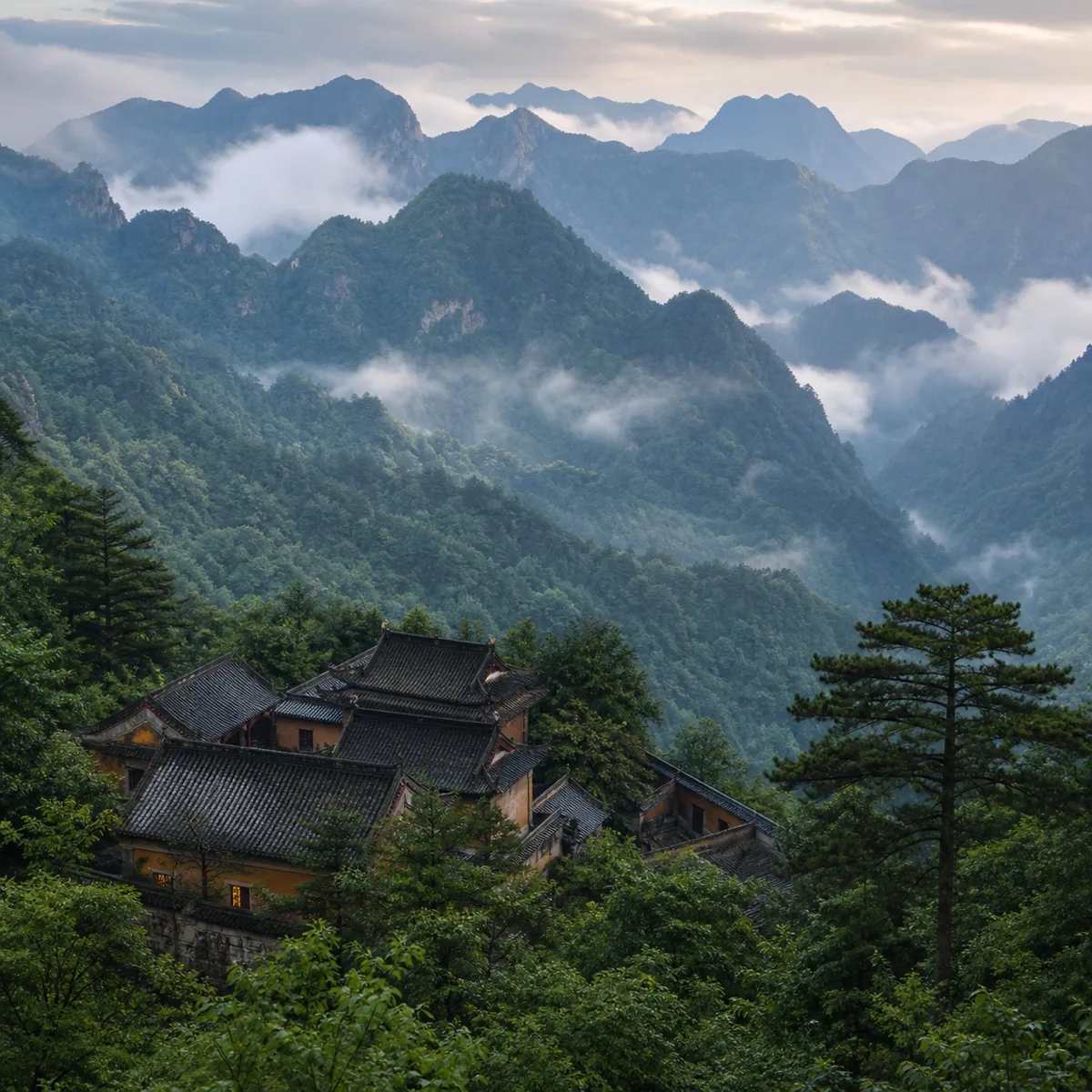
You will find a large, steep, wooded range with a controlled entrance and an internal transport system; a chain of substantial halls and palaces climbing towards the summit; a small bronze hall on the highest peak; several quieter complexes off the main line; resident clergy conducting daily services; a considerable amount of commerce at the obvious points; large domestic crowds at peak times; and martial arts schools, mostly in and around the town below rather than inside the temples.
You will not find an untouched ancient site. A great deal is reconstruction, some of it recent, and the twentieth century was hard on the mountain. You will not find a place where the temples teach martial arts as an institutional activity, which surprises many visitors; the association between clergy and martial schools is much looser than the marketing suggests. You will not find solitude on the main axis in season. And you will not find a single authority who can tell you the correct version of the mountain's contested history, because there isn't one.
Whether the trip suits you
Say honestly what the visit demands. It is physically real: the main experience involves sustained climbing on stone steps, often in humidity, and the summit approach is steep enough to defeat people who assumed a cable car solves everything. It rewards time; a rushed day trip to the summit and back gives you a photograph and very little else, while three or four days lets you reach the quieter complexes where the place makes sense. And it rewards a particular kind of curiosity, because much of what is interesting here is architectural, historical and institutional rather than scenic.
It suits you if you want to understand how Chinese religion actually works as an institution, if you like buildings and landscape design, if you are willing to walk, or if you are seriously considering training and want to see the setting first. It suits you less if you are looking for wilderness, for an uncommercialised spiritual retreat, for a martial arts monastery of the kind that exists in films, or for a comfortable sightseeing stop between two cities. None of that makes the mountain a poor destination. It makes it a specific one.
Why so few foreign visitors
By the standards of its importance, Wudang receives remarkably few international visitors, and the reasons are mostly banal rather than mysterious.
It is inland, in a part of Hubei that sits off the standard first-visit circuit of Beijing, Xi'an, Shanghai and Guilin, and it takes a deliberate detour to reach. English-language signage and interpretation, while improving, has historically been thin, and the interest of the place is dense with names, ranks and dates that are hard to absorb without preparation. There is no single iconic image of Wudang with the global recognition of the Great Wall or the Terracotta Army, which means it rarely makes an itinerary by default. And the foreigners who do come arrive disproportionately for one of the three senses of the name: martial arts students, who often stay for months and see very little of the temples.
The practical consequence is that you will usually be a small minority in a very large domestic crowd, that facilities are designed for that crowd rather than for you, and that a little preparation goes further here than at more heavily interpreted sites. That is largely why this section exists.
What these pages cover
The introduction group takes the background you need before any of the practical material makes sense: the mountain itself, its geography, scale, water and climate; Zhenwu, the deity the whole place is organised around, and how to recognise him; a short history from Tang recluses through the Ming programme to the twentieth century and the present; what survives and what was rebuilt, stated frankly; and how the site is governed and managed today, which explains a surprising amount of what you encounter as a visitor.
Read this group first if you want the mountain to be legible. If you only need logistics, the planning group stands on its own, and the etiquette group can be read in a few minutes before you walk through the first gate.
Sources and limits. The historical and cultic material here follows the standard scholarship on Zhenwu, the Ming construction campaign and Chinese sacred mountains, along with the site's inscriptions and published conservation material. The characterisation of the martial label reflects the documentary record, which is thin before the late imperial period; traditions that assert more are noted as assertions rather than dismissed. Visitor conditions, signage and access change, and nothing here should be treated as a current operational description.
Key points
The name means three separable things: a physical range, a religious tradition centred on Zhenwu, and a martial arts category.
Claims true in one sense are often false in another, and the martial label is a category rather than an organisation.
Unlike the Five Marchmounts, the object of worship here is a deity rather than the mountain, which is why the landscape could be designed as his residence.
Its distinction among Taoist mountains is the scale and coherence of state-sponsored building, not antiquity of foundation.
The pious etymology tying the name to Zhenwu is a later back-formation; the place name is older.
The visit is physically demanding, rewards several days, and suits historical and architectural curiosity more than a search for wilderness.
Foreign visitors are few for ordinary reasons of geography, interpretation and itinerary, so preparation pays off unusually well.
Recommended next page
Where next?
Wudang Mountain Today: Temples, Tourism and Daily LifeHeritage management, religious life, martial arts and a palace raised fifteen metresA few alternatives