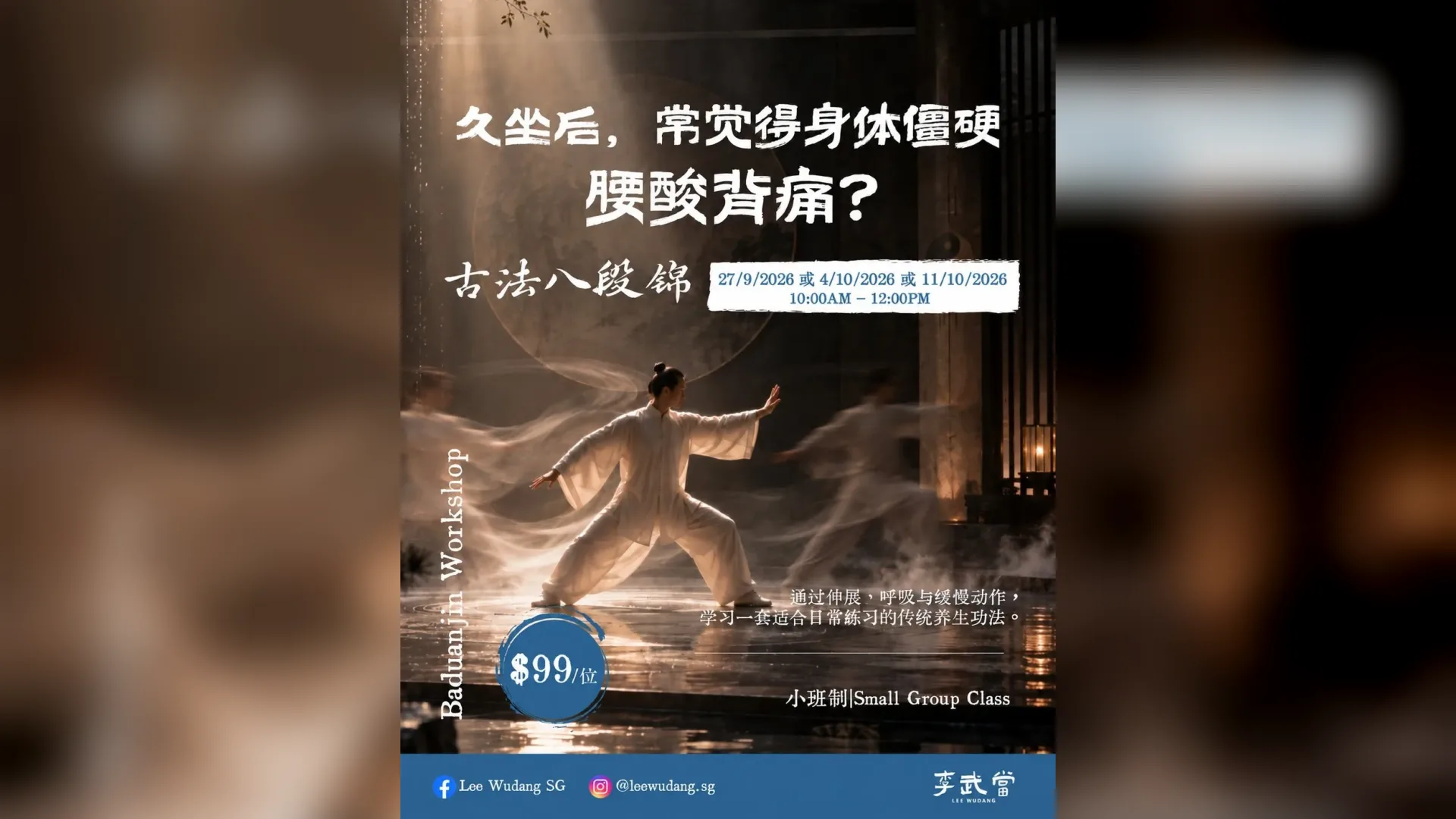
- Sessions
- Four sessions available
- Dates
- Location
- Singapore
- Fee
- S$99 per participant; S$39 for repeat participants
A path into the reading
Baduanjin (Eight Brocades)
Explore the history, eight-part structure and teaching variations of this named qigong sequence.
Start here01 Find your bearings
The Eight Sections of Baduanjin
A movement-by-movement guide to the traditional names, physical patterns and beginner-friendly practice principles of the Eight Brocades.
Explore this sectionGo further
Deeper reading
The full guide
What should I know before reading further?
Baduanjin (八段锦), often translated as the “Eight Brocades”, is a traditional Chinese qigong sequence built around eight short exercises. The name compares the practice to brocade: something composed section by section and valued for its refinement. Modern standing versions usually combine slow, coordinated movement with comfortable breathing and attentive posture. There is no single universal performance; schools may vary in stance, hand positions, sequencing and emphasis.
Read more The complete guide
What is Baduanjin?
Baduanjin (八段锦), often translated as the “Eight Brocades”, is a traditional Chinese qigong sequence built around eight short exercises. The name compares the practice to brocade: something composed section by section and valued for its refinement. Modern standing versions usually combine slow, coordinated movement with comfortable breathing and attentive posture. There is no single universal performance; schools may vary in stance, hand positions, sequencing and emphasis.
Unlike a martial routine performed for speed or impact, Baduanjin is commonly practised at an unhurried pace. The aim is not to force range of motion or create dramatic shapes, but to organise the body, breathing and attention through patterns that can be repeated and gradually refined.
A history shaped over time
Baduanjin belongs to the wider history of daoyin — Chinese traditions of guiding and stretching the body while coordinating movement, breathing and attention. The name Baduanjin appears in sources from the Song period, but surviving descriptions do not establish one fixed modern routine. Seated and standing versions, regional methods and later manuals all contributed to the forms practised today.
The popular attribution of Baduanjin to the Song general Yue Fei is best understood as a traditional account rather than documented authorship. Contemporary standardised routines are therefore one branch of a broader living tradition, not an unchanged sequence preserved from a single creator.
How the eight sections are practised
In many modern versions, the sequence includes reaching upward, opening the arms as though drawing a bow, turning to look behind, folding toward the legs, shifting weight and rising or sinking with control. The familiar names and exact order can differ between lineages. What connects the sections is the use of whole-body coordination rather than isolated muscular effort.
Good instruction gives priority to stable footing, comfortable knees, relaxed shoulders and steady breathing. Beginners do not need to copy the teacher’s maximum range. A smaller movement performed with balance and ease is often more useful than a deep position reached through strain. The breath should not be held or forced.
For a movement-by-movement explanation of the traditional names, physical patterns and beginner adaptations, continue with The Eight Sections of Baduanjin:
/wellness/baduanjin/eight-sections
How Baduanjin may help
Regular practice may support mobility, balance, coordination, body awareness, gentle strength and a calmer rhythm of exercise. Clinical studies have also examined Baduanjin in relation to outcomes such as balance, sleep, quality of life and blood pressure. Results are promising in some areas, but study quality and populations vary, so the practice should not be presented as a cure or a replacement for medical care.
The value of Baduanjin depends on the individual, the quality of instruction and the consistency of practice. Anyone managing an injury, dizziness, significant joint pain, a heart or breathing condition, pregnancy or recovery from illness should ask an appropriate healthcare professional whether and how to adapt the movements. Stop if a movement causes sharp pain, unusual breathlessness or loss of balance.
From learning the sequence to forming a practice
A beginner usually starts by learning the order and general pathway of each section. With repetition, attention can shift toward transitions, alignment, weight distribution and the relationship between movement and breathing. The sequence can then become a compact framework for regular practice rather than a list of shapes to memorise.
Learning in a small group can be helpful because a teacher can adjust stance width, range of motion and pacing for different bodies. Current verified workshops and programmes appear below when available.
Evidence and further reading
For a cautious overview of qigong research, see the US National Center for Complementary and Integrative Health: nccih.nih.gov
A systematic review of randomised Baduanjin trials is available through PubMed Central: pmc.ncbi.nlm.nih.gov
Upcoming Baduanjin and Related Programmes 近期八段锦与相关活动

Recommended next page