A path into the reading
Chinese Flower Arrangement: History, Materials and Ways of Looking
A cultural guide to vessels, seasonal branches, late-Ming texts and attentive looking
Start here
01 Find your bearings
A History of Chinese Flower Arrangement: Vessels, Pictures and Voices
Read Song images, Ming flower books and Qing memoirs as different windows onto a changing art.
Explore this section
02 Explore the subject
Seasonal Flowers and Symbolism: How to Read Context
Choose from what is present, then read cultural associations without turning them into fixed codes
Explore this section
03 Keep reading
Chinese Flower Baskets: Weaving, Painting and the Vessel
How to distinguish a working basket, a painted arrangement and a basket image on ceramic
Explore this sectionGo further
Deeper reading
- A History of Chinese Flower Arrangement: Vessels, Pictures and VoicesRead Song images, Ming flower books and Qing memoirs as different windows onto a changing art.
- Chinese Flower Arrangement: Line, Balance and Ways of LookingLearn to notice direction, intervals and depth before reaching for a formula.
- Choosing Flower Vessels and Tools: Form, Support and CareHow vessel shape, safe support and clean water shape an arrangement
- Seasonal Flowers and Symbolism: How to Read ContextChoose from what is present, then read cultural associations without turning them into fixed codes
- Flower Arrangement as Cultivation: Attention, Change and LimitsTrain observation through material choices while keeping literati, religious and philosophical contexts distinct
- Further Reading and Practice: Sources, Museums and a First MonthBuild a reliable source ladder, assess modern guidance and plan four weeks of accountable practice
- Chinese Flower Baskets: Weaving, Painting and the VesselHow to distinguish a working basket, a painted arrangement and a basket image on ceramic
The full guide
What should I know before reading further?
Chahua (插花), literally “inserting flowers,” can describe many acts of placing cut plant material in a vessel. On this site, Chinese flower arrangement is a cultural field rather than a single timeless style: offerings, courtly display, literati looking, domestic decoration, teaching and contemporary design may share materials without sharing the same purpose.
Read more The complete guide
Chahua (插花), literally “inserting flowers,” can describe many acts of placing cut plant material in a vessel. On this site, Chinese flower arrangement is a cultural field rather than a single timeless style: offerings, courtly display, literati looking, domestic decoration, teaching and contemporary design may share materials without sharing the same purpose.
This gateway teaches readers how to ask better questions. What setting does an arrangement belong to? Which object, image or text supports the claim? How do vessel, branch, season and viewpoint shape what we see? The answers are more interesting—and more accurate—than reducing Chinese practice to “not a bouquet.”
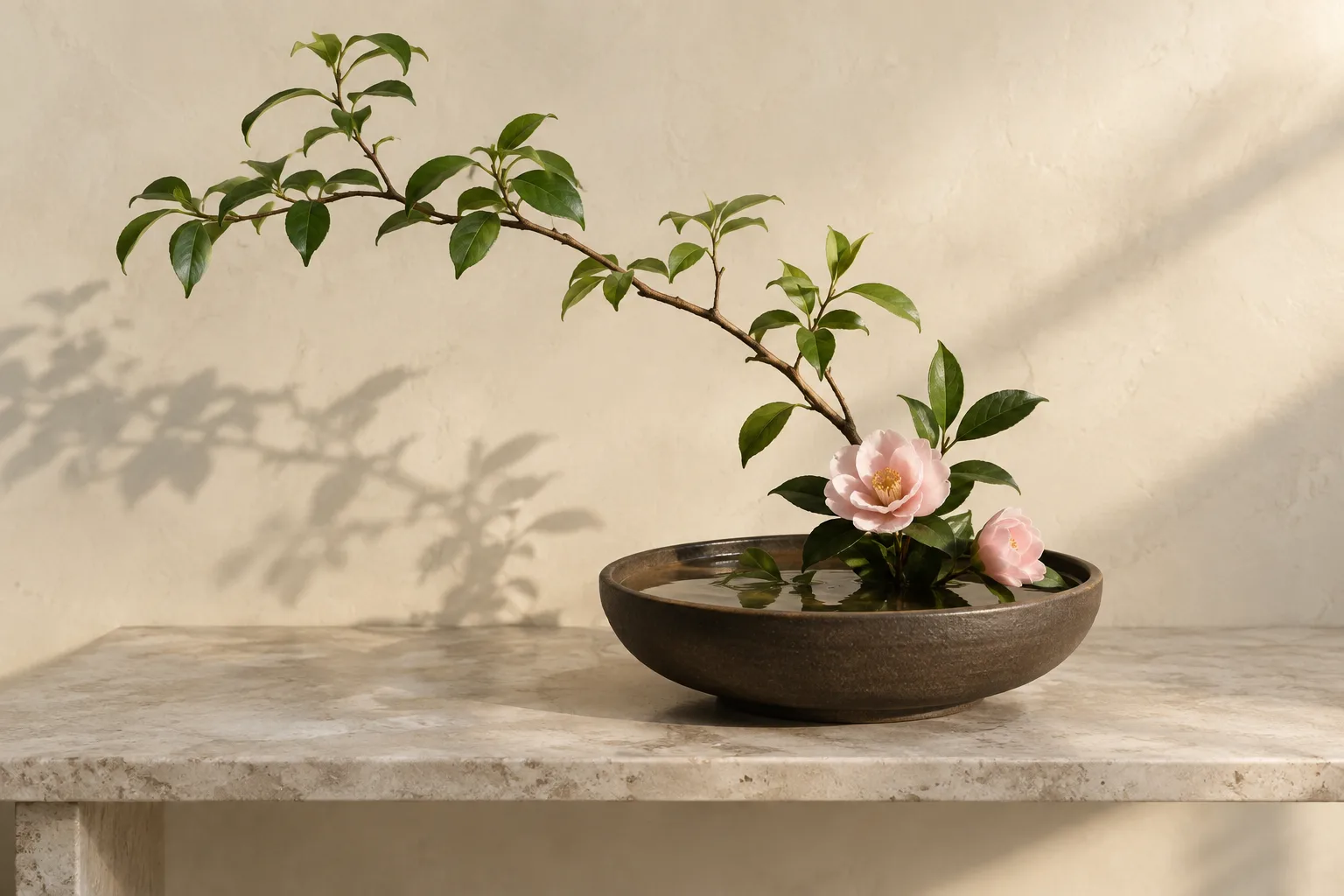
One name, several cultural settings
Offerings, rooms and contemporary practice
Flowers placed before a religious image, branches arranged for a scholar’s room and a composition made in a modern class can look related while doing different work. An offering participates in a particular rite; an interior display shapes a lived space; a classroom exercise makes choices visible. Context should be identified rather than inferred from a vase alone.
“Chinese flower arrangement” also covers change across region, period and community. Court workshops, gardens, markets, painting, poetry and household custom did not form one continuous school. A responsible history follows dated evidence and leaves room for practices that were transmitted, revived or newly organised.
Do not define a tradition by opposition
Chinese, Japanese and European flower cultures are each internally diverse, and they have met through travel, trade, books, exhibitions and teaching. It is misleading to make China stand only for line and emptiness, Japan for fixed rules, or “the West” for dense colour and symmetry.
Comparison becomes useful when it is specific: a named text, school, teacher, exhibition or object at a stated date. This site therefore asks who made or described an arrangement, for what place and audience, before treating resemblance as proof of descent.
Build history from objects, images and texts
Read paintings and vessels as situated evidence
The National Palace Museum’s “Arranging Flowers” collection guide brings together porcelain, bronze, baskets, paintings and written records. It shows that the container was not a neutral afterthought: material, mouth, height and setting all helped determine how cut plants were presented.
Li Song’s Southern Song Flower Basket records a splendid courtly image; it does not show how every household arranged flowers. Song Boren’s Register of Plum Blossom Likenesses follows plum from bud to fruit, reminding us that attention to a plant’s changing state can be historical evidence without becoming a universal recipe.
Treat late-Ming manuals as dated voices
Zhang Qiande’s Manual of Vase Flowers (《瓶花谱》) and Yuan Hongdao’s History of the Vase (《瓶史》) discuss flowers, vessels, water, care, placement and connoisseurship. They are invaluable late-Ming voices, not transcripts of all Chinese practice before or after them.
Their afterlives also crossed borders. Research on the reception of Yuan Hongdao’s text in early modern Japan shows why transmission must be traced through particular editions and communities rather than assumed from appearance. Read these books alongside surviving objects and images, and distinguish an author’s preference from an eternal rule.
Learn how to look before fixing rules
Line, weight, interval and viewpoint
Begin with observable relationships. Where does the main branch lean? What visual weight counters it? Which interval lets one stem remain legible? Does the composition have a front, or does it reward walking around? These questions train attention without claiming that every arrangement obeys one numerical system.
Negative space is not simply an empty patch. It is shaped by the vessel, branch direction, background, height of the viewer and neighbouring objects. Turn the vase, lower your eyes and photograph it from two positions; what looked balanced from one angle may collapse from another.
Season and plant condition change the work
A bud, open flower, curled leaf, seed head and fruit describe different moments. Arrangements continue to change after they are made: stems drink, bend, open and fade. A study can therefore include observation over time rather than treating the first photograph as the only finished state.
Plants carry cultural associations, but meanings vary with genre, period and setting. Plum, orchid, bamboo, chrysanthemum, lotus and peony should not be assigned one automatic message. The seasonal flowers and symbolism guide connects interpretations to sources and explains where caution is needed.
Choose vessels, tools and materials responsibly
Let the vessel participate
A vessel’s weight, depth, opening and surface affect stability, water, branch angle and visual rhythm. Before cutting, test the empty container on a level surface, add water and offer the uncut branch to the opening. Supports may be modern or improvised; identify them honestly rather than labeling every technique ancient.
Use a clean container and fresh water, protect the work surface and keep tools within a safe reach. Make the fewest cuts needed to test the idea. The vessels, tools and composition guide explains practical options without turning one setup into a cultural law.
Identify plants and respect where they come from
Some plants can irritate skin, trigger allergies or harm people and animals if eaten. Identify material before bringing it indoors; keep uncertain or toxic species away from food, children and pets; use gloves when sap is irritating; and close or sheath sharp tools when not in use.
Do not cut from parks, protected land, historic gardens or private property without permission. Follow local rules for native and invasive species, and ask florists or growers about origin when possible. Responsible sourcing is part of cultural practice, not an obstacle to beauty.
Follow the collection as a connected route
Move from evidence to practice
Start with the history, then use principles of arrangement to turn looking into questions. Continue to the guides on vessels and composition and seasonal plants and symbolism. Each page separates documented history from adaptable studio advice.
The final pair considers arrangement as cultivation without calling every quiet activity Daoist ritual, and offers further reading and practice. Together they form a route, not a ladder of certification.
Place flower arrangement within a Wudang cultural site
Flower arrangement meets painting, calligraphy, tea and incense through shared rooms, objects, seasons and acts of attention. Those connections matter without making all arts interchangeable or attributing every literati habit to Wudang.
For a first exercise, choose one legally sourced branch and one stable vessel. Observe the branch uncut, add one supporting stem only if it clarifies the relationship, then view the result from eye level and from the side. Note what changed after an hour. Return to the Arts gateway to compare how other practices make attention visible.
Recommended next page
Where next?
Chinese Flower Arrangement: Line, Balance and Ways of LookingLearn to notice direction, intervals and depth before reaching for a formula.A few alternatives