Chinese Painting: Materials, Formats and Ways of Looking
中国绘画:材料、形制与观看方法
Chinese painting is not one style. It includes tomb and temple images, court commissions, portraits, narrative handscrolls, coloured landscapes, monochrome ink painting, albums, fans and modern experiments. Materials and critical ideas connect some of these practices, but no single formula describes them all.
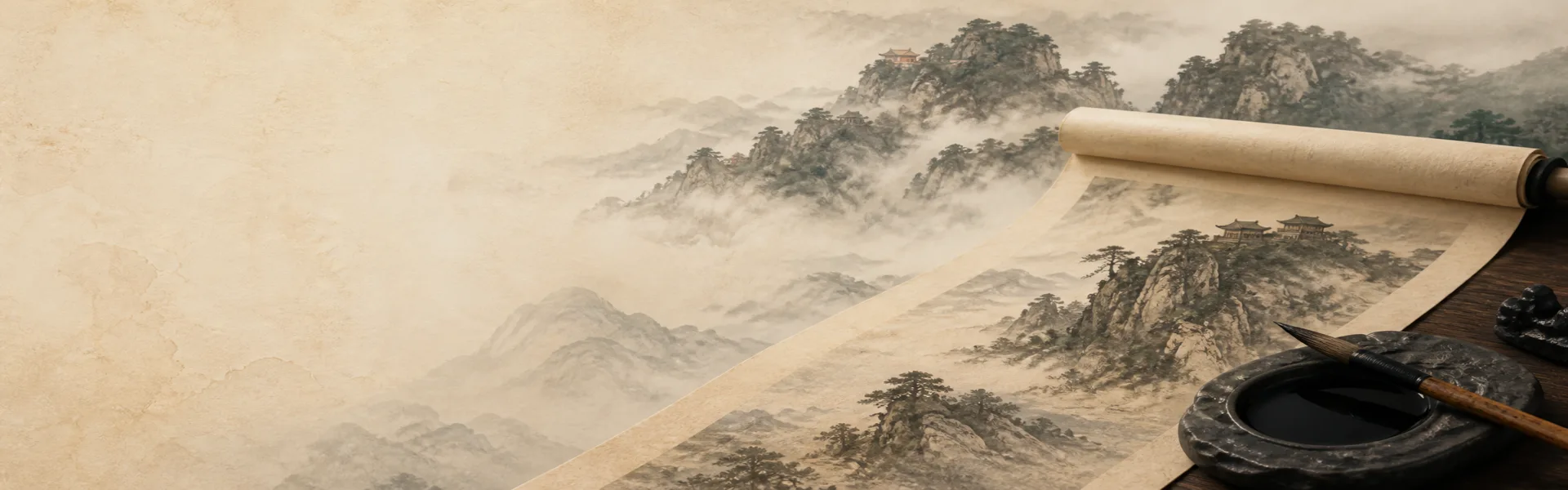
This overview offers a way to begin with objects rather than stereotypes. Ask what a work is made of, how it was mounted, who used it and what evidence supports its attribution. Those questions leave room for visual response while keeping different periods and communities distinct.
1. Begin with the object
A museum label is a useful first map. Record the title, attributed maker, date or date range, material, format and dimensions. Notice qualifications such as “attributed to,” “after” or “formerly attributed to.” They describe the state of the evidence, not a minor editorial detail.
Then look at the work before turning it into an example of “Chinese aesthetics.” A handscroll guides attention through a sequence; a hanging scroll meets the viewer more nearly at once; an album invites leaf-by-leaf comparison. A photograph on a screen cannot reproduce those experiences exactly.
2. Materials change what a painter can do
Brush, ink, paper and silk are central materials, but they do not produce one fixed effect. Unsized paper can respond quickly to moisture; sized paper and silk behave differently. Ink may be dry, wet, pale or dense. Colour can be transparent or built from mineral and other pigments, and may carry structural or symbolic weight.
The claim that a painting can never be revised is too absolute. Some brush marks are difficult to conceal, yet painters could layer washes and colour, work on prepared surfaces, repeat forms through established methods, and collaborate in workshops. Examine the recorded support and technique before inferring speed or spontaneity from appearance.
3. Painting and calligraphy share tools, not a single history
Chinese writers often linked painting and calligraphy through the movement and quality of the brush. That relationship matters: a viewer may attend to pressure, direction, rhythm, texture and the way one stroke answers another. Many scholar-painters also practised calligraphy and poetry.
Shared brushwork does not mean that painting simply descended from writing or that every painter was first a calligrapher. Court specialists, professional workshops, religious painters and other makers worked under different conditions. Treat “painting and calligraphy share an origin” as an influential historical proposition whose meaning changed, not as a complete genealogy.
4. Subjects and makers exceed one hierarchy
Landscape, figure painting and bird-and-flower painting are useful broad categories, but they overlap with portraiture, narrative, architecture, animals, religious icons and auspicious subjects. Their status changed with period, patron and critical community. A landscape admired by scholars and a court portrait answered different needs.
Literati writers gave landscape and expressive brushwork special prestige and sometimes disparaged professional skill as mere craft. Their judgments helped shape later collections and textbooks, but they were participants in the history, not neutral judges above it. Ask which court, workshop, market, region, gender or religious setting a familiar account leaves out.
5. Read the Six Laws in historical context
The Six Laws associated with the sixth-century critic Xie He are a foundational critical text, especially the first principle commonly rendered as “spirit resonance” and the attention paid to brush method, form, colour, composition, transmission and copying. Their concise wording has invited centuries of interpretation.
Use the Laws as questions rather than a checklist that every work must pass in the same way. Which translation or commentary are you reading? Is it describing portraiture of Xie He's time, a later landscape tradition or modern teaching? A historical formulation gains meaning when its original problem and later uses remain visible.
6. Follow space through the format
Many Chinese paintings organise space through shifting viewpoints, layered planes, paths, mist and changes of scale. In a handscroll, the viewer uncovers only part of the image at a time, so movement through the work is physical as well as imagined. A hanging scroll or album leaf creates a different rhythm.
It is more accurate to describe these choices than to say Chinese painting has no perspective. Works may use foreshortening, recession, architectural projection or several spatial systems together; later painters also encountered European optical methods. Compare how a particular image directs the eye instead of measuring every work against one vanishing point.
7. Separate painting, mounting and later additions
An inscription by the painter can identify an occasion, recipient or act of making. Collectors' seals and later colophons may record ownership, viewing, interpretation and changes in attribution. Mounting can join these elements into a larger object and may itself be renewed over time.
Do not assume that everything now visible was present when the image was painted. The Metropolitan Museum's Night-Shining White, attributed to Han Gan and dated about 750, is an ink-on-paper horse image mounted in a handscroll enlarged by later inscriptions and seals. Its present form is evidence of both Tang painting and a long history of reception.
8. Compare two identified works
Set Night-Shining White beside Wang Hui and assistants' The Kangxi Emperor's Southern Inspection Tour, Scroll Three, datable to 1698. The latter is an exceptionally long handscroll in ink and colour on silk, made for an imperial project and organised as a journey through named and imagined sites.
The comparison disrupts several shortcuts at once: monochrome and colour, compact image and extended sequence, attributed individual and documented collaboration, later collected object and court commission. Record these differences before comparing line, rhythm or landscape. Context does not replace looking; it gives looking sharper questions.
9. Keep Daoist interpretation precise
Chinese paintings can depict Daoist deities, sacred mountains, ritual narratives, immortals or places connected with religious communities. Those subjects deserve historically specific reading. Daoist institutions also commissioned and used images, and Daoist practitioners were among their makers and viewers.
Not every empty passage, clouded peak or retreat is therefore a Daoist statement. Landscape could serve political, social, poetic, Buddhist, commercial and personal purposes as well. Separate an identified religious subject or setting from a later philosophical analogy, and describe uncertainty without treating respect as proof.
10. Choose the next viewing route
For chronology and changing institutions, continue to Origins and History of Chinese Painting. For materials and marks, use The Art of Ink and Brush. Landscape Painting and Birds, Flowers and the Four Gentlemen examine two major groups of subjects without turning them into timeless rankings.
Painting as Taoist Cultivation focuses on evidence for religious and philosophical connections. Great Masters and Further Study offers an object-led reading path. Whichever route you take, keep a small record of object, material, format, attribution and source; it is the simplest defence against a beautiful generalisation becoming a false rule.