01
Begin with the Mountain
Why does Wudang mean more than a mountain?
初识武当山
Wudang is a mountain range, a working Taoist centre and a name associated with martial traditions. Begin by understanding how those identities meet.
Get to know the mountainMeet Wudang as a real mountain landscape and a working religious centre. Use grounded guides to its places, daily culture and practical demands to plan a thoughtful visit or period of study.
Start here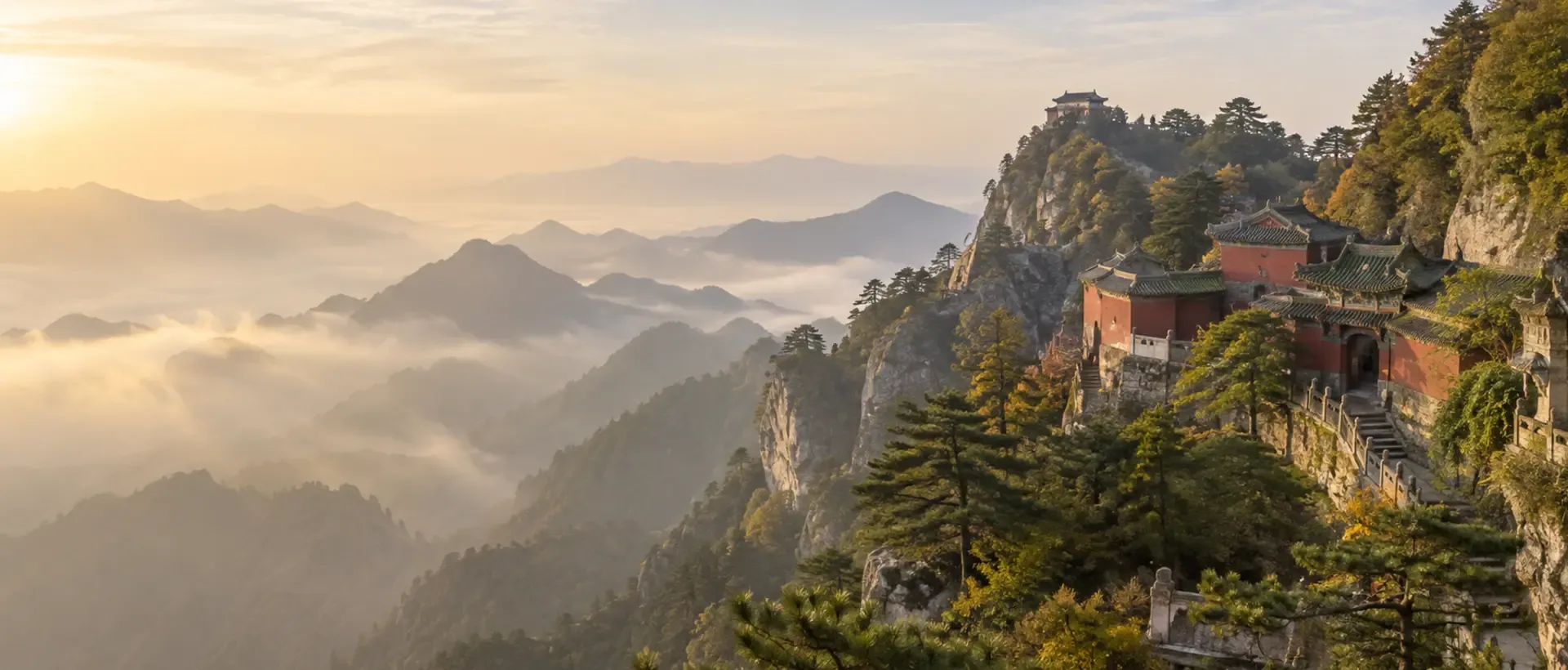
Build an understanding of Wudang’s geography, sacred sites and layers of history.
Wudang is a mountain range, a working Taoist centre and a name associated with martial traditions. Begin by understanding how those identities meet.
Get to know the mountain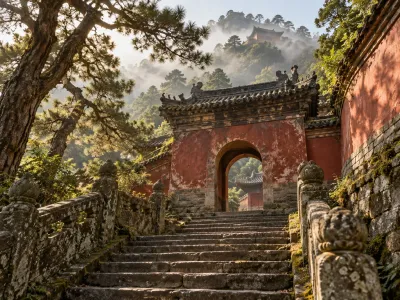
Zixiao Palace, Nanyan Palace and the Golden Hall offer distinct starting points. Locate them and explore how their architecture and histories relate to the mountain.
Explore Wudang’s sacred sites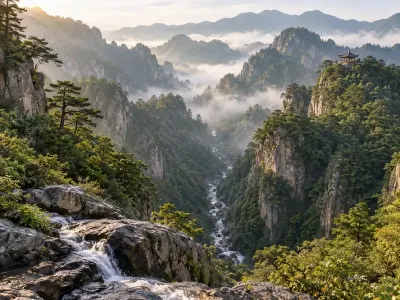
The traditional landscape catalogue is a form of cultural geography. Explore historical names alongside modern identifications and survey counts.
Read the landscape cataloguePlan the practical details and learn how to enter working temples respectfully.
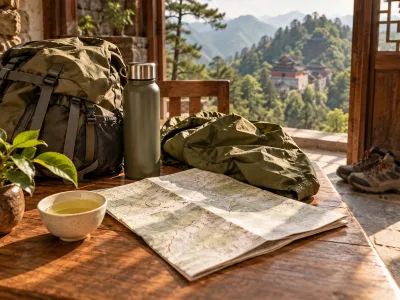
Consider transport, seasons, accommodation, food and physical demands before choosing a route. Work through the practical details that will shape your visit.
Plan your Wudang visit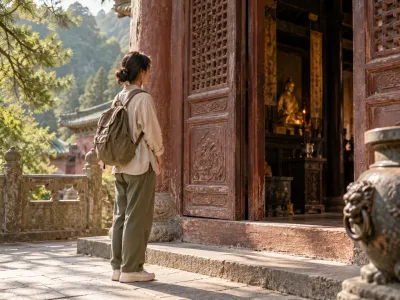
Local conventions and quiet, considerate conduct matter in working Taoist temples. Learn the context behind them before you arrive.
Read the temple etiquette guide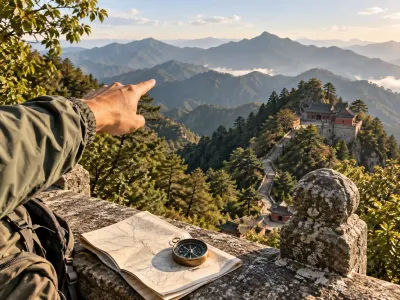
Names, temple figures, maps and suggested routes make useful companions to a visit. Find them together with further reading in one practical reference.
Open the mountain referenceConnect the mountain’s sites and cultural setting with practical preparation, respectful visiting and realistic plans for study.
Look into study at Wudang and the ordinary moments in which its culture is lived.
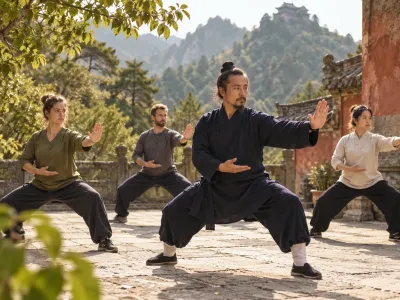
Daily training and living arrangements shape a period of study. Understand what to look into and which questions to ask when evaluating a school.
Prepare to study at Wudang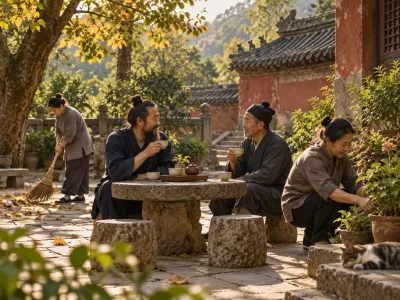
Attributed teacher reflections, practice scenes and ordinary moments offer a closer view of the mountain’s daily culture.
Encounter everyday WudangThe full guide
Wudang Mountain is a living cultural landscape where temples, mountain paths, Daoist practice and everyday life remain closely connected.
Wudang Mountain is a living cultural landscape where temples, mountain paths, Daoist practice and everyday life remain closely connected.
Before choosing temples or a day itinerary, use the map and route guide to understand the mountain gateways, shuttle corridors, cable cars and walking sections.
Wudang Mountain map and route guide
This part of the site is about a real place rather than a set of ideas. Everything else here discusses Taoist thought, practice and the arts largely in the abstract; this section deals with a mountain range in northwestern Hubei that you can buy a ticket to, climb, sleep on, and be rained on. The change of register is deliberate, and it is worth explaining why a website about a religion and its philosophy gives an entire branch to one piece of geography.
Wudang.Org works with Lee Wudang and Chan’s World Holidays, a company-owned franchise shop within the Chan Brothers Travel group, on selected Wudang tours offered for booking in Singapore. Lee Wudang helps shape the cultural programme and local Wudang connections; Chan’s World Holidays serves as the Singapore travel and booking operator for the advertised itinerary.
Departure dates, availability, itinerary, prices, inclusions, booking conditions, cancellations and refunds are governed by the specific tour offer and the travel operator’s terms. Unless a programme page expressly says otherwise, Wudang.Org provides cultural orientation and pre-journey guidance but does not itself issue travel bookings.
Because Wudang is where the rest of this site becomes visible. Ideas that are hard to hold onto from reading acquire physical form here. The deities stop being names in a list and become seated figures in halls with their titles written over the door. The liturgy stops being a described procedure and becomes something chanted at fixed hours in a cold hall, whether or not any visitor is listening. The relationship between landscape and cosmology stops being a metaphor and becomes a set of decisions about where buildings were put, which way they face, and what you have to walk past to reach them. And the martial tradition that brought a large share of Western readers to Taoism in the first place claims this mountain as its home, which means the claim can be examined on the ground rather than argued about in the abstract.
A visit also supplies a corrective that books rarely give. Taoism read at a distance can look purely philosophical: a literature of paradox, water imagery and pleasant vagueness about nature. Wudang shows the institutional reality underneath. This is a religion with ordained clergy who have residence papers, with property and maintenance budgets, with a state to negotiate with, with rules about who may enter which building, with a ticketing system, and with a very long history of imperial politics baked into its architecture. Both pictures are accurate. The second is much harder to obtain from reading, and it changes how the first one sounds.
Wudang is a physical mountain range whose UNESCO-listed Ming architecture was shaped around the cult of Zhenwu; it is also a working Daoist centre and a name used for several martial traditions. These meanings meet on the ground, but they are not interchangeable. Begin with An Introduction to Wudang Mountain to separate them before moving into temples, travel planning, training and etiquette.
Wudang is not one peak but a range, administratively inside Shiyan municipality in northwestern Hubei, with the Danjiangkou reservoir immediately to the north. Traditional descriptions count seventy-two peaks, thirty-six cliffs and twenty-four streams; the figures are conventional rather than surveyed, and their point is to say that the place is large and articulated, not to be counted. The high point is Tianzhu Peak, the Pillar of Heaven, at roughly sixteen hundred metres, and the Golden Hall stands on top of it.
The older name of the range was Taihe, Supreme Harmony. Under the Ming it was formally elevated and styled a Great Peak, which placed it above the ancient Five Marchmounts in imperial ranking. That promotion was not a compliment paid to scenery. Yongle had taken the throne from his nephew by force and needed a patron deity whose approval could be displayed; Zhenwu, a northern martial deity, suited an emperor whose power base was in the north and whose legitimacy needed supernatural endorsement. The building programme is, among other things, a very expensive political argument.
Practically, the site has a shape you should understand before you go. There is a town at the foot, a controlled entrance, an internal transport system, a principal axis of major halls climbing towards the summit, and a set of outlying palaces and temples that sit off that axis and are correspondingly quiet. Almost every planning decision you make is really a decision about how much of the axis you cover and whether you leave it.
Three editorial decisions are worth stating in advance, because they explain why this section reads differently from most travel writing about Wudang.
No prices, timetables or journey times are quoted anywhere. They change, and figures published online are routinely years out of date, which makes them worse than no figure at all because they are trusted. What is described instead is structure: how charging is layered, how the transport stages fit together, which costs are unavoidable and which are optional, what the seasons do to crowding and weather. Structure stays stable for years and is what you can actually plan around. When you need a number, get it on the day from the operator.
The account is honest about the difficult parts. That means saying plainly that a great deal of what you see is reconstruction, that some of it is recent, that the mountain lost buildings to fire, neglect and the twentieth century, that the commercial layer is heavy in places, that a proportion of martial arts schools are weak or dishonest, and that some famous stories do not survive historical examination. None of that is a reason not to go. It is a reason to go with accurate expectations, which is the difference between disappointment and interest.
The tone is descriptive rather than promotional. This section does not tell you that the mountain will change your life, and it does not use the language of spiritual tourism. It tries to tell you what is there, why it is there, what it means to the people who use it, and how to behave.
Four sorts of reader, with different needs, and the pages are written so that each can skip what does not apply.
The visitor who has a few days and wants to see the place properly, and who needs orientation, sequence and etiquette more than history. The prospective student, who needs a realistic account of what the schools teach, how to evaluate one, and what daily training and living conditions are actually like. The reader with an interest in Chinese religion or architecture, who wants to know what the buildings were for, how the cult of Zhenwu works, and what survives from which period. And the reader who will never travel there but wants the concrete counterpart to the ideas discussed elsewhere on the site, because reading about ritual without any sense of the room it happens in produces a distorted picture.
Six groups of pages, arranged so that you can read the introduction and then go directly to whichever part you need.
Introduction — the mountain's history, the Zhenwu cult, the Ming programme, and what happened to the site in the twentieth century.
Temples and sites — the central route, the outlying palaces, and how the layout and architecture work.
Planning a visit — getting there and around, tickets, costs and seasons, accommodation and food, fitness, access and safety.
Studying at Wudang — what the schools teach, how to choose one, and what training is really like.
Temple etiquette — what a working temple is, conduct inside the halls, and dealing with people and money.
Practical reference — names and terms, identifying the figures you will see, itineraries, and further reading.
It is not a guidebook in the ordinary sense, because it carries no figures and no listings, and it will not tell you which hotel to book. It is not a directory of schools, and it names none as recommended; what it gives you instead is a method for assessing one, which is more durable than any endorsement. It does not defend the traditional origin stories of Wudang martial arts, and it does not attack them either; it separates what is documented from what is asserted and says which is which. And it cannot replace the rules of an individual temple, which are set locally and may be stricter than anything described here. Where a notice on a door contradicts this site, the notice is right.
Sources and limits. The historical material here rests on the standard scholarship on the Ming building campaign, the Zhenwu cult and Chinese sacred mountains, together with the site's own inscriptions and published conservation records. The practical material rests on how the site is organised rather than on quoted figures. Access arrangements, opening of individual halls, transport stages and school circumstances all change, and the martial arts genealogies in particular are contested; where evidence is thin or disputed, the pages say so instead of choosing a side.
This section covers an actual place, not a body of ideas, and it is the point where the rest of the site becomes physical.
For the distinction between Wudang as a mountain, a Daoist centre and a martial-arts name, begin with An Introduction to Wudang Mountain.
The Ming campaign from 1412 was a political act as much as a religious one, endorsing an emperor who had seized the throne.
No prices, timetables or journey times are quoted, because structure lasts and numbers do not.
The account is deliberately honest about reconstruction, difficulty, commerce and weak schools.
It is written for visitors, prospective students, readers interested in religion and architecture, and readers who will never go.
It offers a method for evaluating schools rather than recommendations, and a local temple's own notices always override it.
For heritage context, consult UNESCO’s Ancient Building Complex in the Wudang Mountains entry and our guide to what UNESCO inscribed and why. Confirm current visitor arrangements with the relevant operator before travelling.