A path into the reading
Sound & Energy Practices
Ritual, attention and modern wellbeing, presented with cultural context and clear evidence limits.
Start here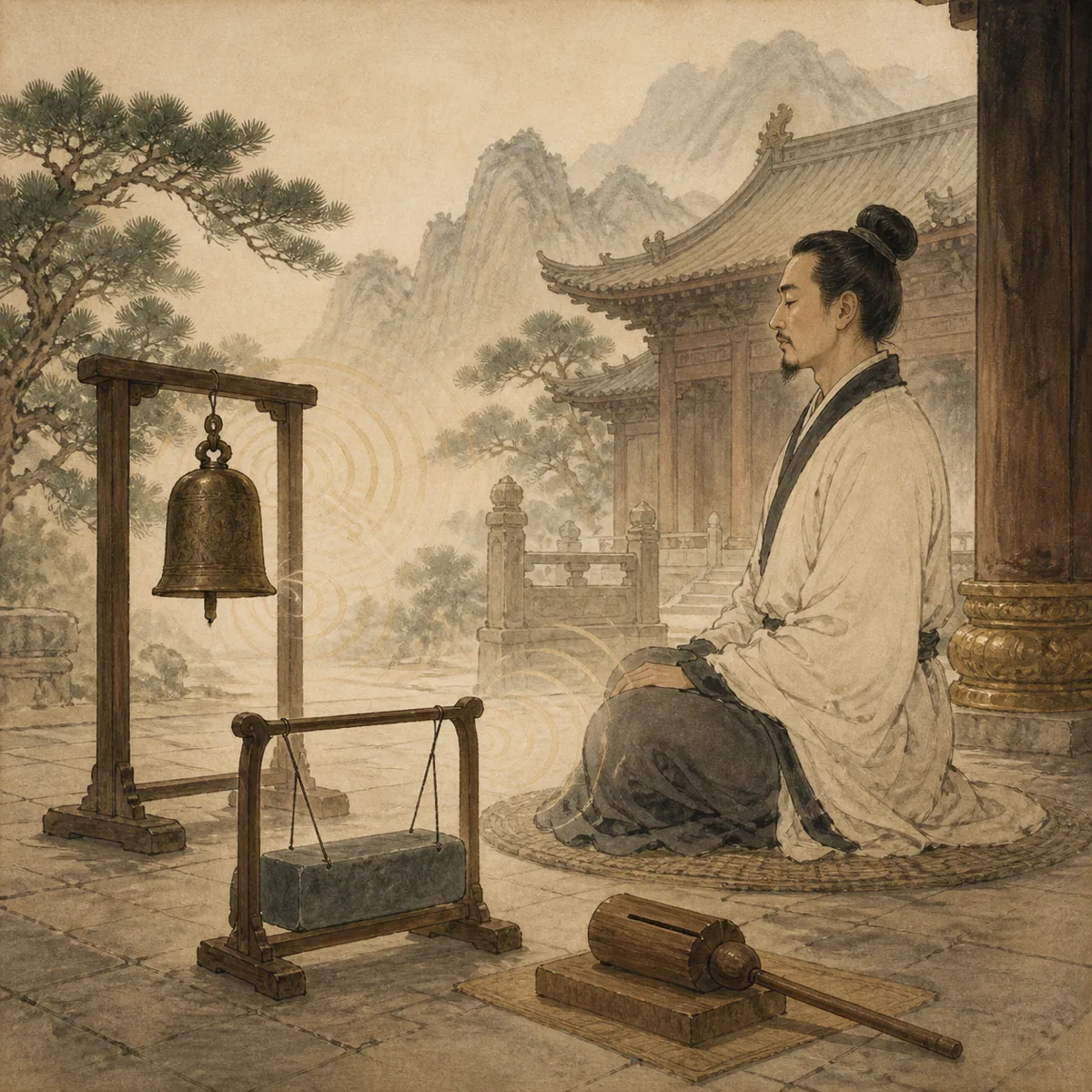
01 Find your bearings
The Taoist Sound Tradition
Bells, the guqin and chant on Wudang Mountain
Explore this section
02 Explore the subject
A Session: What to Expect
What actually happens in a sound or energy session
Explore this sectionGo further
Deeper reading
- The Taoist Sound TraditionBells, the guqin and chant on Wudang Mountain
- Sound Baths & InstrumentsSinging bowls, gongs and the modern sound bath
- Forms of Energy WorkFrom qi cultivation to hands-on practices
- A Session: What to ExpectWhat actually happens in a sound or energy session
- How It Works & the EvidenceReal relaxation, honest limits
- Getting Started & Further ReadingHow to try it, and where to learn more
The full guide
What should I know before reading further?
This is the newest of the four areas in this section, and its modern forms require the clearest separation between documented history, personal experience and clinical evidence. Some practices have genuine Chinese or Taoist contexts; others developed elsewhere and later entered an Asian or wellbeing setting.
Read more The complete guide
This is the newest of the four areas in this section, and its modern forms require the clearest separation between documented history, personal experience and clinical evidence. Some practices have genuine Chinese or Taoist contexts; others developed elsewhere and later entered an Asian or wellbeing setting.
These pages describe what the practices involve, trace their histories, and mark the limits of current evidence. Careful distinction is not dismissal: people may value relaxation, ritual, attention and community without turning them into unsupported medical claims.
What falls under this heading
The category is loose and commercially defined rather than traditional. In practice it covers sound work, using gongs, singing bowls, tuning forks, chanting, and recorded frequencies; hands-on or hands-near energy work, including external qi therapy, reiki, and various forms of therapeutic touch; and a range of practices involving crystals, colour, and claimed biofields.
These have quite different histories. Chanting and ritual sound have a genuine and documented place in Chinese religious practice going back many centuries. External qi therapy is Chinese and old in concept though its modern form dates from the twentieth century. Reiki is Japanese and dates from the 1920s. Singing bowls in their therapeutic use are largely a Western invention of the last fifty years. Crystal healing is Western and modern.
Grouping these together is a marketing decision, not a traditional one, and it obscures the fact that they have almost nothing in common except the vocabulary now used to describe them.
The Chinese material that is genuine
Sound has a real place in Taoist practice. Ritual chanting of scriptures is central to temple liturgy and has been for well over a thousand years. Ritual music using specific instruments accompanies ceremonies. The six healing sounds are a documented health practice from at least the sixth century.
Recitation of divine names and formulas is a standard devotional and apotropaic practice. Sound is understood in the ritual context as efficacious, capable of summoning, dispersing, purifying, and communicating.
What none of this constitutes is a therapeutic sound system in the modern sense. Ritual efficacy and clinical treatment are different claims, and the modern sound healing session is not a continuation of temple liturgy however much its promotional language implies otherwise.
Where the modern practices came from
Therapeutic sound work in its current form assembled in the West from the 1960s onward. Himalayan metal bowls, which are the signature instrument, were domestic vessels rather than ritual or therapeutic objects, and their use in sound healing dates from Western enthusiasm in the 1970s.
Claims about specific frequencies corresponding to organs, emotions, or spiritual states are twentieth-century inventions with no traditional basis in any Asian culture. The commonly cited frequency sets, including the solfeggio numbers, originate in modern speculative writing and do not appear in any historical source.
Reiki was developed in Japan in the 1920s and reached the West via Hawaii. It is not Chinese, not Taoist, and not ancient, though it is frequently offered alongside material presented as such.
This history is not a secret and is easily checked. It is nonetheless routinely misrepresented, and a practice presented as a five-thousand-year tradition when it is fifty years old should raise questions about what else is being asserted casually.
What the evidence shows
For sound-based relaxation practices, there is a small body of research finding reductions in self-reported stress, anxiety, and tension after sessions. The studies are generally small, uncontrolled or poorly controlled, and rely on subjective outcomes measured immediately afterwards.
The most plausible explanation is straightforward: lying still in a quiet room for an hour, in a comfortable position, with continuous non-demanding sound and no obligations, is relaxing. That would be expected to reduce self-reported tension whatever the instruments were.
For energy-based practices, the evidence is weaker. Better-controlled studies of external qi and of therapeutic touch have not produced replicable effects, and where effects appear they tend to disappear when recipients do not know whether treatment is being given.
For crystals, colour therapy, and specific frequency claims, there is no credible supporting evidence and no plausible mechanism.
The word energy, and what it is doing
A large part of the confusion in this field comes from one word carrying two incompatible meanings at once.
In physics, energy is a precisely defined quantity, conserved, measurable, and expressible in specific units. In this field, energy means something like vitality, presence, mood, or an unspecified influence passing between people. These are entirely different concepts sharing a name.
The confusion is productive for anyone making claims, because the everyday sense is unobjectionable — people do affect each other's mood, and the phrase good energy in a room describes something real — while the physical sense borrows scientific authority. A claim can slide between the two, being defended in the weak sense and asserted in the strong one.
The test that separates them is simple. Can it be detected by an instrument, or by a person who does not know when it is being applied? Anything meeting that standard is energy in the physical sense. Anything that does not is energy in the metaphorical sense, which is fine as long as nobody claims otherwise.
The same problem affects vibration, frequency, and resonance, all of which have exact technical meanings that the popular usage does not respect. When a session is described as raising your vibration, no quantity is being specified and no measurement is implied.
Why people report benefit anyway
This deserves a proper answer rather than a dismissal, because the reports are genuine.
Deep rest is genuinely uncommon in most people's lives, and an hour of it produces real effects. Sustained attention on sound is a meditative practice whether or not it is described as one. Being attended to by someone whose whole focus is on you is a rare and affecting experience. Expectation produces measurable physiological changes. And the setting — quiet, dim, ritualised, set apart — is a well-established amplifier of all of these.
None of this requires energy to be transmitted or frequencies to be therapeutic. The effects are real and their causes are ordinary, which is a different thing from saying they are imaginary.
Where this becomes a problem
The practices themselves are largely harmless. The problems arise from what is claimed and from what people do as a result.
Claims to treat disease. Where these lead someone to delay or forgo effective treatment, the harm is serious and documented in other alternative modalities.
Diagnostic claims. Practitioners who say they can detect illness by sensing a person's field are making a testable claim that has been tested and has failed.
Cost. These sessions are frequently expensive, and packages sold on the basis of accumulating benefit have no evidential support.
Emotional vulnerability. People come to these practices at difficult times, which is precisely when confident claims are least likely to be examined.
How to engage with it sensibly
If you find a sound session restful, that is a real benefit and a sufficient reason to attend one. Enjoying something does not require a mechanism.
What is worth avoiding is accepting the explanatory framework because the experience was pleasant. The experience being good is not evidence that the account of why it is good is correct.
Practical questions help. Does the practitioner claim to treat conditions? Do they ask about medical care and encourage it? Are prices and commitments clear? Do they respond to a question about evidence with an answer or with a reframing?
Wudang and this material
Sound work is offered at and around Wudang, and it is worth being clear about what the connection actually is.
Genuine Taoist ritual music exists on the mountain and is performed in temple ceremonies. It is not a therapy and is not offered as one. Visitors who hear it are hearing liturgy.
Separately, sessions using bowls, gongs, and similar instruments are available in the tourist economy around the mountain, as they are in almost every destination with a spiritual reputation. These are modern offerings using a modern format, and their presence at Wudang reflects visitor demand rather than local tradition.
Neither of these facts is discreditable. The problem arises only when the second is presented as the first, which happens often enough to be worth mentioning.
Key points
This category is commercially rather than traditionally defined and groups practices with entirely different origins.
Ritual chanting and the six healing sounds are genuinely old Chinese practices; therapeutic sound healing as sold today is not their continuation.
Singing bowls as therapeutic instruments, specific healing frequencies, and reiki are twentieth-century in origin.
Evidence supports short-term relaxation, best explained by rest, attention, and setting rather than by sound properties.
External qi and therapeutic touch have failed under proper controls, and crystal and frequency claims have no support.
Enjoying a session is a sufficient reason to attend one and is not evidence that the explanation offered is correct.
Recommended next page
Where next?
Sound Baths & InstrumentsSinging bowls, gongs and the modern sound bathA few alternatives