A path into the reading
Chinese Physiognomy: Face Reading, Palm Reading and Their Limits
How traditional xiangshu interprets appearance—and why its claims require care
Start here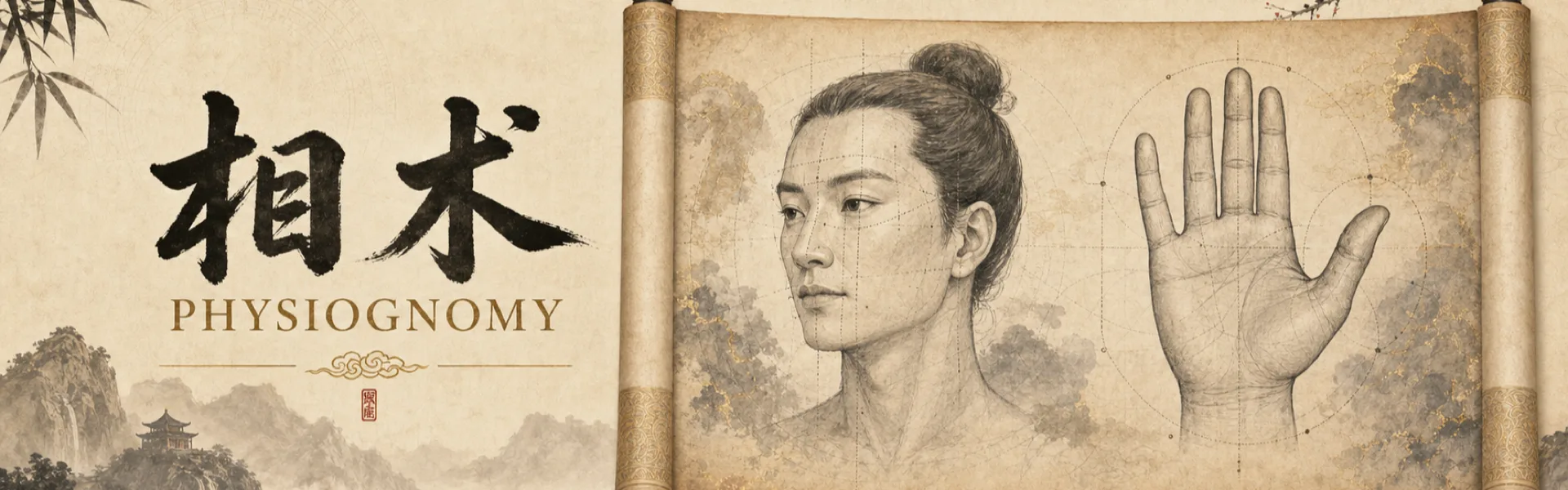

01 Find your bearings
Origins and History of Chinese Physiognomy
From early face-reading traditions and classical criticism to later manuals and palmistry
Explore this section
02 Explore the subject
Chinese Physiognomy in Practice Today: Readings, Apps and Risks
Where face and palm reading appear now, how sessions work, and where harm can arise
Explore this section
03 Keep reading
Chinese Physiognomy: Primary Sources and Further Reading
Classical texts, historical records, modern scholarship and empirical research
Explore this sectionGo further
Deeper reading
- Origins and History of Chinese PhysiognomyFrom early face-reading traditions and classical criticism to later manuals and palmistry
- Chinese Face Reading (Mianxiang): Methods, Meanings and LimitsHow traditional physiognomy maps facial regions—and where interpretation becomes assumption
- Chinese Palm Reading (Shouxiang): Traditions, Methods and LimitsHow older Chinese hand-reading ideas blended with modern Western palmistry
- Chinese Physiognomy in Practice Today: Readings, Apps and RisksWhere face and palm reading appear now, how sessions work, and where harm can arise
- How to Interpret Chinese Physiognomy ResponsiblyHistorical context, consultation practices, cultural value and ethical limits
- Chinese Physiognomy in History, Literature and Everyday CultureHow face reading shaped historical narratives, opera, fiction, language and social judgement
- Chinese Physiognomy: Primary Sources and Further ReadingClassical texts, historical records, modern scholarship and empirical research
The full guide
What should I know before reading further?
Physiognomy is the traditional art of reading a person's character and fortune from the features of the body, above all the face and the hand. In Chinese it is xiangshu (相术), the art of examining appearances, and it belongs to the same family of words as reading a site for a house (风水) or appraising an object: in each case, looking at the outside in order to know the inside. It has long been among the most familiar forms of Chinese divination, practised in temple courtyards and market streets as much as in scholars' studies. Where date selection reads the qualities of time, and BaZi and Zi Wei read the moment of birth, physiognomy claims to read the person directly.
Read more The complete guide
Physiognomy is the traditional art of reading a person's character and fortune from the features of the body, above all the face and the hand. In Chinese it is xiangshu (相术), the art of examining appearances, and it belongs to the same family of words as reading a site for a house (风水) or appraising an object: in each case, looking at the outside in order to know the inside. It has long been among the most familiar forms of Chinese divination, practised in temple courtyards and market streets as much as in scholars' studies. Where date selection reads the qualities of time, and BaZi and Zi Wei read the moment of birth, physiognomy claims to read the person directly.
What physiognomy tries to do
The working assumption is that a person's inner nature leaves legible traces on the surface of the body, and that the reading of those traces can be codified, written down and transmitted. From this follows the whole apparatus: divisions of the face into regions, each governing a domain of life; classifications of eyes, noses, mouths and ears into types; systems of lines on the palm, each with an assigned meaning.
Two claims are being made at once, and they are worth separating because they are not equally strong. The weaker claim is that appearance reveals something about a person's present condition — their health, their occupation, their habitual mood. The stronger claim is that appearance reveals a person's moral character and predicts the course of their life. The first is partly true and unremarkable; the second is the actual content of the tradition, and it is the one that fails.
One thing that must be said first
The central claim of this art — that a person's character, ability and prospects can be judged from their face — is not supported by reliable evidence, and it has been used repeatedly to justify treating people badly.
The traditional literature is full of moral verdicts on appearance. A certain shape of eye is called treacherous; a certain nose, mean; a certain configuration of features in a woman, unchaste. These judgements were not abstract. They were used to decide marriages, hiring, and whether a person could be trusted, and the harm they did was real and fell on people who had no way to answer it.
Because of this, these pages present physiognomy as cultural history and as a psychological phenomenon. They do not present it as a method for assessing anyone, and this site does not endorse judging any individual by their appearance. That position is stated at the outset rather than buried in a later assessment, because on this particular subject the qualification is not a footnote.
The layer that can be explained
One layer of observation within the tradition does hold up, and it deserves acknowledgement.
Expression, posture, gaze and the movements of the face while speaking do convey mood, health and habit. This is common knowledge and has partial support in modern psychology. Chinese medicine's diagnostic looking (望诊) — examining complexion, the colour of the lips, the eyes and the tongue — is an observational tradition with genuine clinical content, and it shares part of its vocabulary with physiognomy. Jaundice, anaemia, thyroid disease, prolonged malnutrition and heavy drinking all leave visible signs. Calluses, deformed knuckles and the texture of the skin tell you what kind of work a person does. Deep lines form where a face has habitually been held in a particular expression.
Experienced readers are often genuinely observant people, and it would be foolish to deny it. The failure comes at the next step: taking information that is visible now and extending it into a claim about wealth, rank and fate across a whole life. Nothing in the first supports the second.
The layer that is pure convention
The rest of the system has no such foundation. Face reading divides the face into twelve palaces, thirteen positions, three courts and five features, and assigns to each a domain: this region governs wealth, that one children, another one lifespan. Palmistry names one crease the life line and another the career line, and reads length as duration.
These correspondences have no verifiable source. Different schools assign them differently and contradict one another, and no systematic study has ever been done to check any of them. They appear convincing for a reason that has nothing to do with their truth: a face carries so many features that some subset can always be selected to match whatever is already known about the person. The flexibility of interpretation, not the accuracy of the rules, is doing the work.
Why it feels accurate
A reading is almost never just an inspection of a face. The person being read talks, reacts, and shows expressions, and the reader adjusts continuously in response. Descriptions are typically phrased in broad terms that most people can recognise in themselves — the effect demonstrated by Bertram Forer in 1949 and named after Barnum.
This is not a mechanism peculiar to fraud. It operates in every face-to-face reading whether or not anyone intends it, and a completely sincere practitioner will produce it. Memorable hits are retained and misses forgotten; the reader's real perceptiveness gets credited to the system rather than to the reader. The feeling of accuracy is generated by the encounter, not by the doctrine.
The two branches
The tradition divides into two principal arts, treated separately in this section.
Face reading (面相, mianxiang) interprets the shape of the face, the placement and proportion of the features, and the marks, lines and colouring of the skin, mapping these onto temperament and the course of a life. It is the older and more elaborate of the two, and it carries most of the moral vocabulary.
Palm reading (手相, shouxiang) interprets the lines, mounts and shape of the hand. It is the branch most familiar to Western readers, because European palmistry developed a broadly similar scheme, and the two traditions have influenced each other in the modern period to the point where popular Chinese palmistry books often contain material of European origin presented as ancient.
Related practices — reading the bones, the voice, the gait, the back — appear in the literature but are far less commonly practised today.
Its division of labour with fate calculation
BaZi and Zi Wei Dou Shu calculate from birth time; physiognomy reads the body. In the tradition these were frequently practised by the same person, and it is common for a practitioner to consult both.
The bases are entirely different, however, and this creates a problem the tradition never resolved. When a chart and a face give conflicting readings, no rule decides between them. In practice the reader decides, which means the conclusion came from the reader's judgement rather than from either system — the same structural feature described on the BaZi and Zi Wei pages.
There is also a difference in principle worth noting. A chart is fixed at birth and cannot be altered. A face changes, and the tradition acknowledges this: a well-known strand of physiognomic thought holds that appearance follows the heart, so that a person's conduct over time reshapes their features. That idea sits awkwardly with the claim that a face reveals a fixed destiny, and the literature never quite reconciles the two.
The European parallel, and where it led
Physiognomy is not distinctively Chinese. Europe developed its own, from the classical period onwards, and in the nineteenth century it took a turn that ought to be part of any honest account of the subject.
Phrenology proposed that mental faculties could be read from the shape of the skull. Cesare Lombroso's criminal anthropology proposed that criminals constituted a biological type identifiable by physical features. Both were presented as sciences, both accumulated impressive-looking data, and both were wrong. Their practical consequence was not academic: they supplied the vocabulary and the apparent authority for racial hierarchy, for eugenics, and for the treatment of whole populations as biologically defective.
The Chinese tradition did not produce a Lombroso, and the comparison should not be pushed further than it goes. But the underlying claim is the same claim — that visible physical form reveals inner moral quality — and the European case shows with unusual clarity what that claim licenses when it is taken seriously by people with power.
The same claim in modern dress
The idea has not gone away; it has been re-equipped. Papers have periodically appeared claiming that machine learning models can infer criminality, sexual orientation or trustworthiness from photographs of faces, and they attract wide coverage.
These claims have been examined and do not survive scrutiny. The standard findings are that such models detect artefacts of how the photographs were produced rather than anything about the faces: the criminality studies used official identity photographs for one group and ordinary photographs for the other, so the models learned to distinguish photograph types, expression and grooming. Where confounds are controlled, the effects disappear.
The important point is not that the technology is immature. It is that a claim which fails as folk tradition does not become true when it is restated with a neural network, and that the applications proposed for it — screening job applicants, assessing suspects, scoring loan risk from a photograph — would inflict the same harms as the older version, at greater scale and with a more convincing appearance of objectivity.
Where the harm actually falls
It is worth being concrete about who gets hurt, because in the abstract this can seem harmless.
People are refused work because an employer or a consulted reader disliked their features. Marriages are blocked because a prospective bride was said to carry a face that harms her husband — a judgement made about women far more often than about men, and one that has caused a great deal of quiet misery. Children are labelled early with verdicts they cannot escape. People with facial differences, scars, asymmetries or conditions affecting appearance carry an additional and entirely undeserved burden in any culture where this art is taken seriously.
None of these people can appeal the judgement, because there is nothing to appeal to. That asymmetry — the reader's verdict costs the reader nothing and the subject everything — is the reason this particular art requires a firmer warning than the others in this section.
How to read this section
The pages that follow describe the system accurately: its history, its categories, its methods and its literature. Describing something accurately is not endorsing it, and the description is worth having, because this material is deeply embedded in Chinese literature, opera, fiction and everyday idiom, and a reader who does not know it will miss a great deal.
What these pages will not do is provide a method for assessing people. They contain no instructions for judging a face, and where the tradition's rules are set out, they are set out as the content of a historical system rather than as advice. Anyone hoping to learn to read faces in order to evaluate others will find this section unsatisfying, which is deliberate.
What this section contains
- Origins and history — the early references, the Ming compendia, and how the art became a profession.
- Face reading — the palaces, the positions, the classification of features, and the vocabulary this produced.
- Palm reading — the lines and mounts, and the entanglement of Chinese and European palmistry in the modern period.
- Physiognomy in practice — how a reading is actually conducted, and what is happening during one.
- An honest assessment — what the evidence shows, why readings persuade, and where the practice does damage.
- Key sources and further reading — primary texts, scholarship, and books to treat with caution.
Key points
- Physiognomy reads character and fortune from the body, chiefly the face and the hand; in Chinese it is xiangshu, the art of examining appearances.
- Its central claim — that appearance reveals character and predicts a life — has no reliable evidential support.
- It has repeatedly been used to justify discrimination in marriage, employment and trust, and the resulting harm was real.
- One layer does hold: expression, complexion and the hands genuinely indicate mood, health and occupation, as in Chinese medical diagnosis.
- The failure is the step from present condition to lifelong fate, which nothing in the first observation supports.
- The palaces, positions and palm lines are convention: schools contradict each other and no systematic test has been made.
- Readings feel accurate because of interaction, flexible interpretation and the Forer effect, not because the rules work.
- Europe developed the same idea, and in phrenology and criminal anthropology it supplied vocabulary for racism and eugenics.
- Modern claims that machine learning can read criminality or character from faces fail on examination, detecting photographic artefacts.
- These pages describe the system as cultural history and do not offer it as a method for judging any person.
Recommended next page
Where next?
Chinese Face Reading (Mianxiang): Methods, Meanings and LimitsHow traditional physiognomy maps facial regions—and where interpretation becomes assumptionA few alternatives