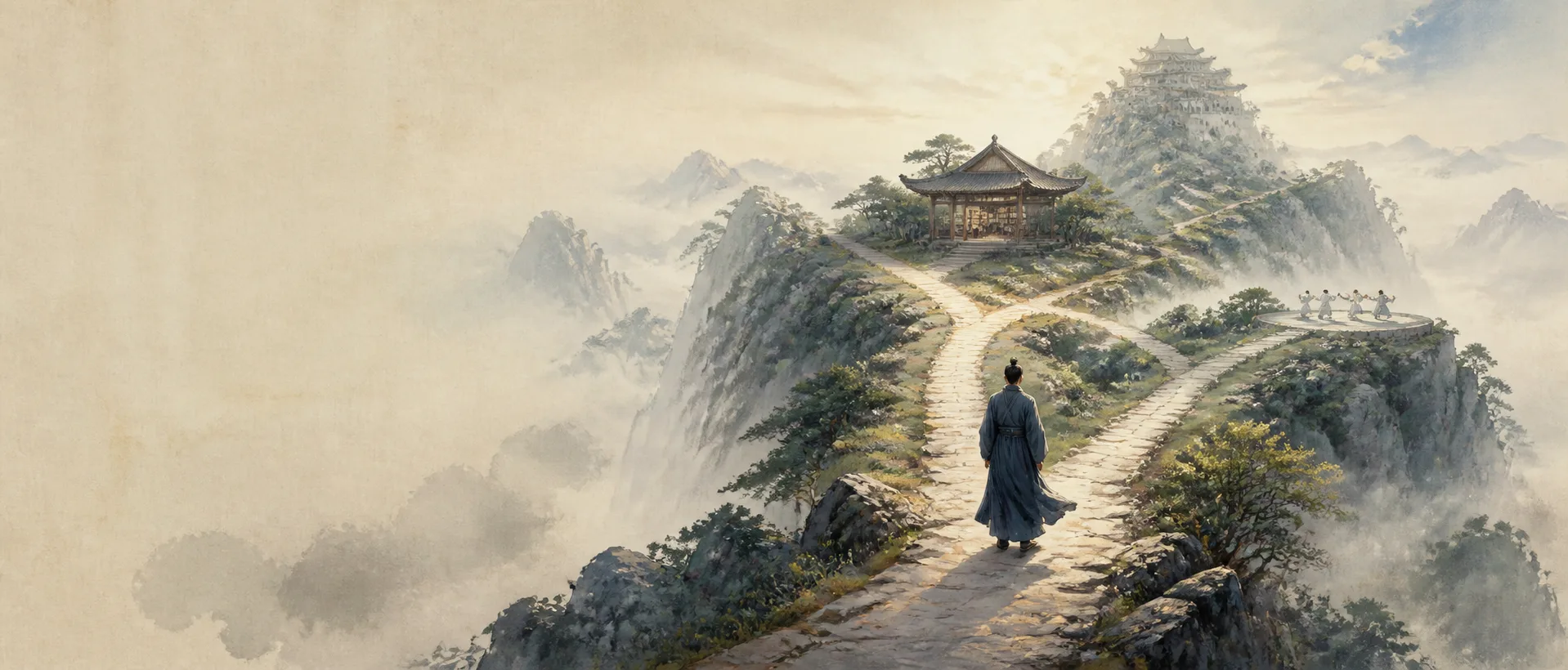
The Tao points to the way life unfolds through relationship, change, return and balance. The Tao Te Ching, Zhuangzi and other classical works approach these questions from different directions: how to act without excess, how to loosen fixed viewpoints and how to remain responsive when circumstances change.
Wudang.Org presents these ideas in clear language, close to the texts and connected to living practice. You do not need a background in Chinese philosophy to begin. Start with a simple introduction, follow a guided reading path or enter through the classic that speaks to you.
Tao: The Source of All Things
“The Tao gives rise to One. One gives rise to Two. Two gives rise to Three. Three gives rise to the ten thousand things.”
Tao Te Ching (Dao De Jing), Chapter 42 — draft Wudang.Org translation
This is an image of unity unfolding into the richness of life. It invites us to see individual things within the relationships and patterns that allow them to arise, change and return.
Later Chinese traditions describe change through yin and yang, the Five Phases and the relationship of Heaven, Earth and humanity. These frameworks are not identical, yet they share an attentiveness to connection, timing and transformation. This is the conceptual ground from which Wudang philosophy, martial arts, wellness, the literati arts and Yi studies can be understood together.
Choose a Way to Begin
Tao Te Ching — Enter eighty-one brief chapters on the Tao, simplicity, strength, governance, desire and the movement of return.
Zhuangzi — Meet a world of humour, transformation, skilled action and shifting perspectives that opens the mind beyond fixed positions.
Taoist Philosophy — Understand the central ideas: Tao, de, ziran, wu wei, yin and yang, simplicity, return and the limits of naming.
Wu Wei & Natural Living — Learn how responsive action, good timing and fewer unnecessary interventions can bring greater ease and effectiveness.
A Taoist View of Life — Reflect on change, sufficiency, softness, perspective and the value of leaving room for life to unfold.
Read the Classics
The Classical Library brings complete collections and guided reading paths into one place. Read the Tao Te Ching chapter by chapter, explore the sixty-four patterns of the I Ching (Yijing), enter the stories of the Zhuangzi and discover the eight chapters of the Liezi. Each collection keeps the source text, historical setting and modern reflection clearly related without treating every work as though it teaches the same thing.
Enter the Classical Library
From Understanding to Practice
Taoist ideas take on another dimension through movement, breath, attention and the arts. Explore Wudang martial arts and wellness practices, or join a class, talk or reading circle that gives the texts a place in shared experience.
Taoist Thought and Taoist Culture
Taoist philosophy and Taoist religion have influenced one another across Chinese history, but they are not interchangeable. This section centres on ideas and classical teachings. For temples, deities, festivals, ritual, lineages and sacred mountains, continue to Taoist Culture.