Taoist Medicine
道家医学
Taoist medicine is used in several related ways, and it helps to distinguish their contexts before exploring how they connect.
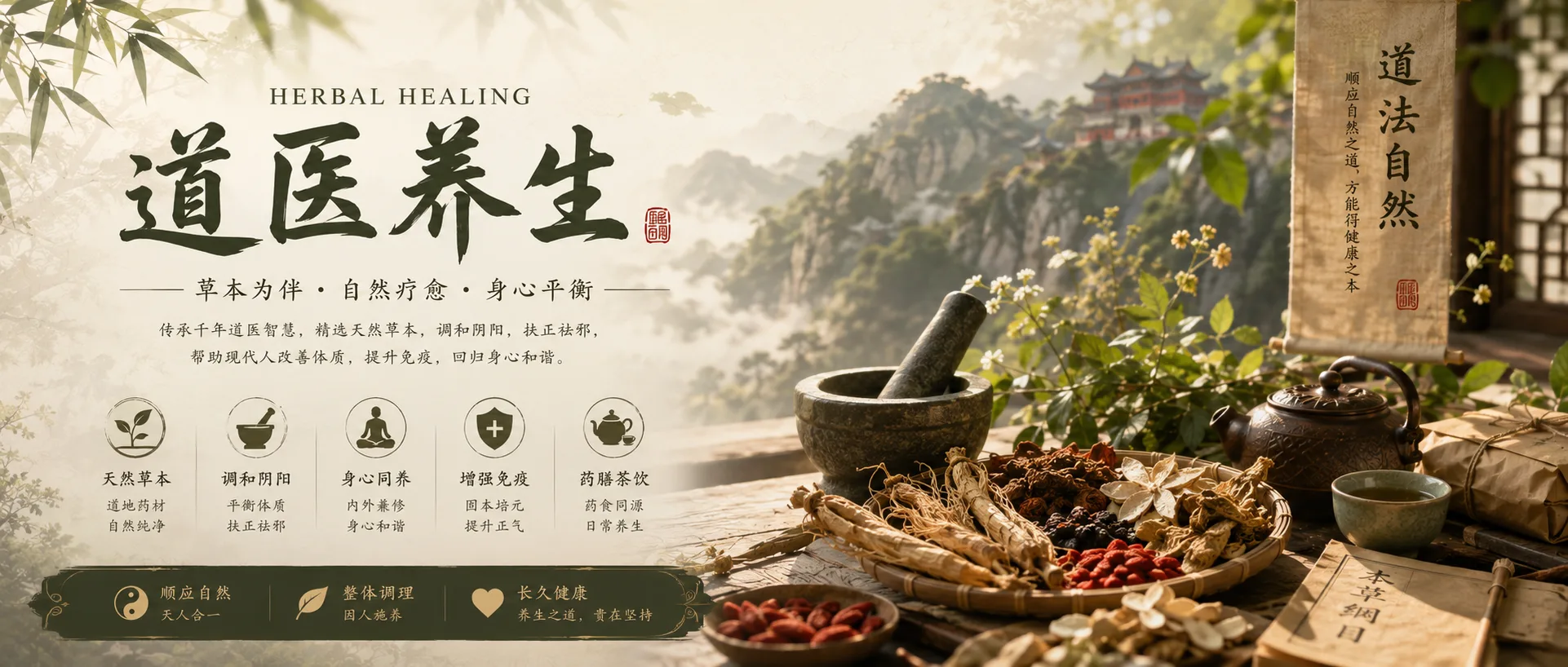
It can refer to medicine practised by Taoists, to Taoist contributions to Chinese medical thought, or to newer services assembled under that name. These pages focus mainly on the second, acknowledge the first, and examine the third carefully through historical context and evidence.
The relationship between Taoism and Chinese medicine
The two are related but not identical, and the popular assumption that Chinese medicine is Taoist medicine is not accurate.
Chinese medicine drew its theoretical vocabulary — yin and yang, the five phases, qi — from a general body of thought that was shared across Chinese intellectual culture rather than owned by any school. The Huangdi Neijing, the foundational medical text, is not a Taoist work. It uses the same cosmological terms that Taoist texts use, because those were the terms available.
Where Taoism made a specific contribution was in the cultivation tradition: the practices and theories aimed at extending life and transforming the practitioner. That tradition developed a detailed internal geography of the body, a vocabulary for internal energetics, and a set of practices that medicine later borrowed from.
The traffic went both ways. Taoist practitioners used medical theory; physicians used cultivation techniques. Separating the two cleanly is not possible and was not attempted at the time.
The body as a country
The most distinctive Taoist contribution is the treatment of the body as a landscape or a state rather than as a mechanism.
In this picture, the organs are administrative offices with functions and relationships, the channels are watercourses and roads, and the whole is governed by a ruling faculty. Some Taoist texts populate the body with resident deities, each responsible for an organ or region, who must be maintained by visualisation and correct conduct.
This sounds fanciful and is easy to dismiss. What it actually encodes is a functional and relational view of physiology: the significant thing about an organ is what it does and how it interacts with the rest, not what it looks like. That emphasis produced a medicine attentive to systemic patterns and comparatively uninterested in anatomy.
Health as a by-product of cultivation
The framing that most distinguishes Taoist medicine from ordinary medicine is that health is not the goal. It is a precondition and a side effect of a longer project.
In the cultivation literature, a healthy body is what makes practice possible. Illness interrupts the work. So the medical apparatus exists to keep the practitioner functional, in the way that maintaining a workshop serves the work done in it.
This has practical consequences that are visible in the emphasis. Taoist health practice is overwhelmingly preventive rather than curative. Diet, sleep, breathing, sexual moderation, emotional regulation, and seasonal adjustment occupy far more space than treatment of established disease.
The three treasures in Taoist medicine: jing, qi and shen
The organising concepts of Taoist internal medicine are jing, qi, and shen, conventionally rendered as essence, energy, and spirit. They are treated at length on their own page.
The short version is that they describe a hierarchy of refinement rather than three substances. Essence is the densest and most material, associated with reproduction, growth, and constitutional endowment. Qi is the active functional level. Spirit is the most rarefied, associated with awareness and mental clarity. Internal alchemy describes a process of refining each into the next.
These are not measurable quantities and no proposed physical correlate has held up. They are best read as a framework for organising observations about vitality, function, and mental state.
Preventing rather than treating
The tradition's most quoted line on this comes from the Neijing, which compares treating disease after it has developed to digging a well when you are already thirsty. The superior physician, in this account, treats what has not yet happened.
This is a genuinely valuable emphasis and one where the tradition looks good against much of medical history. The practical content — regular habits, moderate diet, adequate sleep, physical activity, emotional regulation, seasonal adjustment — is advice that modern preventive medicine largely endorses.
It also has a shadow side worth naming. A framework in which illness results from failing to live correctly can become a framework in which illness is the patient's fault. Traditional texts sometimes say this quite directly, and the modern wellness version of it is not an improvement.
Notable Taoist physicians
Several figures are cited as evidence for a Taoist medical tradition, and it is worth looking at what they actually show.
Ge Hong, writing in the fourth century, was both an alchemist and the author of an emergency medical handbook. That handbook is notably practical: it gives treatments for common conditions using cheap and available materials, explicitly because expensive prescriptions are useless to people who cannot obtain them. It is also the text that supplied the lead for artemisinin sixteen centuries later.
Tao Hongjing, in the fifth and sixth centuries, organised Taoist scriptural material and also compiled a major revision of the materia medica. He is the clearest case of one person working seriously in both domains.
Sun Simiao, in the seventh century, is often described as a Taoist physician. His medical work is enormous and largely conventional, though it includes cultivation regimens. His essay on medical ethics is his most distinctive contribution and is not particularly Taoist in content.
What these figures demonstrate is that religious and medical expertise regularly coexisted in the same person. What they do not demonstrate is a separate Taoist medical system. Their medicine was the medicine of their time, practised by men who also had religious commitments.
How Taoist and modern medicine relate
The two traditions use different explanatory languages. Modern medicine works through testable mechanisms: this happens because of a structure or process, and the explanation can be examined by intervening. Taoist medicine often works through correspondence, relating a state to a pattern, season, phase or organ system.
Correspondence-based explanation can organise experience, but it is not tested in the same way because a correspondence can be redescribed. This distinction matters when readers assess what each approach is designed to explain and what evidence can establish.
The two systems need not be treated as competing accounts of the same thing. They are different kinds of account. When practical decisions concern a sick person, safety and the evidence for better outcomes provide the clearest common ground.
What is worth taking from it
The preventive emphasis, which is sound. The attention to sleep, routine, and seasonal variation, which is sensible and increasingly supported. The insistence that mental and physical states are not separable, which modern medicine took a long time to come back around to. The framing of health as something maintained rather than restored.
These do not require accepting the metaphysics. They are practical positions that the tradition arrived at through long observation, and they can be adopted independently of the framework that generated them.
What should be held at a distance
Claims that the framework describes physical structures that exist and could be found. They have been looked for, and the search has not succeeded.
Claims that Taoist medicine can treat serious disease. There is no evidence for this and the substitution risk is real.
The modern packaging of Taoist medicine as a distinct ancient system with its own diagnostics and treatments. This is largely a recent construction, assembled from genuine materials but presented with a coherence and antiquity it does not have.
Moral interpretations of illness, which cause unnecessary suffering to people who are already unwell.
Common Questions About Taoist Medicine
Is Taoist medicine the same as traditional Chinese medicine?
No. The histories overlap, and some Taoist practitioners also worked as physicians, but Chinese medicine was never owned by Taoism. “Taoist medicine” is most useful when it identifies a particular religious setting, cultivation tradition or historical influence. It becomes misleading when used as the name of a complete rival medical system.
Does “natural” mean safe?
No. A plant, mineral or traditional preparation can have pharmacological effects, interact with medicines, be used at the wrong dose, or be contaminated or misidentified. Age alone does not establish safety. Products and procedures should be judged by their ingredients, quality control, practitioner competence, evidence and the condition for which they are proposed.
Can Qigong, breathing or nourishing-life practice replace treatment?
No. These may be studied as movement, attention, breathing or lifestyle practices, and a particular method may have evidence for a particular outcome. That does not turn the whole category into a treatment. Do not delay diagnosis, emergency care or prescribed treatment because a practice is described as traditional, energetic or preventive.
How should a reader assess a class or practitioner?
First ask what is actually being offered: cultural education, exercise instruction, a general wellness service or regulated health care. Then ask about training, scope of practice, risks, referral arrangements, fees and responsibility for the service. Guaranteed cures, instructions to stop medical treatment and vague claims that every illness reflects blocked qi are serious warning signs.
Continue With the Right Path
For the historical framework, continue with the Taoist view of the body and the Three Treasures. For grounded daily practice, read nourishing life and seasonal prevention. The page on Taoist and modern medicine explains the evidence boundary in more detail.
Qigong, standing practice and Baduanjin are covered as movement and cultivation subjects. Chinese herbal medicine has its own safety questions and should not be treated as interchangeable with them. For current educational classes and cultural programmes in Singapore, use Find a Practice and Events & Courses, and check who is responsible for teaching, registration, payment and any health-related claim.
How these pages proceed
The pages that follow take the framework in turn: how the tradition pictures the body, what the three treasures are and what work the concept does, what practices for nourishing life actually consist of, how the seasonal regimen is organised, and where the tradition sits in relation to modern medicine.
Throughout, the aim is to explain the framework accurately in its own terms while being clear about its evidential status. Explaining a system is not endorsing it, and the two are worth keeping separate.
Key points for understanding the Taoist medical tradition
The phrase covers medicine practised by Taoists, a theoretical contribution to Chinese medicine, and a modern commercial category, and these should not be confused.
Chinese medicine is not Taoist medicine; both drew on a shared cosmological vocabulary that neither owned.
The distinctive Taoist contribution is a functional and relational picture of the body as landscape or state rather than mechanism.
Health is framed as a precondition for cultivation rather than an end, which produces a strongly preventive emphasis.
The tradition explains by correspondence rather than mechanism, which is why it cannot be tested in the way mechanistic claims can.
The preventive emphasis and the mind-body integration are worth taking; the anatomical and curative claims are not.