What Is Taoism? A Map of Texts, Traditions and Practice
什么是道家与道教?经典、传统与实践地图
Daoism is not one doctrine, one book or one kind of practice. It is a long, changing family of Chinese texts, communities, rituals, arts and methods of self-cultivation organized around the dao—a word that can mean a way, path, course or guiding process. Some readers meet it through the Daodejing or Zhuangzi; others through temples, liturgy, meditation, ethical precepts or local religious life.
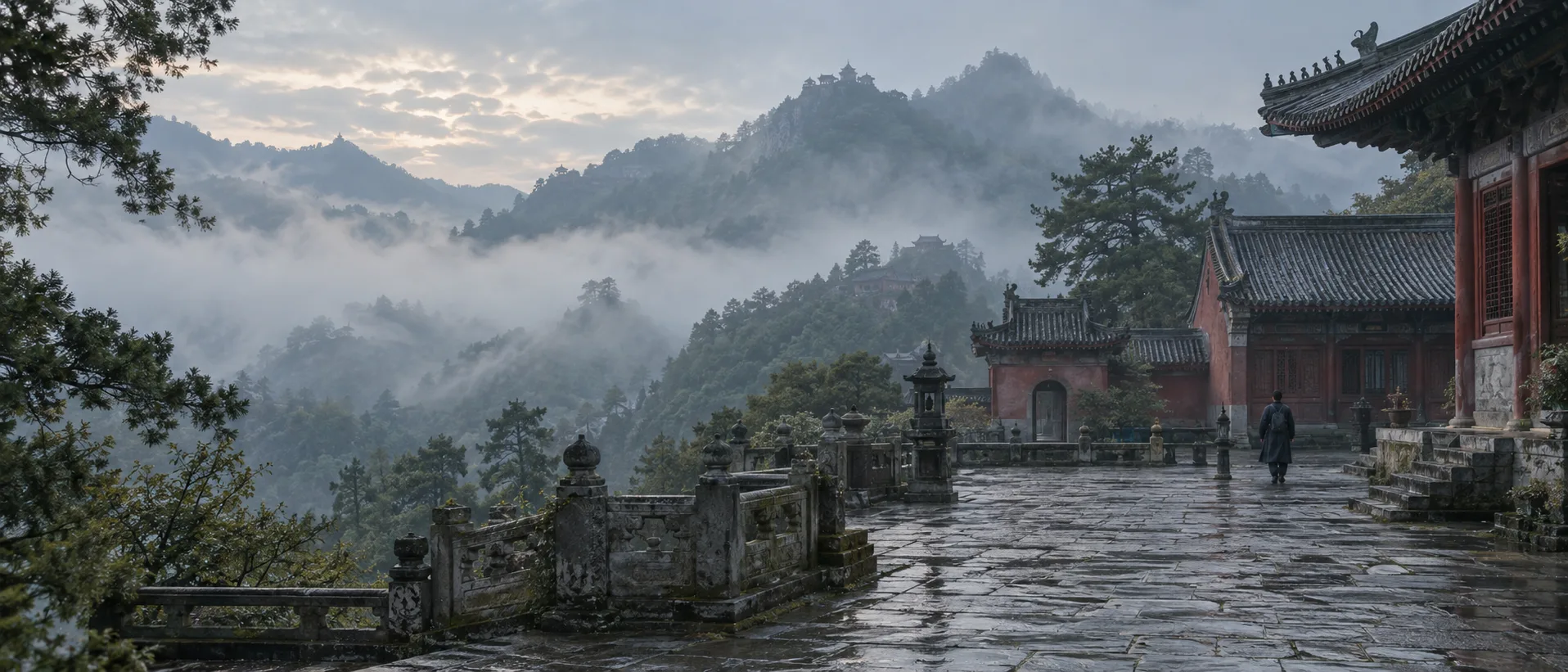
This overview offers a map rather than a definition that closes the subject. It explains why “philosophical” and “religious” Daoism can be useful labels, why they should not be treated as sealed compartments, and how Wudang fits into a much wider history. It opens the nine-part Begin with the Tao sequence.
What the name covers
Dao, Daoism and Taoism
Dao is the spelling used by the pinyin system; Tao reflects an older romanization and remains familiar in English and French. The Chinese word 道 long predates any single Daoist institution. Depending on the text and setting, it may name a road, a method, a course of conduct, the way things unfold, or the generative order that cannot be reduced to a thing.
“Daoism” is therefore an umbrella term, not a claim that every person, text or lineage says the same thing. The current Stanford Encyclopedia of Philosophy overview traces early reflection on dao through the classical period while also showing that the later category was constructed retrospectively. Translation helps us enter the subject, but no single English equivalent should be mistaken for the whole range of 道.
A family of texts, communities and practices
The family includes early works associated with Laozi and Zhuangzi, later commentaries, revealed scriptures, ritual manuals, monastic and priestly lineages, meditation, ethics, alchemy and practices of nourishing life. Not every Daoist performs every practice, and a reader influenced by one text is not automatically a member of a religious community.
Conversely, living Daoist religion cannot be reconstructed from two classical books alone. The SEP survey of Daoist religion stresses the tradition's heterogeneity and warns that modern divisions between philosophy and religion can hide relationships visible to Daoists themselves. A reliable introduction keeps literary, institutional and lived histories in view at the same time.
How the categories were made
Classical writings and Han classifications
The texts now called the Daodejing and Zhuangzi took shape over time in the late first millennium BCE. Their authorship, layers and dates remain subjects of scholarship. The received Zhuangzi, for example, is a thirty-three-chapter compilation shaped by Guo Xiang's later editing, not a simple transcript from one historical moment; the SEP entry on Zhuangzi explains those textual layers.
Han historians grouped earlier thinkers under labels such as daojia, the “house” or “lineage of the Way.” That classification helped later readers see a family resemblance, but it should not be projected backward as a single organized school with fixed membership. Categories describe history; they also participate in making the history they describe.
Communities, revelations and canons
Organized Daoist movements became especially visible in the late Han. The Celestial Masters trace their founding revelation to 142 CE and developed communities, registers, ritual offices and rules. Later traditions such as Shangqing, Lingbao and Quanzhen formed in different periods and places, while successive collections of Daoist scriptures gathered diverse materials rather than one uniform creed.
The common classroom contrast between daojia as “philosophy” and daojiao as “religion” is thus a starting tool, not an ancient border respected everywhere. Premodern usage could overlap, and the Daoist Canon did not organize itself around the modern split. Ask which text, community, lineage, period and practice a statement concerns.

Ideas without a single creed
Dao, de, wuwei and ziran in context
Several terms recur across Daoist reading. De 德 can suggest potency, virtue or the particular efficacy through which a being follows its course. Wuwei 無為 is often translated “non-action,” but it need not mean passivity; in many contexts it questions strained, coercive or self-defeating action. Ziran 自然, literally “so of itself,” points toward spontaneity or self-so unfolding rather than a vague command to be natural.
These words change emphasis across texts and commentaries. Turning wuwei into “do nothing,” or the dao into a formula for effortless success, removes the argument and setting that give the terms meaning. Begin with a passage, identify its speaker and problem, compare translations, and leave room for disagreement.
Cosmology, ritual and cultivation
Daoist traditions have drawn on yin and yang, the Five Phases, qi and other forms of Chinese cosmology to relate cosmos, body, ritual space and practice. Those ideas are not exclusively Daoist; they have also appeared in medicine, statecraft, calendrics and other traditions. What matters is how a specific Daoist source or community uses them.
Religious life may include offerings, petitions, liturgy, ethical precepts, communal festivals, meditation, study, ordination and care for the dead. Individual cultivation may include stillness, visualization, breath work or forms of nourishing life, but methods and aims vary. Daoism is neither merely a wellness system nor simply belief in a pantheon.
How to enter responsibly
Wudang is one documented center
Wudang is important, but it is not the birthplace or totality of Daoism. UNESCO's record of the Ancient Building Complex in the Wudang Mountains describes a Daoist center established by the early Tang and a surviving architectural landscape shaped through the Yuan, Ming and Qing, with especially large imperial construction under the Ming Yongle emperor.
This evidence supports a precise claim: Wudang preserves a major material history of Daoist patronage, architecture and religious life. It does not make every Daoist text, lineage, martial art or health practice a product of the mountain. Respect for Wudang grows when its documented place is made clearer, not larger than the evidence allows.
A practical reading path
First read a short passage from the Daodejing or Zhuangzi with notes and more than one translation. Then add a historical survey of Daoist communities and ritual traditions. Finally, learn how a living community describes its own lineage and practices. Keep “the text says,” “a scholar argues,” “this community teaches” and “I interpret” as different kinds of statement.
The rest of this introductory sequence follows that method: the meaning of dao, core ideas, the philosophy–religion distinction, historical development, key texts, everyday life, cultural context and routes for further study. The best first answer to “What is Daoism?” is not a slogan. It is a well-marked path into a complex and still-living tradition.