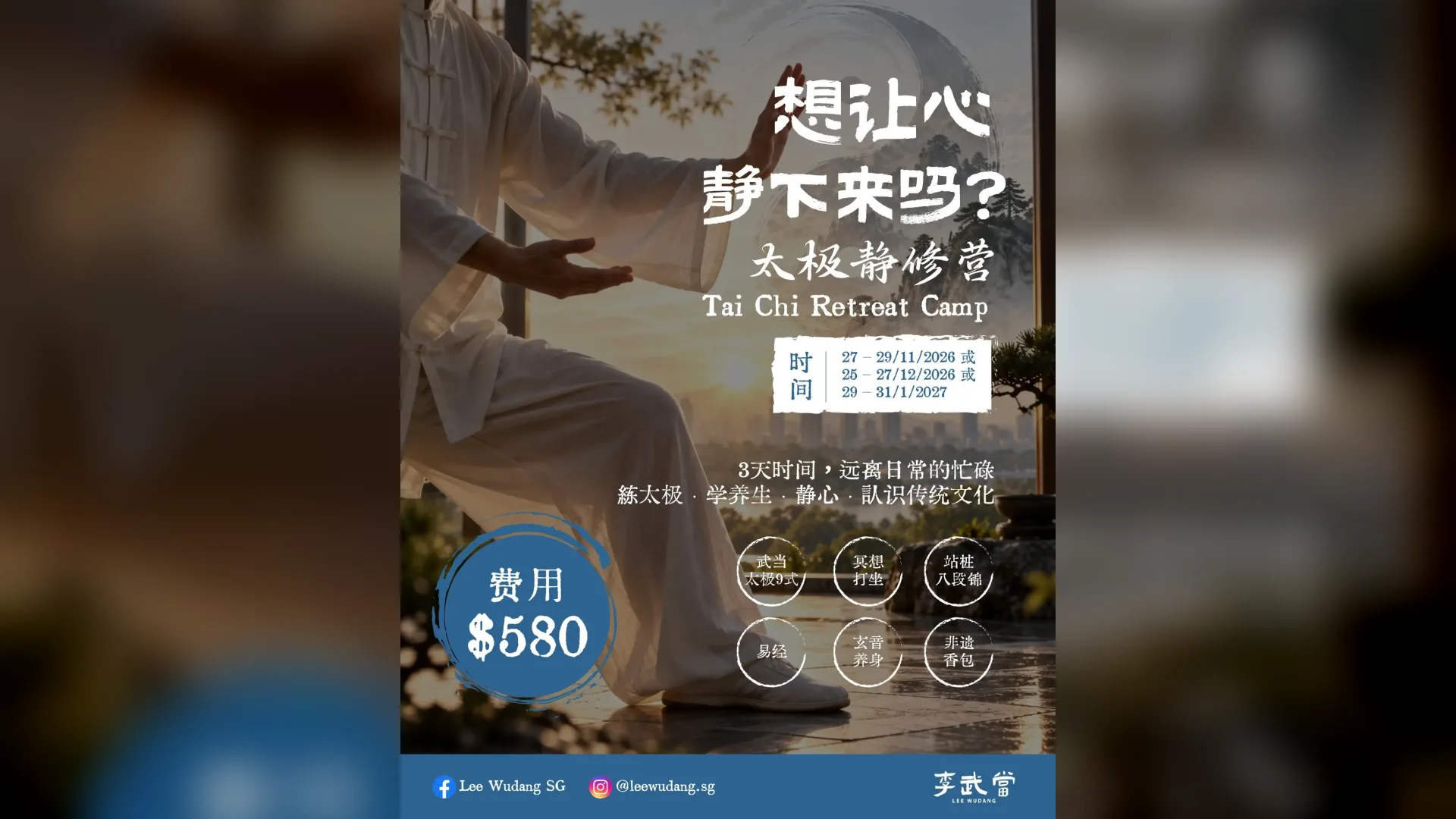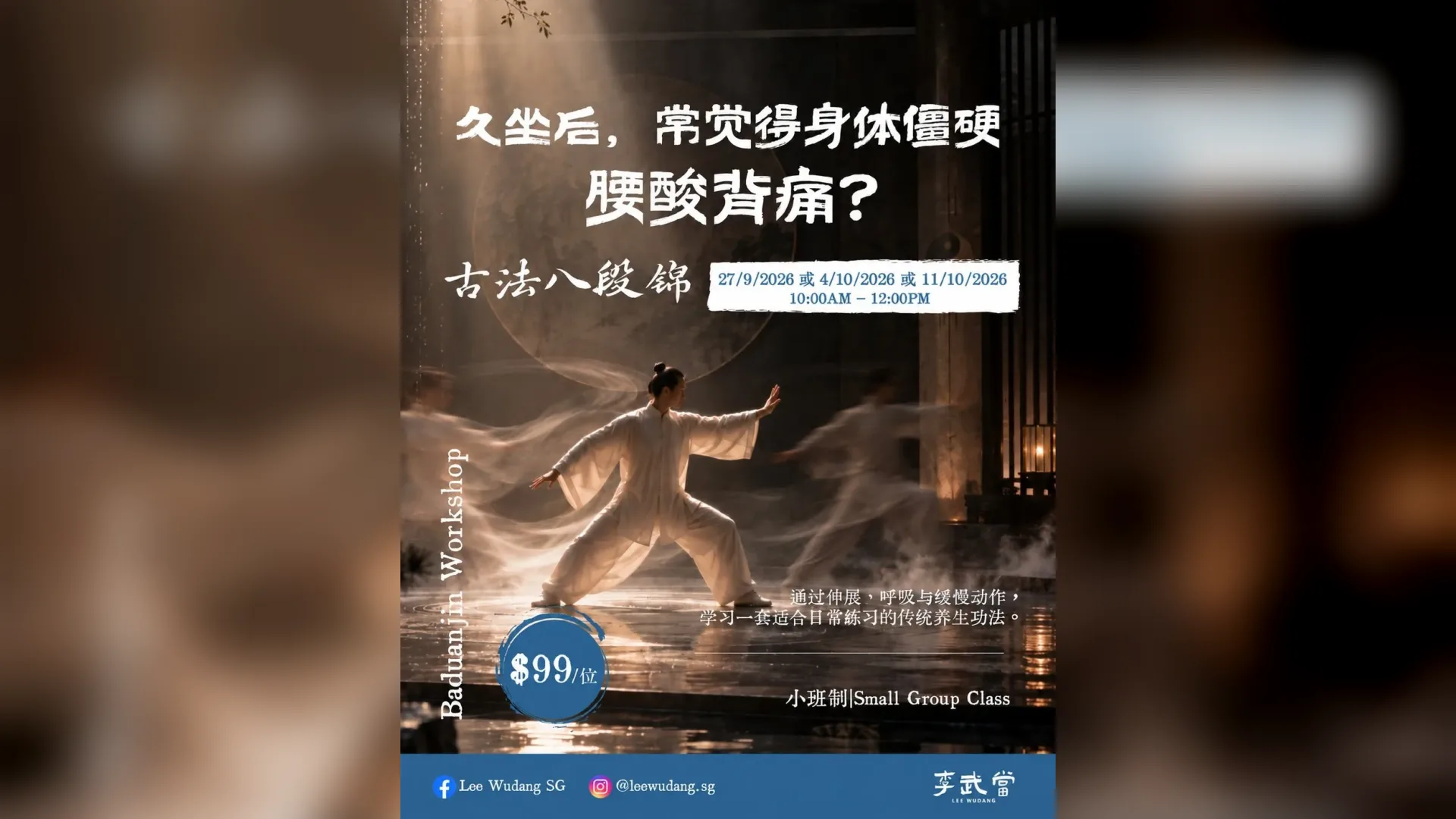
- Sessions
- Four sessions available
- Dates
- Location
- Singapore
- Fee
- S$99 per participant; S$39 for repeat participants
The Eight Sections of Baduanjin 八段锦八式详解
A movement-by-movement guide to the traditional names, physical patterns and beginner-friendly practice principles of the Eight Brocades.
Reading the traditional names carefully
Baduanjin is usually taught through eight memorable titles. These names combine movement images with the vocabulary of traditional Chinese health culture. Phrases such as “regulate the Sanjiao,” “harmonies and injuries,” or “clear heart fire” preserve that cultural setting; they should not be treated as modern diagnoses or promises of a cure. Names, details and order can also vary between lineages. The sequence below follows a widely used modern standing form.
1. Two Hands Hold Up the Heavens
两手托天理三焦 · Liǎng Shǒu Tuō Tiān Lǐ Sānjiāo
Both hands rise along the centre line, turn outward and reach overhead before lowering with control. The important pattern is not simply stretching upward. Let the feet remain settled while the spine lengthens, the ribs stay easy and the shoulders avoid creeping towards the ears. Beginners can keep the hands lower or leave the elbows softly bent. The traditional reference to the Sanjiao belongs to Chinese medical theory and is presented here as part of the movement’s inherited name.
2. Draw the Bow to Both Sides
左右弯弓似射雕 · Zuǒ Yòu Wān Gōng Sì Shè Diāo
From a wider stance, the arms form the image of drawing a bow: one hand extends while the other draws back, then the action changes sides. It develops coordination across the chest, upper back and waist while asking the legs to remain steady. Keep the knees aligned with the feet and use only a comfortable depth. The gesture should feel expansive rather than forceful; avoid yanking the rear elbow or holding the breath.
3. Raise One Hand
调理脾胃须单举 · Tiáolǐ Píwèi Xū Dān Jǔ
One palm presses upward while the other settles downward, creating a gentle opposition through the torso. The sides alternate without leaning or collapsing at the waist. Think of making space between the upper and lower hands while keeping the neck relaxed. If an overhead reach is uncomfortable, reduce the height. “Regulating the spleen and stomach” is the traditional mnemonic, not a claim that the exercise treats digestive disease.
4. Look Back
五劳七伤往后瞧 · Wǔ Láo Qī Shāng Wǎng Hòu Qiáo
The head and upper body turn gradually to look behind, then return through the centre before changing sides. The value of the section lies in controlled rotation and awareness, not in seeing as far back as possible. Keep the crown of the head lifted and let the eyes lead a modest turn. People with neck sensitivity should use a very small range and avoid throwing the chin upward. The phrase “five fatigues and seven injuries” is a historical expression with several traditional interpretations.
5. Sway the Head and Tail
摇头摆尾去心火 · Yáo Tóu Bǎi Wěi Qù Xīn Huǒ
With the hands supported on the thighs, the weight and torso shift through a broad, flowing arc. This is often the most physically demanding section because it combines a wider stance, leg work and changes of direction. Begin higher, move slowly and keep the knees tracking over the feet. Do not force a deep squat or a large spinal circle. Anyone with balance, knee or lower-back concerns can practise a reduced version with support. “Clearing heart fire” belongs to traditional explanatory language rather than modern cardiology.
6. Reach the Hands towards the Feet
两手攀足固肾腰 · Liǎng Shǒu Pān Zú Gù Shèn Yāo
The hands travel down the back or legs as the body folds, then the torso rises again with control. Some versions reach towards the feet; touching the toes is not the goal. Hinge only as far as comfortable, soften the knees and avoid forcing the lower back into a rounded stretch. Hands may stop at the thighs. The movement can be explored as a coordinated fold and return. Its traditional reference to “strengthening the kidneys and waist” should not be read as treatment for kidney disease.
7. Clench the Fists and Gaze Firmly
攥拳怒目增气力 · Zuàn Quán Nù Mù Zēng Qìlì
From a stable stance, the fists extend and return with a focused gaze. Depending on the version, the forearm may rotate as the hand opens or closes. Practise with alertness but not aggression: keep the jaw, shoulders and breath relaxed, and use controlled muscular effort rather than maximum tension. The eyes help organise intention and direction. A smaller stance or gentler reach preserves the pattern for beginners.
8. Rise and Settle on the Heels
背后七颠百病消 · Bèihòu Qī Diān Bǎibìng Xiāo
The heels lift and lower as the body rises and settles along a vertical line. Traditional versions may repeat the action seven times. Modern beginners are better served by smooth control than by dropping the heels hard. Keep the ankles aligned, the gaze level and the breath natural. Use a wall or chair if balance is uncertain. The phrase “a hundred illnesses disappear” is a classical flourish, not a medical guarantee.
What connects the eight sections
Baduanjin is more than eight isolated stretches. The transitions teach the body to change direction without losing balance. Upward and downward actions are paired, opening alternates with gathering, and attention follows the movement without becoming tense. Across the whole sequence, three practical ideas matter: a comfortable posture, unforced breathing and clear attention. These are often described in qigong as regulating the body, breath and mind.
How beginners can practise safely
Learn the order slowly and choose a range that lets you breathe normally. Pain, dizziness, numbness or unusual shortness of breath are reasons to stop. A chair, wall or smaller stance can make the practice more accessible. Instruction is especially helpful for the fifth and sixth sections, where depth and spinal movement are easy to overdo. If you are pregnant, recovering from injury, living with a medical condition or unsure whether exercise is appropriate, seek guidance from a qualified healthcare professional. Baduanjin can complement ordinary care; it should not replace diagnosis or treatment.
Continue exploring Baduanjin
For the form’s history, cultural setting, practice structure and a careful overview of the research, read the main Baduanjin guide:
Sources and further reading
General Administration of Sport of China, official introduction to the eight sections:
General Administration of Sport of China, background on the name and early standing-form record:
US National Center for Complementary and Integrative Health, “Qigong: What You Need To Know”: