Video Note
Sewing Fragrant Sachets at the Purple Bamboo Tea Courtyard紫竹茶院缝香囊
On a rainy afternoon at a Wudang tea courtyard, dried herbs are ground in a stone mortar and sewn by hand into silk-tasselled fragrant sachets.
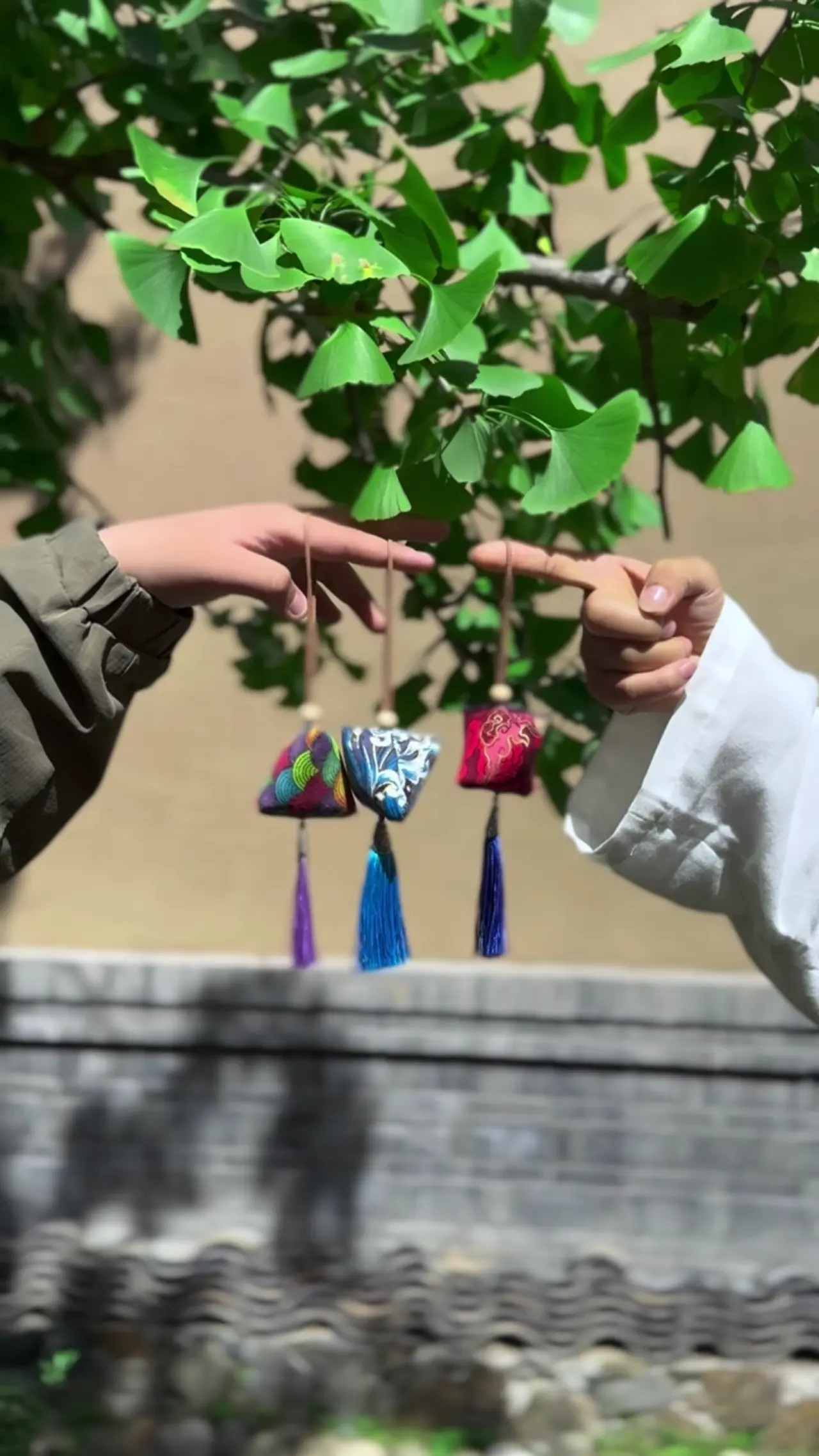
Under the ginkgo by the gate of the Purple Bamboo Tea Courtyard, three small sachets hang from outstretched fingers: one stitched in a riot of colour, one in blue and white, one in deep red, each finished with a silk tassel that turns in the breeze. They are the end of an afternoon's work, and the video goes back to show how they were made.
Inside the tea house the bamboo blinds are lowered and the garden beyond the window is soft with rain. A woman in loose white clothes sits by the glass with needle and thread, a box of cloth and silk within reach on the low table. On the wall above her hangs a scroll in four characters: 道法自然, "the Way follows what is natural".
The filling comes first. Dried herbs go into a heavy stone mortar and are pounded and ground by hand until the leaves break down and the scent rises. Nothing about it is quick. The work asks for the same patience as the sewing that follows: a small pouch cut and folded, the herbs packed in, the seam closed stitch by stitch, a loop and tassel added so it can hang.
Fragrant sachets, xiangnang, have a long history in China. They were carried on the body, hung in rooms and beside beds, and given as gifts, valued as much for the care of their making as for the scent they hold. In a quiet courtyard on Wudang, the old craft fits easily into an ordinary afternoon of rain, tea and handwork.
We close with a short poem in the manner of the Tang poet Du Fu:
Sewing Fragrant Sachets at the Purple Bamboo Tea Courtyard
Brocade sachets hang from the ginkgo bough; purple and blue tassels catch the autumn light.
In the tea house the bamboo blinds hang still; fresh-ground in the stone mortar, a hundred herbs give up their fragrance.
One thread through the needle stitches in the passing years; light rain at half the window drifts into the wide grey distance.
On the wall: the Way follows what is natural. Why go to other mountains looking for a cure?
(A new poem written in the style of Du Fu, not one of his own.)