Video Note
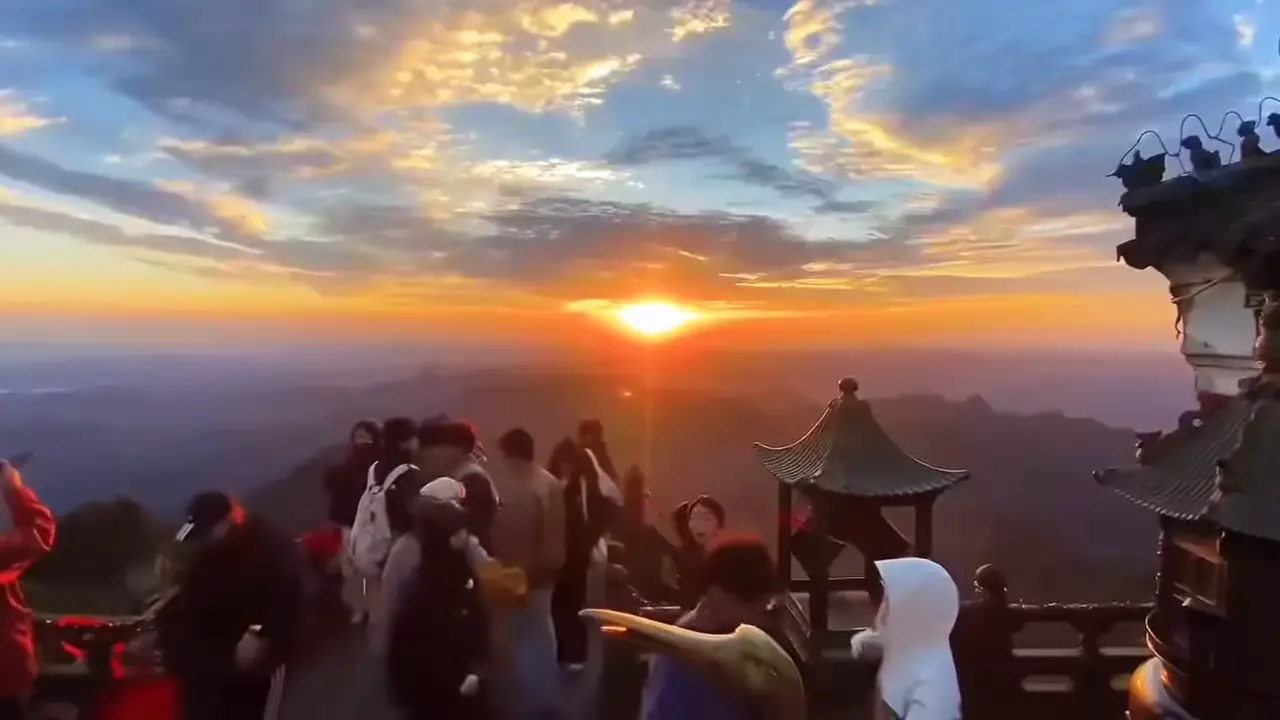
Sunrise at the Golden Summit, 5 October 2026金顶观日 · 2026年10月5日
On the fifth morning of the National Day holiday, crowds climbed to the Golden Summit of Tianzhu Peak to watch the sun rise over the Wudang range, an appointment people have kept here for six centuries.
Long before the sun appears, the path to the Golden Summit is already full. On the fifth morning of the National Day holiday, visitors climbed through the early dark in hats and padded coats to stand at the railing of Tianzhu Peak, the highest point of the Wudang range, and wait.
What they came for lasts only a few minutes. A band of orange opens along the horizon, the cloud above it catches fire from underneath, and then the sun itself lifts clear of the haze, small and very bright. Below, ridge after ridge of the range falls away into blue, and the sea of cloud that so often fills these valleys lies thin and scattered, like smoke drifting off a hearth.
The terrace is not a quiet place at this hour. Phones are raised, friends call to one another, children are lifted onto shoulders. Yet the scene has an old shape. Bronze incense burners and lantern pavilions line the stone balustrade, and the eaves of the summit halls frame the view much as they have for six centuries. People have been climbing here to watch this same light for a very long time; the crowd is simply the latest to keep the appointment.
There is a Chinese tradition of writing a poem at the top of a mountain, and the great Tang poet Du Fu, gazing at a sacred peak, promised that one day he would stand on its summit and see every other mountain grow small. We offer a short poem in his manner, written for this morning:
Sunrise at the Golden Summit
Dawn breaks over Tianzhu Peak; a sea of cloud on ten thousand mountains surrounds the golden terrace.
Incense smoke curls and scatters on the wind; voices rise up the path through the dew.
A thread of red sun floats on the vast haze; the corners of the old halls lean against the heights.
Only up here do you believe how wide heaven and earth are. Don't go back down into the dust lamenting age.
(A new poem written in the style of Du Fu, not one of his own.)