How Wudang Martial Arts Schools Are Organised
武当武馆如何组织和运作
Before you can evaluate a school you need to know what kind of thing you are evaluating. The word covers arrangements that differ enormously in size, structure, purpose and honesty, and most misjudgements come from applying the wrong model. This page describes how schools at Wudang are actually organised, who teaches, how programmes are built, and how to read the claims they make about themselves.
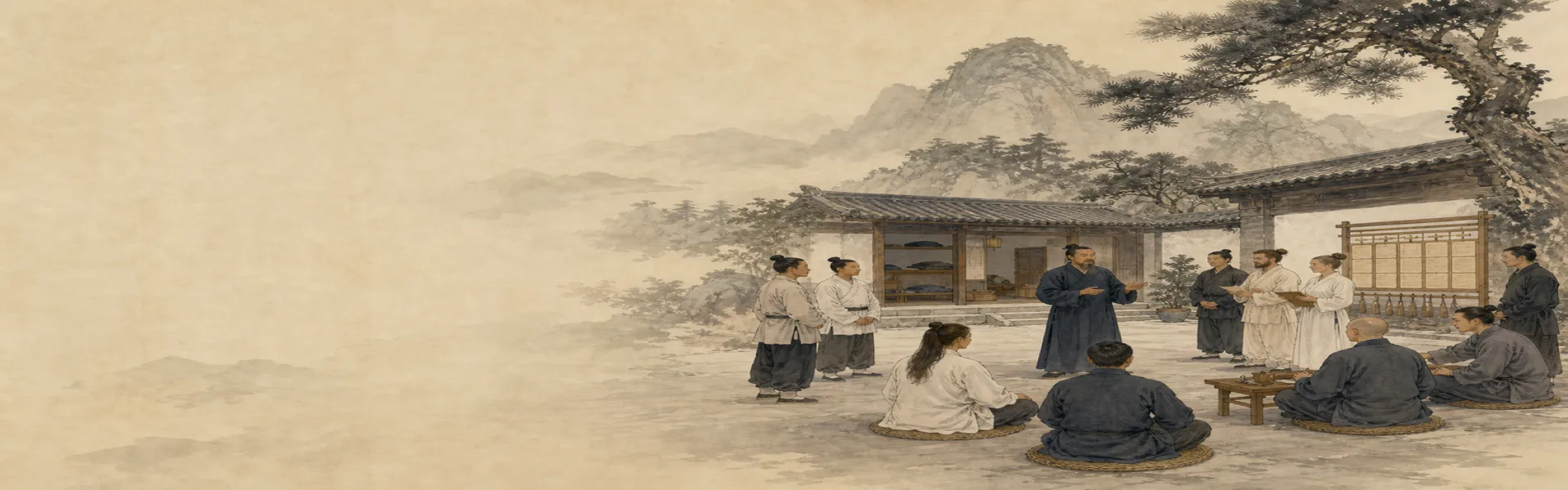
Schools are not the temple
This is the structural fact that everything else depends on, and it is worth stating before anything else because almost every serious misunderstanding traces back to it.
The temples on the mountain are religious institutions. They are managed under a Taoist association, they house ordained Quanzhen clergy who live in community, and their purpose is liturgical: daily services, festivals, rites performed on request, and the upkeep of the halls. They do not run courses for visitors and do not take foreign students as resident trainees.
The schools are private businesses. They are owned and run by individual teachers or families, they occupy rented or purpose-built premises in the town, in the valley near the foot, or occasionally further out, and they survive by charging students for instruction, accommodation and food. Some are registered as training establishments, others are less formal.
Their relationship to the temples ranges from close to nonexistent. A teacher may have a genuine personal connection with a temple, or may have trained there decades ago, or may have no connection at all beyond geography. None of these positions is dishonourable, and none of them makes a school part of a religious institution.
The practical consequence is that when you enrol, you are buying lessons from a business. The lessons may be excellent. A school that implies you are joining a religious community is telling you something about itself rather than about the temples.
The main kinds
Schools fall into recognisable types, and identifying the type tells you more than a website does.
At one end is the single-teacher operation: one instructor, a courtyard, a handful of students, no website, no English, and no administration beyond a notebook. Teaching is direct and correction is constant. Nothing is organised for you, and without functional Chinese you will spend most of your energy on logistics.
In the middle is the family or small-lineage school: a senior teacher, one or two assistants often related to them, a modest permanent group of students, and enough organisation to receive foreigners without being built around them. This is where most of the better teaching sits, and it is also the hardest type to find from abroad because it markets least.
At the other end is the organised academy: dormitories, canteen, training halls, printed curricula, staff who handle visa paperwork, translators in class, and a marketing operation that reaches students before they leave home. Friction is low. Individual attention is usually lower too, because the ratio of students to genuinely senior instructors is worse.
A fourth type is worth naming: the international-facing operation whose primary product is the experience of having trained at Wudang. It may teach adequately, and its priorities are visible in what it photographs and what it certifies.
The trade-off across the range is consistent. The more a school is set up to receive foreigners, the easier your life will be and the less unusual your instruction is likely to be.
Who actually teaches you
This is the most important question about any school and the one least often answered clearly in advance.
In many schools, the person whose name and photograph appear on the marketing is not the person standing in front of you each morning. Day-to-day teaching is frequently delegated to senior students or junior instructors, and the named master appears occasionally, teaches advanced groups, or is travelling.
Delegation is not in itself a problem. A capable senior student who has trained for years can teach basics extremely well, often better than a master who is impatient with beginners. Beginners mostly need repetition and correction of simple things, and that is exactly what an advanced student can provide.
The problem is undisclosed delegation. If a school's entire appeal rests on one person and that person is structurally unavailable, you are paying for access you will not get. The test is simple and you should apply it before booking: ask who teaches the beginners' class each morning, by name, and how many students are in it. A well-run school answers immediately because it knows.
The strongest available indicator of teaching quality is not who teaches but what the teaching has produced. Look at the students who have been there two years. If they move well, something works. If they move like enthusiastic beginners, no lineage claim explains that away.
How a programme is structured
Programmes are presented as levels, but the underlying structure is simpler than the numbering suggests, and knowing it lets you judge where you actually are.
The first stage is the body: a low stable stance, hips that turn independently of shoulders, and slow movement without wobbling. Trained by repetition rather than explanation, and typically occupying most of a first month.
The second is one short form learned properly. Short matters: an abbreviated set contains nearly every principle in the art and is short enough to be corrected in detail.
The third is refinement, which looks like nothing is happening because the change is in quality rather than quantity. This is where students ask to learn something new and where a good school says no.
The fourth adds a weapon or a longer form, and the cycle repeats.
Schools structure the calendar around blocks of time rather than around achievement, because they sell time. This means the correspondence between a level and a competence is loose, and a certificate at the end of a block records attendance rather than attainment. Judge yourself by what you can do, not by which level you were placed in.
Lineage claims and how to read them
Every school makes claims about where its material comes from, and there is a way to read them that avoids both credulity and rudeness.
Start from the documented position. Transmission of these arts at Wudang was badly disrupted in the twentieth century, when religious institutions lost their personnel and organised practice largely stopped. What is taught now was assembled or reassembled from the late 1970s onward, drawing on thin local survival, on teachers trained in other traditions and places, and on forms composed or standardised in the modern period.
Given that, an unbroken line from a named figure centuries ago is not documentation. The attribution of internal boxing to Zhang Sanfeng appears in writing only from the seventeenth century, and of Taijiquan to him only in the nineteenth, both far too late to record events they describe.
But lineage claims are not therefore worthless, and this is the part usually missed. A lineage claim tells you what a school thinks its art is: which principles it takes as central, which family of practice it wants to be understood as belonging to, what it is trying to be. That is real information about intent and character, even when it is not history.
So the useful question is not whether the lineage is ancient but whether the teacher can say where the evidence stops. A good answer sounds like: this is what I was taught, this is who taught me, beyond that it is tradition. That answer is a mark of competence. Increasing certainty about increasingly distant generations, combined with vagueness about next week's classes, tells you which of the two the school has thought about.
Official titles and what they mean
Titles circulate freely and mean less than they appear to, so it helps to know what kinds exist.
Some titles are institutional and real: positions within a Taoist association, or roles within a recognised sports or martial arts administration, which have procedures behind them. Some are grading and examination systems administered through sports bodies, which are genuine, standardised and separate from anything a school issues itself.
Some titles are lineage designations, meaning a school's own account of a teacher's position in its own transmission. These are internal to the school and carry no external authority. That does not make them meaningless within the school; it means they are not credentials.
And some are simply marketing: descriptions of generation, inheritance or mastery that no body confers and no procedure governs.
The practical test is to ask who awarded a title and by what process. A real credential has an issuer and a procedure, and a teacher holding one can name both without difficulty. A title with no issuer is a description a school has chosen for itself, which is fine as long as you read it that way.
Residential life and what it implies
Most schools are residential, and the structure of residence shapes the experience as much as the curriculum.
Accommodation and food are normally bundled with training in a single charge. Conditions are functional rather than comfortable: simple rooms, shared or basic facilities, canteen food at fixed times, and heating that ranges from adequate to notional. This is the standard and it is not a sign of a poor school.
Living on site means the school controls a great deal of your daily life, which is efficient and creates a dependency worth being conscious of. The practical protection is simple: keep your passport, keep your own money, and stay able to afford to leave.
The student population is transient and international, with a few long-term students, a larger group staying weeks to months, and a stream of short visitors. Turnover is constant, friendships form fast and end fast, and the group around you reconstitutes several times during a long stay.
Long-term students are the most valuable people to know and the best source of accurate information about a school. They can tell you who actually teaches, what is really covered, and how the place is run, and they have no commercial interest in your decision.
What to check before committing
Since this page is about organisation rather than choice, the checks here are structural ones.
Establish who teaches you daily, by name, and how classes are grouped by level. Establish what you will study in the first month, in what order.
Establish what is included in the single charge and what is separate, in writing, along with the terms for leaving early and for extending.
Establish who handles residence registration with local authorities, which is an ordinary legal requirement in China, and exactly what documentation the school will issue for your permission to stay, in whose name, and how long it takes. Confirm the rules themselves with the Chinese embassy or consulate responsible for your country rather than with the school.
Establish whether you can watch a class and speak to a current student unsupervised. A school with nothing to hide arranges both easily.
And commit short. Whatever the discount for a long block, the ability to leave is worth more, and extending is always easy once you are already there.
Sources and limits: this page describes general patterns across schools at Wudang as reported consistently by students and teachers, not the arrangements of any particular school, which must be confirmed directly and in writing. It names no schools and endorses none. Statements about lineage reflect what documentary evidence supports; where it does not, that is said plainly. Visa and registration requirements must be confirmed with the relevant embassy or consulate, and no course described here confers a professional or teaching qualification.
Key points
- Schools are private businesses; temples are religious institutions. Enrolling buys lessons from a business, not entry to a religious community.
- Types run from a single teacher with a courtyard to an organised academy. The middle, family-scale schools market least and often teach best.
- The more a school is organised for foreigners, the easier your stay and the less distinctive your instruction.
- Ask who teaches the beginners' class each morning, by name, and how many are in it. Delegation is fine; undisclosed delegation is not.
- The strongest indicator of quality is how the two-year students move.
- Programmes reduce to four stages: the body, one short form, refinement, then a weapon. Levels are sold as time, not attainment.
- Transmission was badly disrupted in the twentieth century, so unbroken ancient lineage is a claim rather than documentation.
- Lineage claims still tell you what a school thinks its art is. Judge a teacher by whether they can say where the evidence stops.
- Ask who awarded any title and by what procedure. A credential has an issuer; a title without one is self-description.
- Get inclusions, terms and paperwork responsibilities in writing, confirm visa rules with the embassy, and commit short.