The BaZi Day Master and Ten Gods: A Relationship Guide
八字日主与十神:命盘关系如何分类
If the previous page explained how the eight characters are obtained, this one explains the single idea that turns that grid of characters into a portrait of a person. That idea is the Day Master (日主, also called 日元 or 日干): the Heavenly Stem of the day of birth, which stands for the self at the centre of the chart. Every other element in the eight characters is read in relation to this one Stem. The Day Master is not judged good or bad in itself; it is simply the reference point from which all the relationships in the chart are measured. Understanding it is the key that unlocks the whole classical method.
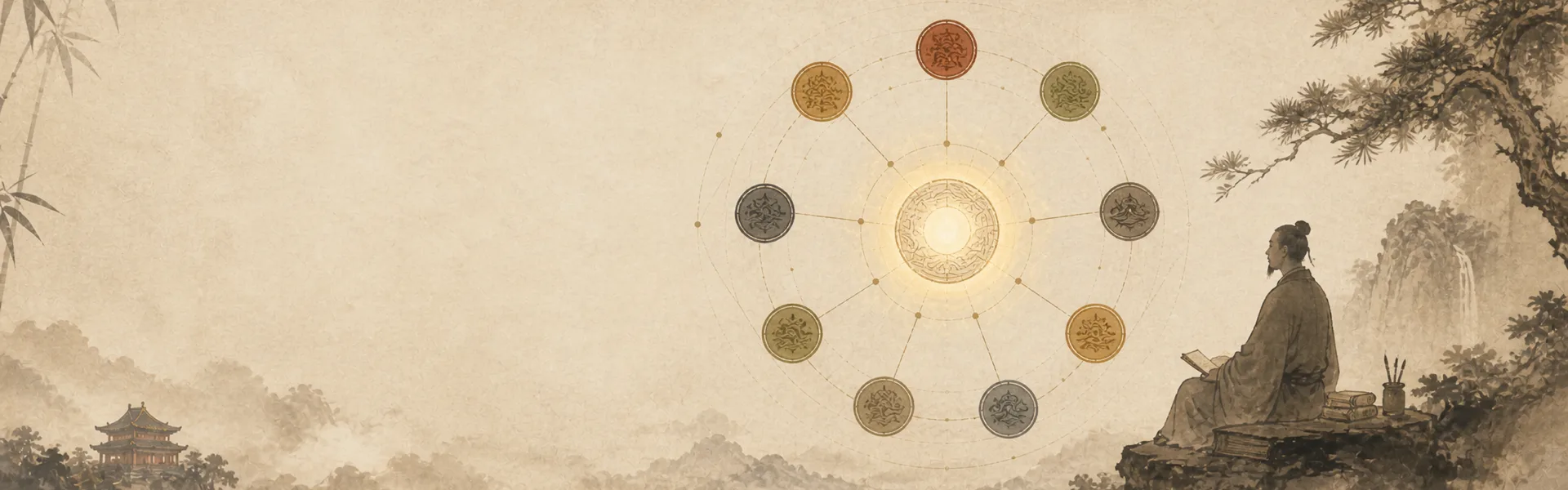
Phase and polarity of the Day Master
The Day Master carries two properties inherited from the Stems themselves: one of the Five Phases — Wood, Fire, Earth, Metal, or Water — and a polarity, yin or yang. A person is thus said to be, for example, a “yang Wood” Day Master or a “yin Water” Day Master. Classical texts attach vivid natural images to each of the ten possibilities: yang Wood as the tall tree, yin Wood as the vine or grass, yang Fire as the sun, yin Fire as the candle or hearth, and so on through Earth, Metal, and Water. These images are mnemonic and evocative rather than literal, but they shape the way practitioners describe a person’s basic character, and they should be understood as traditional symbolism rather than as claims about temperament that have been tested.
One question asked of everything else
Once the self is fixed, the system asks a single, repeated question of every other Stem and of the hidden stems within the Branches: what is its relationship to the Day Master, in terms of the Five Phases and of polarity? The answer is expressed through a set of categories known as the Ten Gods (十神). The name is traditional and slightly misleading to a modern ear: these are not deities but relationship-types, ten labels describing the ten possible ways another element can stand toward the self.
Why there are exactly ten
The ten arise from a simple logic. There are five possible phase-relationships another element can have with the Day Master: it can be the same phase as the self; the phase the self produces; the phase that produces the self; the phase the self controls; and the phase that controls the self. These five relationships derive directly from the generating and controlling cycles of the Five Phases described elsewhere in this section. Each of the five is then split in two according to whether the other element shares the Day Master’s polarity or opposes it, giving ten categories in all. The doubling matters because a relationship between like polarities is felt differently from one between opposite polarities.
The five pairs
The ten are usually grouped into five pairs, each pair sharing an underlying function. The pair known as Companion and Rival (比肩 and 劫财) are elements of the same phase as the self, representing peers, siblings, competitors, and one’s own assertiveness. The Output pair, often translated Eating God and Hurting Officer (食神 and 伤官), are what the self produces, associated with expression, creativity, performance, and children in a woman’s chart. The Wealth pair, Direct Wealth and Indirect Wealth (正财 and 偏财), are what the self controls, associated with money, resources, and, traditionally, a wife or father in certain charts. The Officer pair, Direct Officer and Seven Killings (正官 and 七杀), are what controls the self, associated with authority, discipline, career pressure, and, traditionally, a husband or offspring depending on the chart. Finally the Resource pair, Direct and Indirect Resource (正印 and 偏印), are what produces the self, associated with support, learning, mothers, and protection.
Why the names mislead
The Ten Gods have names that sound like verdicts, and taking them at face value is the most common beginner’s error. Zheng (正) means correct or upright, pian (偏) means partial or lopsided, sha (杀) means to kill, shang (伤) means to injure, and jie (劫) means to rob. Read as a list, five of the ten look like good news and five like disasters.
That reading is wrong, and the tradition says so repeatedly. The names describe the character of a relationship, not its value. Whether a given relation helps or harms depends entirely on the balance of the particular chart. Seven Killings, the most alarming name in the set, represents pressure and control applied to the Day Master; for a weak Day Master that is genuinely burdensome, but for a strong one it is precisely what supplies drive, discipline and the capacity to handle responsibility, and charts of capable people are full of it. Direct Officer, which sounds ideal, becomes suffocating if the Day Master cannot support it. Hurting Officer, which sounds destructive, is associated with talent, expressiveness and originality.
The underlying point is structural. Nothing in a chart is good or bad on its own; everything is good or bad relative to what the Day Master needs. This is why two charts containing the same Ten God can be read in opposite directions without inconsistency, and why a practitioner who reacts to the presence of a particular god rather than to its role in the whole is not using the system properly. The moral flavour of the vocabulary is an accident of the words chosen, and the more careful classical writers are explicit that it should be discounted.
From relationship to area of life
These associations between a relationship-type and areas of life — wealth, authority, expression, support, kinship — are where BaZi moves from structure to meaning, and they are also where it becomes most clearly a system of traditional interpretation rather than of fact. The link between, say, the “Wealth” relationship and actual money, or between the “Officer” relationship and a spouse, is a matter of long convention within the tradition. It is presented here to explain how practitioners read a chart, not as a demonstrated correspondence between a birth date and a person’s finances or marriage.
How a chart is actually read
In practice, a reader scans the chart to see which of the Ten Gods are present, which are strong, which are absent, and where they sit among the four pillars. A chart heavy in Output but light in Officer, for instance, might be described as expressive and creative but resistant to authority; one rich in Resource but poor in Wealth might be cast as scholarly but impractical with money. The month pillar carries particular weight in these judgements, because the season of birth strongly conditions which phases are naturally strong or weak — a theme taken up on the next page. Skilled practitioners insist that no single feature should be read in isolation, and that the art lies in weighing the whole configuration rather than ticking off labels.
Where the framework came from
The Ten Gods are not an ancient feature of Chinese fate reckoning. They are a systematisation, and knowing what they replaced shows what kind of achievement they were.
Earlier fate calculation worked largely through shensha (神煞), a large and open-ended collection of named spirits, omens and special combinations. Each had its own name, its own rule for when it appeared in a chart, and its own consequence. There were hundreds of them, they were not derived from any common principle, they had accumulated over centuries from different sources, and they frequently contradicted one another. Learning the art meant memorising a catalogue.
The Ten Gods framework did something quite different. It threw out the catalogue and replaced it with a small closed set generated from a single question asked systematically: what is the five-phase and polarity relation of this character to the Day Master? Five relations times two polarities gives ten, and the set is complete by construction. Nothing has to be memorised except the derivation, and every character in every chart can be classified without appeal to a list.
This was a genuine intellectual improvement, and it is worth recognising as one whatever one concludes about the art’s validity. It is the same kind of move as replacing a table of separate cases with a general rule, and it is what made BaZi teachable and analytically tractable in a way its predecessors were not. The older spirits were never entirely abandoned — many manuals carry both systems side by side, and some practitioners still use them heavily — but the Ten Gods became the backbone, and the analytical tradition that runs through the Ditian Sui and the Ziping Zhenquan is built on them rather than on the spirits.
Two cautions
Two cautions are worth keeping in view. First, the gender-linked and kinship readings — Wealth as wife, Officer as husband, and so on — reflect the assumptions of the society in which the system matured, and many contemporary practitioners reinterpret or set them aside. They are part of the tradition’s history, not fixed truths. Second, the confident mapping of chart features onto character and life events has never been shown to hold up under controlled testing; it is an interpretive craft with deep cultural roots, and that is the spirit in which it is described here.
What the system achieves
Understood in that spirit, the Day Master and the Ten Gods are an elegant piece of symbolic engineering. From a single reference point and the five-fold logic of the phases, the tradition generates a rich vocabulary for talking about a person’s drives, relationships, and circumstances. The next page turns from this vocabulary to the question that governs how the whole chart is judged: whether the Day Master is strong or weak, and which elements the chart is thought to need.
Key points
The Day Master is the Day pillar’s Stem and stands for the person whose chart it is.
It carries a Five Phase value and a yin or yang polarity — for example “yang Wood”.
Every other Stem in the chart is then described by its relationship to the Day Master.
Five possible phase relationships, each in matching or opposing polarity, give exactly ten categories.
These Ten Gods are grouped into five pairs sharing an underlying function.
Each pair is associated with an area of life — wealth, authority, expression, support, kinship.
A reader looks at which Gods are present, strong, weak or absent, and how they interact.
Gender-linked and kinship readings reflect the society that produced them and should be read with that in mind.
From one reference point the system generates a complete descriptive vocabulary.
Sources drawn on for this article include: Richard J. Smith, Fortune-tellers and Philosophers: Divination in Traditional Chinese Society; Ho Peng Yoke, Chinese Mathematical Astrology: Reaching Out to the Stars; Ted Kaptchuk, The Web That Has No Weaver (for the generating and controlling cycles of the Five Phases); and standard reference expositions of the Ten Gods within the classical Ziping tradition.