Zi Wei Dou Shu Four Transformations: How the Chart Moves Through Time
紫微斗数四化:命盘如何随时间变化
A chart cast from a person’s birth is fixed: the palaces and the stars within them do not move. Yet Zi Wei Dou Shu is not read as a still picture. Two further devices set the fixed chart in motion and allow a reader to speak about how a life unfolds over time. The first is the set of Four Transformations, which colour certain stars according to the birth year; the second is the system of moving limits, which carries the whole chart forward through the decades and years of a life. This page explains both, and shows how they turn a static map into something a reader treats as dynamic.
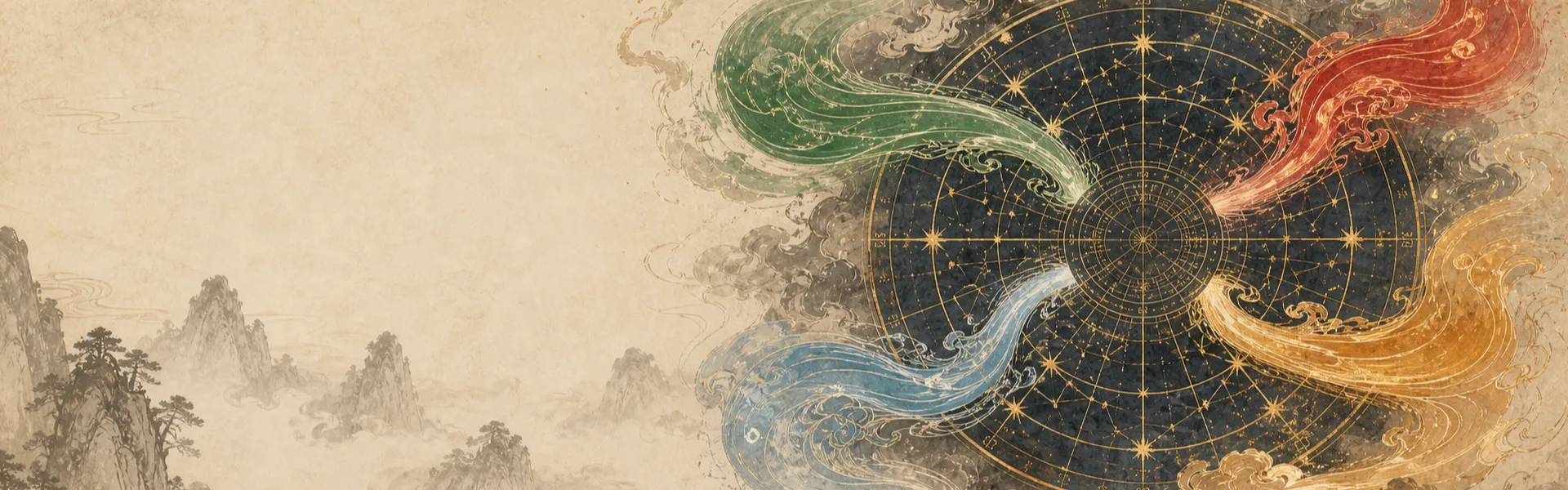
The Four Transformations
The Four Transformations are the heart of the matter, and they are the feature that most distinguishes Zi Wei Dou Shu from a simple placement of stars. In each chart, four of the major and minor stars are singled out and marked with one of four qualities, and which stars receive which mark is determined by the heavenly stem of the birth year. The four are Lu, Quan, Ke and Ji, rendered here as prosperity, power, distinction and obstruction; some translations prefer emolument, authority and renown for the first three. A star touched by the first is understood to have its favourable side drawn out and its capacity for gain enhanced. A star touched by the second is understood to gain force and authority, its influence made stronger and more assertive. A star touched by the third is understood to bring a kind of recognition or smoothing of the way, often connected with reputation and study. A star touched by the fourth is understood to become a point of obstruction or entanglement, the place where the chart’s difficulties tend to gather.
The four, named
The transformations are four states that a star can be put into, and each has a name describing what it does to the star it lands on.
Hua lu (化禄) is transformation to prosperity. It indicates smoothness, resources, income and things arriving without excessive struggle, and it is generally the most welcome of the four. Hua quan (化权) is transformation to power. It indicates power, control, responsibility and the capacity to make things happen, with a corresponding tendency toward force and inflexibility. Hua ke (化科) is transformation to distinction. It is associated with reputation, examinations, scholarship and being well thought of, and it is the mildest of the four in effect. Hua ji (化忌) is transformation to obstruction. It indicates blockage, entanglement, preoccupation, loss and things that will not resolve, and it is the one every practitioner looks for first.
Two points about them are worth grasping early. The first is that the transformation attaches to a star, not to a palace, so the effect is read as the star’s quality being intensified or redirected in whatever palace the star happens to occupy. The second is that hua ji is not simply misfortune. It is more accurately described as fixation: the matter it touches becomes the thing a person cannot leave alone. That can be destructive, and it can equally be the mechanism behind persistence and specialisation, which is why a chart entirely without it is not read as fortunate.
Shared by everyone born in the same year
Because these marks are keyed to the birth year alone, everyone born in a year of the same stem shares the same four transformed stars. What makes each chart individual is where those stars happen to sit. The star that carries obstruction means one thing when it falls in the palace of wealth and quite another when it falls in the palace of relationships or of health; the reader’s task is to see which areas of life the four marks land upon. In practice the transformations are often the first thing an experienced reader looks for, because they point directly to where the chart’s energies are concentrated and where its strains are likely to show.
How transformation tables vary
Which four stars are transformed is determined by the heavenly stem of the birth year, so there are ten sets of four learned as a table. Most stems are handled in the same way across the major traditions; for a few, different lineages preserve established variant assignments.
The best-known case concerns one particular stem, for which lineages assign two of the transformations to different stars. Several versions circulate, each with some textual lineage. Because the choice changes which stars carry obstruction and distinction, a careful reader should identify the table being used and apply it consistently throughout the chart.
This deserves attention because of what it reveals about the system’s foundations. The transformation table is transmitted rather than derived: it is not calculated from the Five Phases or from the structure of the two star series, and no surviving source explains why each stem transforms a particular star. When versions vary, the choice cannot be reconstructed from an underlying formula. The sound practice is therefore to document the textual or teaching lineage of the table and, where relevant, compare how each established version changes the reading.
For a reader, the practical response is to check which table a book or program uses and favour sources that state their version clearly, explain its lineage and situate it alongside other established tables.
Transformations that move
The transformations also do more than sit still. Each palace has its own stem, and in more advanced reading a palace can send out its own transformations to other palaces, creating chains of influence that link one area of life to another. This layer of the system is intricate and is handled differently by different schools, but the underlying idea is consistent: the marks of prosperity, power, distinction, and obstruction are the threads by which the separate palaces are tied into a single fabric.
Flying transformations and self-transformation
Everything above treats the transformations as fixed by the birth year, but there is a second and more elaborate use of them which forms the basis of one of the two main modern approaches.
Each of the twelve palaces carries a heavenly stem of its own, assigned when the chart is laid out. Since a stem generates transformations, each palace can be treated as a source: the stem of the marriage palace transforms four stars, wherever in the chart those stars happen to sit. The transformation is then said to fly from the palace it originates in to the palace it lands on, and the resulting link is read as a connection between the two areas of life. If the stem of the career palace sends obstruction into the health palace, that is read as work bearing on health.
Tracing these links produces a web of connections across the whole chart, and practitioners of this approach work primarily with the web rather than with the static star descriptions. A special case arises when a palace’s stem transforms a star sitting in that same palace, which is called self-transformation and is read as a quality that turns back on itself — often as instability, or as something that dissipates as fast as it accumulates.
Two observations are in order. This method is genuinely more dynamic than reading stars in place, and its adherents argue with some force that it is what makes the system capable of specificity. But it also multiplies the number of available statements enormously: twelve palaces each sending four transformations gives forty-eight links before decade and annual stems are added, and with that many connections available a practitioner can construct a plausible account of almost any situation after the fact. The increase in expressive power and the increase in unfalsifiability are the same increase, and honest teachers within this approach acknowledge the risk.
Decade cycles
The second device is the movement of the chart through time. The fixed chart describes the whole of a life at once, but a reader also wants to speak about particular periods, and for this the system provides moving frames. The largest of these is the decade limit. Beginning at an age set by the Five-Element bureau, the reader’s attention moves from palace to palace around the chart, each palace governing roughly ten years of life in turn. During its decade, a palace is read almost as a temporary Life palace, and the stars it contains, together with the transformations that fall on it, are taken to describe the tenor of those years.
The annual frame
Within each decade the chart is read at a still finer grain. An annual frame moves one palace further each year, so that every year of life is assigned a palace and, with it, a set of stars and a fresh set of transformations drawn from that year’s own stem. A reader can descend further still, to monthly and even daily frames, though the finer the grain the more cautious a careful reader becomes about the weight to place on it. The principle throughout is the same: a fixed birth chart supplies the underlying pattern, and the moving frames pass over that pattern like a light, illuminating one region at a time.
Several layers at once
When these devices are combined, a reading of a particular year draws on several layers at once. There is the birth chart beneath everything, with its palaces, stars, and birth-year transformations. There is the decade limit, resting on one palace and its neighbours. And there is the annual frame, adding its own transformations. A reader weighs these together, noticing especially where the transformations of different layers fall on the same palace or star, since such meetings are taken to mark years of particular emphasis, for good or ill. It is this layering that allows Zi Wei Dou Shu to speak not only about a life in general but about its seasons.
A measure of caution
A measure of caution belongs here as much as anywhere in the system. The machinery of transformations and moving limits is elaborate, and that elaborateness can create an impression of precision beyond what independent evidence supports. The rules for assigning transformations and advancing the limits can be applied consistently, but the meanings read from them rest on tradition and the interpreter’s judgement. Schools may advance the annual frame through different conventions and give the finer frames different weight; these emphases become intelligible when the framework is named and used consistently. The most balanced description is a structured method for reflecting on phases of a life, coherent within its rules, rather than a guaranteed forecast of a particular year.
Key points
A birth chart is fixed, but Zi Wei is not read as a still picture.
The Four Transformations single out four stars and mark them with particular qualities.
They are the feature that most distinguishes Zi Wei from a simple star placement.
Because they key to the birth year stem alone, everyone born in such a year shares them.
In advanced reading each palace has its own stem and can generate its own transformations.
The chart also moves through time in decade-long periods.
Within each decade an annual frame advances one palace per year.
A reading of one year therefore draws on birth chart, decade and annual layers together.
The machinery is intricate, but intricacy is not evidence that the predictions hold.
Sources drawn on for this article include: the Zi Wei Dou Shu Quanshu and later instructional literature on the four transformations and the moving limits; Richard J. Smith, Fortune-tellers and Philosophers: Divination in Traditional Chinese Society, on the cultural setting of Chinese astrology; and Ho Peng Yoke, Chinese Mathematical Astrology: Reaching Out to the Stars, on the technical structure of such systems.