History of Zi Wei Dou Shu: Origins, Legends and Documented Evidence
紫微斗数的起源与历史:传说、文献与可考证据
The history of Zi Wei Dou Shu is harder to trace than one might expect of so elaborate a system, and much of what is popularly said about its origins belongs more to legend than to documented record. Understanding what can and cannot be established about its past is a useful corrective, because the tradition itself often speaks of its beginnings with a confidence that the historical evidence does not support.
Where the name comes from
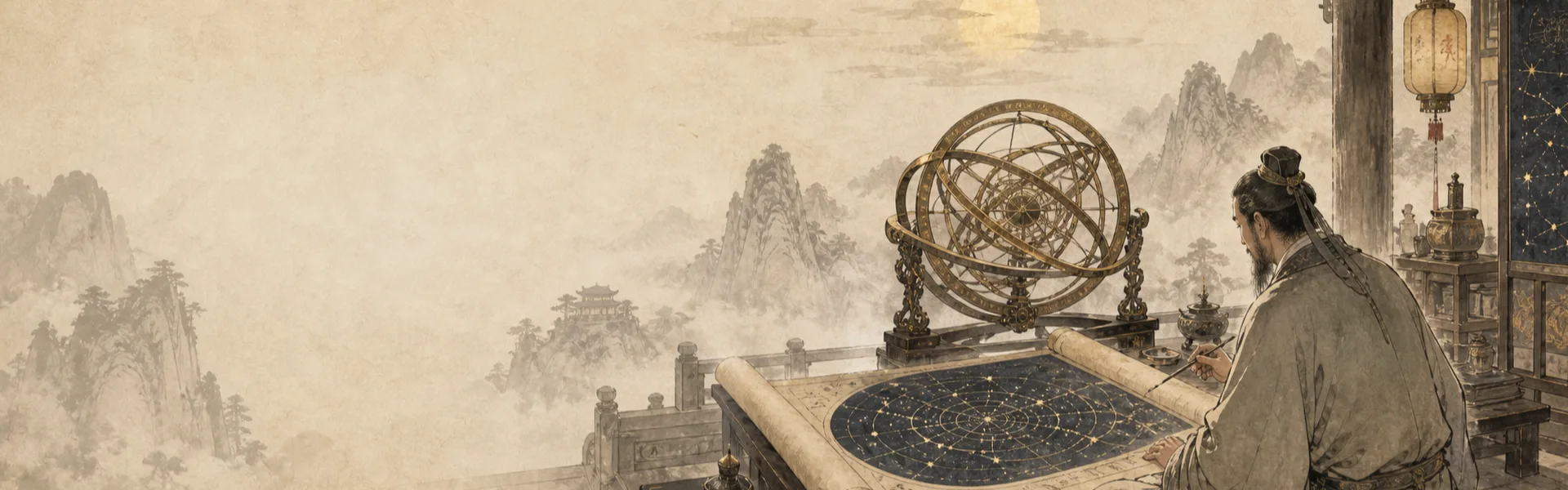
The system takes its name and its guiding image from the heavens. Zi Wei, the Purple Star, is the Chinese name for the region of the sky around the celestial pole — the “Purple Forbidden Enclosure” (紫微垣) of traditional Chinese astronomy, the circumpolar region that never sets and was imagined as the palace of the celestial emperor. Because the pole star appears fixed while the whole sky wheels around it, it became a natural symbol of the sovereign and of a still centre governing all change. Dou Shu, “the calculation of the Dipper,” ties the system to the Northern Dipper (the Plough), the great asterism that classical Chinese astronomy used to mark time and direction. The name thus announces a system that reads a life against the ordered turning of the northern sky.
The “stars” are not observed stars
It is important to note, however, that the “stars” of Zi Wei Dou Shu are largely not the actual stars of observational astronomy. Most of the system’s star-names — the Purple Star (the Emperor star), the Military Song, the Greedy Wolf, and dozens more — are symbolic entities placed on the chart by calculation from the birth date, not bodies whose positions are looked up in the sky. This is a crucial point often misunderstood: Zi Wei Dou Shu is a calculational and symbolic system dressed in astronomical imagery, rather than a form of observational astrology like the tracking of visible planets. The sky supplies the metaphors; the arithmetic of the calendar supplies the chart.
The attribution to Chen Tuan
Tradition attributes the system to Chen Tuan (陈抟, died 989), a famous Taoist recluse of the early Song dynasty associated with Mount Hua and with a body of cosmological and divinatory lore. Chen Tuan is a historically real figure, but the attribution of Zi Wei Dou Shu to him is not securely documented and is best regarded as the kind of founding legend that many Chinese arts acquired, lending prestige by association with a revered sage. The earliest texts that clearly set out the system in its recognisable form date from considerably later, and the received classic of the tradition, the Zi Wei Dou Shu Quanshu (紫微斗数全书), circulated in the Ming dynasty and after.
What the earliest evidence actually shows
Setting the traditional story aside and asking only what can be documented produces a much shorter history than the tradition claims.
The standard collection, the Complete Book of Zi Wei Dou Shu, is a Ming printing of the sixteenth century, and even its editorship is uncertain — different editions name different compilers. Before that there is essentially nothing: the system is not described in Song bibliographies, it is not quoted by Song or Yuan writers on fate calculation, and no manuscript predating the Ming has been produced. For an art supposedly founded in the tenth century, a five-hundred-year silence in a bibliographically dense culture is difficult to explain away.
More telling is its absence from the great compendia. The Ming produced enormous encyclopedic works on fate reckoning that set out to record a broad range of available methods, including approaches their compilers did not personally favour and systems built on different premises. Zi Wei Dou Shu is marginal or absent in this material. Compilers willing to include hundreds of named spirits and several stem-and-branch approaches had little or nothing to say about a twelve-palace star system. The natural inference is that it was not yet prominent enough to require notice, which fits a picture of a minor and localised technique rather than an established branch of the arts.
What can be said with confidence, then, is that the system exists in print from the Ming, that it circulated on a small scale through the Qing, and that its emergence as a major popular art belongs to the twentieth century. Everything earlier is attribution rather than record.
China did have real observational astrology
One point transforms how this system should be understood, and popular accounts almost never make it: China possessed a genuine observational astrology, and Zi Wei Dou Shu is not it.
That other tradition is usually called the seven regulators and four remainders. The seven are the sun, the moon and the five visible planets; the four remainders are computed points including the lunar nodes. Practitioners of this art calculated where these bodies actually were at a birth, using real ephemerides, and interpreted their positions in the zodiacal divisions. It reached China substantially through Indian and Persian transmission from the Tang onward, with translated texts entering the technical literature, and it has its own classics and its own long history. In other words, an astrology that observes and computes the actual sky was available in Chinese, well established, and older in China than Zi Wei Dou Shu.
Against that background, the character of Zi Wei Dou Shu comes into focus. Its fourteen major stars are not the bodies of the observational tradition, its placements are not ephemeris positions, and its calendar is the ordinary lunar one rather than an astronomical calculation. It uses the imagery and much of the vocabulary of sky-reading while discarding the sky. Whether one calls that a simplification or an innovation, it was a move away from astronomy, not toward it, and it had a practical advantage that probably explains a good deal: a system requiring no ephemeris and no astronomical training can be practised by anyone with a calendar and a set of rules. The observational tradition declined as Zi Wei Dou Shu rose, and it is now the far more obscure of the two.
The modern revival and its principal approaches
The system’s transformation into a major popular art is recent and reasonably well documented, which makes it unusually easy to see how a tradition acquires its present shape.
From the 1970s onward Taiwan saw a wave of publishing on Zi Wei Dou Shu: accessible expositions, case collections, and teaching manuals aimed at a general readership rather than at initiates. In Hong Kong a parallel development centred on a lineage claiming transmission under the name of the Zhongzhou (中州) school, which published extensively from the 1980s and positioned itself as preserving an authentic teaching against popular simplifications. Between them these developments created the modern field, and from there the art returned to the mainland and spread through Chinese communities abroad.
The principal approaches of the present day are best understood as twentieth-century formations, and their main distinction is methodological. One works primarily from star combinations and the geometric relations among palaces — the palace under examination together with its opposite and the two palaces forming a triangle with it. The other works primarily from the Four Transformations, treating them as influences that move from one palace to another and tracing chains of connection through the chart. The first is more descriptive and character-based; the second is more dynamic and generally requires additional study. Both organise the same chart through a coherent but different emphasis.
These are not minor variations of emphasis. They analyse the same chart through different structures and can reach different conclusions, and each has adherents who regard the other as a misunderstanding of the art. Anyone reading in this field should establish early which approach a given book or teacher follows, because the two do not combine straightforwardly and a beginner who mixes them will produce incoherent readings.
A specialised art for most of its history
For much of its history Zi Wei Dou Shu was a relatively specialised and somewhat esoteric art, transmitted within lineages and less widely practised than the Four Pillars. Its dramatic rise to prominence is largely a twentieth-century story centred on Hong Kong and Taiwan. In the postwar decades, teachers, publishers and a flourishing popular press turned it into one of the best-known forms of Chinese astrology, while distinct schools codified and shared their methods. Computers and, later, smartphone apps accelerated this further: chart-casting that once required substantial manual work could now be done instantly, opening the system to a mass audience.
A vigorous and varied modern tradition
This modern flourishing has produced a tradition that is both vigorous and varied. Different schools place emphasis on different stars, palace relationships and methods of synthesis, while the popular literature ranges from serious study to simplified introductions. A newcomer quickly discovers not one centralised orthodoxy but a family of related methods. This variety reflects the system’s rapid recent growth and the absence of a single authority, and it can be approached constructively by identifying each school’s framework and learning it consistently.
An honest summary
For the historian, then, the honest summary is this. The astronomical imagery and the correlative cosmology that underlie the system are genuinely ancient, part of the same intellectual world that produced the calendar and the other arts described in this section. The system as a coherent divinatory method, however, is documented only from the later imperial period, and its dramatic popularity is recent. The romantic story of a Song dynasty sage handing down a complete system is best treated as tradition rather than history — which takes nothing away from the interest of the system itself, but does place its claims about its own antiquity in perspective.
What comes next
The pages that follow set aside these questions of origin and turn to how the system actually works, beginning with its structural heart: the twelve palaces around which every chart is built.
Key points
The documented history of Zi Wei Dou Shu is thinner than its popular origin stories suggest.
Its name comes from the Purple Forbidden Enclosure, the region of sky around the celestial pole.
Its “stars” are largely symbolic positions rather than observed astronomical bodies.
Tradition attributes the system to Chen Tuan, a Song-dynasty Taoist recluse, but the attribution is not secure.
For most of its history it was a specialised art transmitted within lineages.
Its modern popularity has produced a vigorous tradition with several recognised approaches.
Different schools emphasise different methods, so readers should identify the framework each source follows.
The astronomical imagery and cosmology are old; the system as practised today is much later.
Sources drawn on for this article include: Richard J. Smith, Fortune-tellers and Philosophers: Divination in Traditional Chinese Society and Mapping China and Managing the World; Ho Peng Yoke, Chinese Mathematical Astrology: Reaching Out to the Stars; Joseph Needham, Science and Civilisation in China (Vol. 3, on the circumpolar constellations and the Purple Forbidden Enclosure); and reference accounts of the Zi Wei Dou Shu Quanshu and the modern history of the tradition.