Wudang World Heritage: What UNESCO Inscribed and Why
武当山世界遗产:古建筑群为何列入名录
What does the World Heritage designation protect at Wudang? In 1994, UNESCO inscribed the Ancient Building Complex in the Wudang Mountains, a cultural property in Hubei. That name matters. The inscription recognises an ensemble of historic buildings and their relationship to the mountain setting; it does not mean that every path, modern business or martial arts claim on the mountain has UNESCO approval.
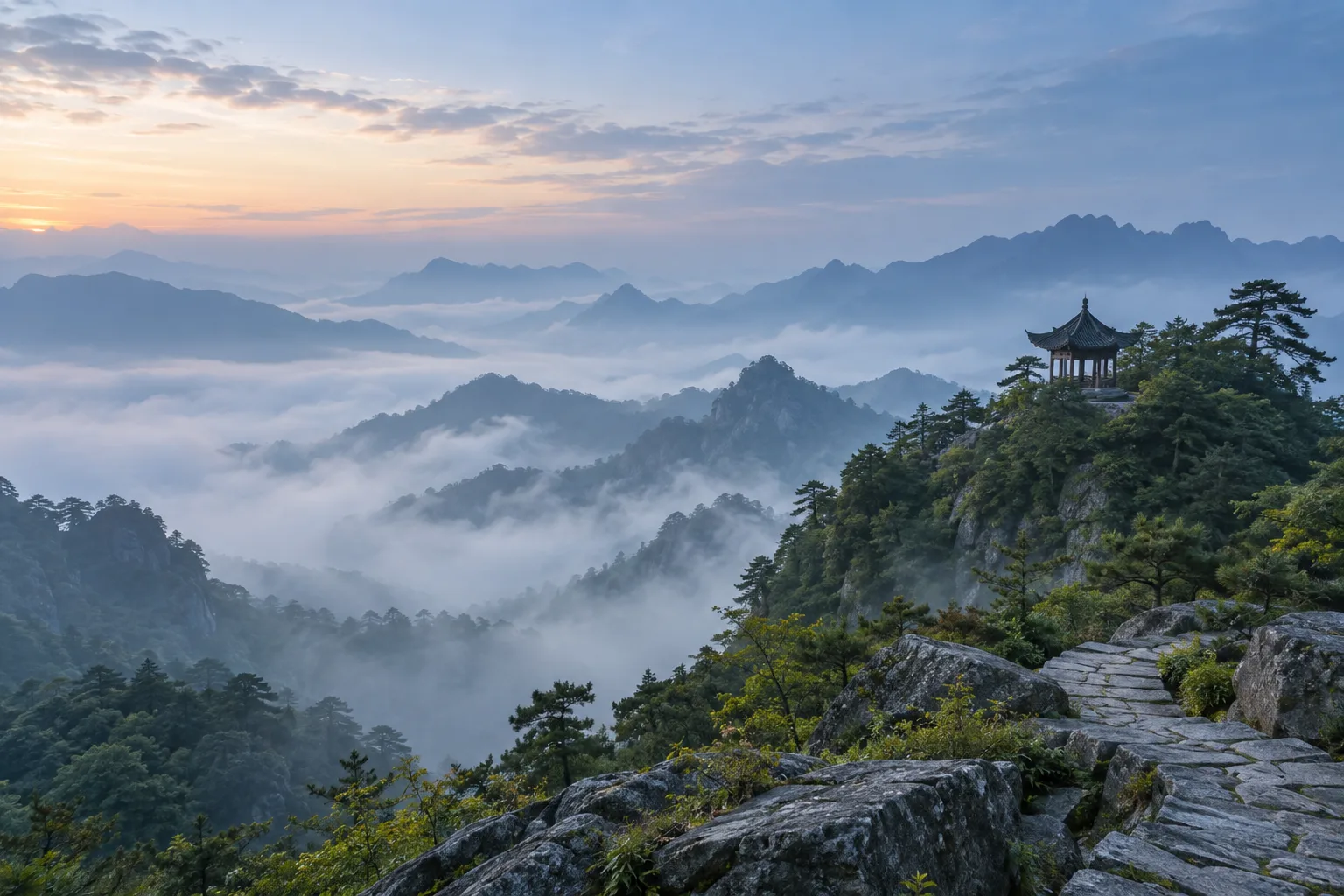
Read the listing as an invitation to look more carefully. A hall has a place in a network of temples, roads, patronage and religious use. A dramatic view becomes more informative when you ask how the buildings occupy slopes and valleys, and who cares for them now.
What was inscribed?
A building complex, not a single summit
The UNESCO property record describes palaces, temples and other religious and secular buildings among the peaks, ravines and valleys of Wudang. It records 53 surviving ancient buildings and nine architectural sites within the property. That inventory is a way to understand the breadth of the complex, not a promise that all components are open, equally preserved or reachable on one visit.
UNESCO lists the property under cultural criteria (i), (ii) and (vi): architectural and artistic achievement, influence on Chinese religious and public architecture, and association with the development of Daoist belief and thought. These are the Committee's reasons for recognising the property. They should not be turned into a claim that every story told about Wudang has been historically proved.
Many periods, a decisive Ming campaign
UNESCO traces Daoist buildings in the area to as early as the seventh century, while describing surviving work from the Yuan, Ming and Qing dynasties. Its account places the complex's most extensive coordinated building phase in the Ming, particularly the imperial campaign under the Yongle emperor, Zhu Di. Earlier traces and later repairs belong in the story too: a World Heritage site is neither a single-date monument nor a mountain frozen in one dynasty.
To see the religious context behind this patronage, read our introduction to Zhenwu and Wudang. The deity's role helps explain why halls, routes and summit structures were linked; it does not require treating a legend as an architectural date.
How do buildings and landscape work together?
Follow a route, then look at the details
A visitor may remember a summit photograph, yet the heritage argument concerns an ensemble distributed through a mountain. Compare a gateway, a valley complex and a higher hall. Look at changes in access, the placement of a courtyard against a slope, and the way a building frames the next stretch of the route. Our temples and sacred sites guide distinguishes sites and names so that one photograph is not asked to stand for the whole property.
UNESCO's description includes the Golden Shrine, the Ancient Bronze Shrine and Purple Heaven Palace among its examples. Their materials, dates and later interventions differ. Asking which structure you are viewing is more useful than calling every golden roof “the Golden Hall.” The listing is a starting point for reading fabric and location, not a substitute for an individual site's record.
A living place has more than one use
Religious activity, conservation and tourism meet in the same landscape. A hall can be a protected building and a place of worship; a route can serve both visitors and a religious community. That overlap asks for ordinary care: respect ceremonies and access rules, stay on permitted routes, and distinguish what a guide can show today from what a historic document establishes. Our Wudang today guide explains the contemporary setting.
What does protection require now?
Designation is a continuing obligation
The inscription did not finish the work of protecting Wudang. In its 2025 decision on the property, the World Heritage Committee welcomed conservation efforts while asking for clearer component boundaries, a proposed unifying buffer zone, more information about visitor controls and an updated management plan. It also asked for better on-site explanation of the Yuzhen Palace uplift project and its archaeological context. These were requests made in 2025, not a claim that every measure has since been completed.
The Committee's attention to sacred pathways and the wider mountain setting gives a useful reading principle: a temple is not isolated from the approach to it. Maintenance of materials, explanation of changes and management of crowds can affect how the complex is understood as much as a panoramic viewpoint does.
Three questions to take with you
At any stop, ask: What is this particular place? Check its name and period rather than relying on a caption for the mountain as a whole. What can I actually see? Separate surviving fabric, repair, interpretation and legend. What connects it to the next stop? Notice routes, terrain and living use. These questions work from a desk as well as on a walk.
Start with the Wudang Mountain introduction, then move to the temples and sites guide for individual places. For the formal inscription and later conservation decisions, follow the two UNESCO records linked above. The World Heritage label becomes useful when it leads back to the buildings, their setting and the responsibilities that come with both.