A path into the reading
Where to Stay and Eat at Wudang Mountain
Choosing between the base town and the mountain, plus local food and temple meals
Start here
01 Find your bearings
Where to Stay at Wudang Mountain
The base town, mountain accommodation and why temple stays are usually unavailable
Explore this sectionGo further
Deeper reading
The full guide
What should I know before reading further?
Where you sleep is the single highest-leverage decision available to a visitor to Wudang, and it is one most people make casually. Food matters less but has a few traps, particularly for vegetarians, who will find provision here better than almost anywhere else in China for reasons connected to the religion.
Read more The complete guide
Where you sleep is the single highest-leverage decision available to a visitor to Wudang, and it is one most people make casually. Food matters less but has a few traps, particularly for vegetarians, who will find provision here better than almost anywhere else in China for reasons connected to the religion.
The trade-off in one paragraph
Staying in the town at the foot gives you more choice, better value, more comfort, easier logistics, restaurants, shops and no need to carry anything up. Staying on the mountain gives you the halls at dawn and dusk without day visitors, the resident clergy conducting services, weather and light that day visitors never see, and a head start on the summit — at the cost of higher prices, simpler rooms, limited food, carrying your own bag up stairs, and much less flexibility. Everything else in this sub-group elaborates that sentence.
Why the mountain premium exists
Accommodation on the mountain costs more and offers less, and visitors sometimes read this as exploitation. It is mostly arithmetic.
Everything on the mountain has to be carried there. Supplies, fuel, laundry, staff and waste all move up and down a steep road or a stairway, and in some places by hand. There is limited space, so buildings cannot expand to capture economies of scale. Water, heating and drainage are harder and more expensive to provide at altitude on a protected site where new construction is restricted. Seasonality is severe, so a business must cover its costs from a compressed period of demand. And heritage protection constrains what may be built or altered, which raises costs and caps supply.
Understanding this makes the premium easier to accept, and it also tells you what to expect: you are paying for position, not for comfort. Judge mountain accommodation by where it puts you at six in the morning, not by the room.
Which to choose
Decide from your priorities rather than from price.
Stay on the mountain if you want to see services, if photography in early or late light matters to you, if the summit is a priority and you want to be above the entrance queue, if you are staying several days, or if the atmosphere of a working temple site out of hours is part of what you came for. This is the choice that produces the experiences people remember.
Stay in the town if your visit is short, if you value comfort or eating well, if you are travelling with children or anyone who tires easily, if you want flexibility to change plans, if you are also there for a martial arts school, or if you are on a tight budget. There is no shame in this, and a well-organised day trip from the base sees a great deal.
A hybrid works well for a stay of three or more nights: town first while you get oriented and cover the lower and outlying sites, then one or two nights up the mountain positioned for early mornings and the summit, then down. It captures most of the benefit of both and is what many experienced visitors do.
Booking, and two practical warnings
Book ahead for holiday periods and school vacations, when demand at both levels exceeds supply and prices move accordingly. Outside those periods there is generally more slack, though mountain accommodation is limited in absolute terms at any time.
Two warnings are worth stating plainly. First, verify what you are booking and where it actually is. Listings sometimes describe town accommodation in terms that imply a mountain location, and the difference is a transport stage and an entrance queue, not a short walk. Establish which side of the controlled entrance your bed is on before you pay.
Second, if you are staying on the mountain, confirm how your area admission and transport interact with an overnight stay before relying on the plan. Arrangements for re-entry and multi-day validity vary and change, and getting this wrong can mean paying twice or being unable to complete an itinerary. Ask at the point of purchase, not afterwards.
What to expect from the food
Set expectations at the level of good regional cooking rather than destination dining, and you will eat well.
The town at the foot has the range: Hubei home cooking, noodle and dumpling shops, freshwater fish, plenty of chilli, and the usual national standards. On the mountain, provision is limited, concentrated at the busy nodes and around accommodation, simpler, and more expensive for the reasons above. Between sites there may be nothing at all, so carry water and something to eat rather than assuming you can buy.
Vegetarians are unusually well served, and this is worth knowing in advance. Taoist dietary practice involves abstention from meat in various contexts, and monastic kitchens on this mountain cook accordingly, so vegetarian food here is a normal category rather than a special request. Some temples serve simple vegetarian meals, and the tradition also excludes the five pungent vegetables of the allium group in stricter contexts, so temple food may be plainer than restaurant vegetarian cooking. Outside the temples, be aware that dishes described as vegetable-based commonly contain meat stock or small amounts of pork as seasoning, so say clearly what you do not eat rather than assuming.
Practical points that actually matter
A short list, all of them things that recur.
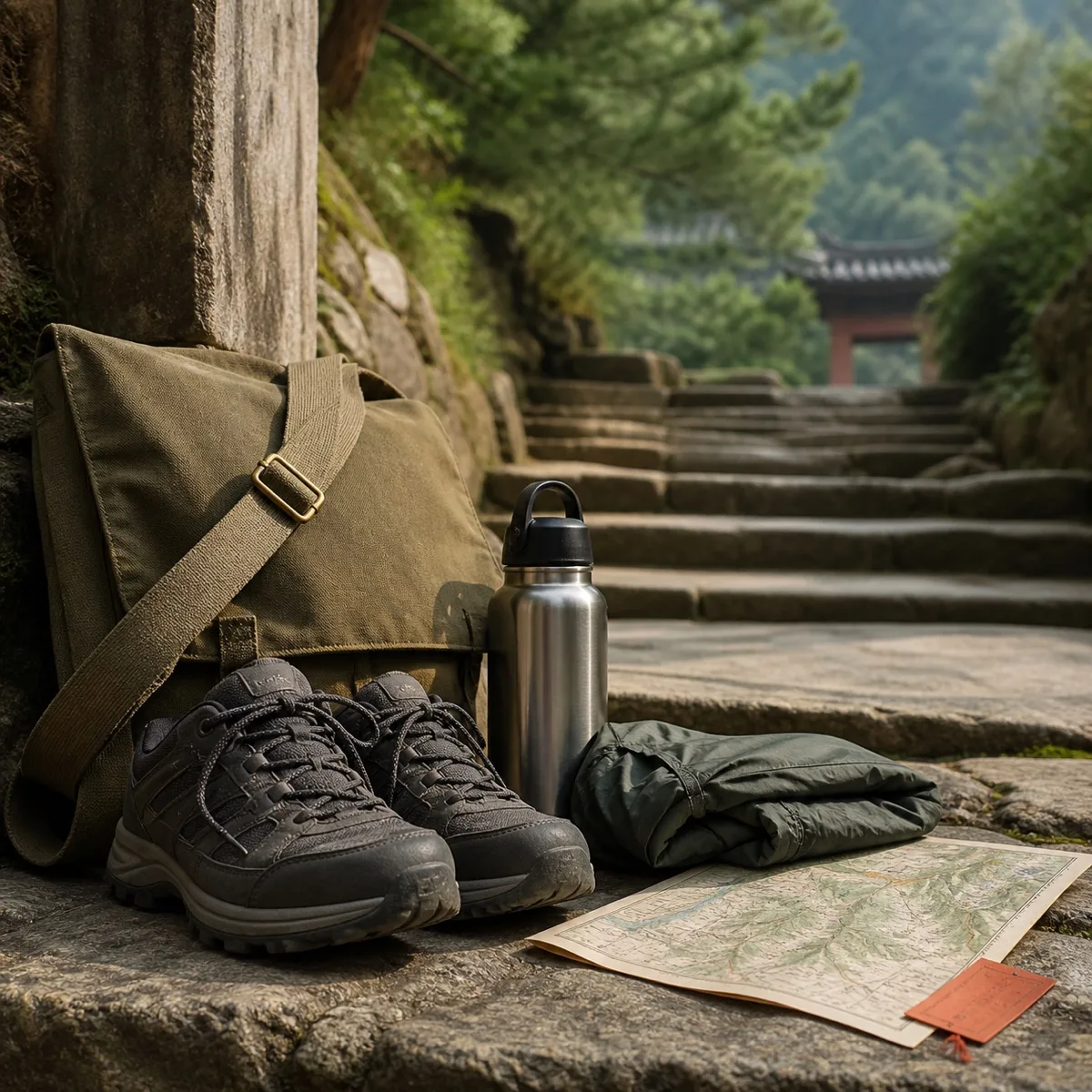
Carry your own bag up if you sleep on the mountain, and pack accordingly — small, light, and only what you need for a night. Bring layers for the evening, because it gets markedly colder up there than in the town. Expect simple rooms, thin walls, early noise from other guests leaving for sunrise, and heating that may be minimal outside winter. Charge devices when you can. Take a torch, because paths and stairways are dark and lighting is not continuous. Drink more water than you think you need on climbing days. And if you have any dietary restriction, learn the phrase for it, because explaining in English is not reliable here.
Eating as part of the visit
One reframing is worth offering, because it changes how the practical business of meals fits into the trip.
Food on this mountain is not incidental to the religion. Abstention, vegetarian cooking, the offering and later consumption of food, communal meals at festivals and the monastic kitchen are all part of Taoist practice rather than a dietary preference attached to it. Eating a plain vegetarian meal at a temple, if the opportunity arises, is closer to the subject of this website than most of what you will photograph.
It also affects etiquette. Food offered at a temple, whether as a meal or as something handed to you, is not sold as a commercial transaction. Some temples ask a stated charge for a meal and others accept a donation; either way, the appropriate response is to accept it courteously, eat it, and pay the charge or give a donation without treating it as a transaction. The etiquette pages cover this more fully, but it belongs in your planning as well as in your conduct.
Staying longer, and staying as a student
A different set of considerations applies if you are on the mountain for weeks rather than days, which is common among people who come to train.
Long stays are almost always based in the town at the foot rather than on the mountain, because the economics and the practicalities of daily life require it. Schools frequently include accommodation, and its standard varies enormously; it is one of the things you should inspect in person before committing, along with the training space and the food arrangements. Shared rooms, basic facilities and limited heating are normal rather than exceptional at the cheaper end.
Two practical matters bear on long stays specifically. Food becomes a real issue over weeks rather than days: a diet that is fine for a week may not sustain hard daily training for three months, and students routinely supplement what a school provides. And the seasons matter far more: winter in unheated accommodation and summer humidity are both genuinely difficult, and people who arrive in a comfortable season sometimes underestimate what the rest of the year is like. The studying section treats all of this at length, but it belongs here too, because it is fundamentally a question of where and how you live.
The two pages
One page covers accommodation in detail: the base town, staying on the mountain, the kinds of places available, and how to judge them. The other covers food: what regional cooking here is like, what to expect at the different levels, vegetarian and temple food, and the practicalities of eating on a climbing day.
Sources and limits. This page describes the structure of the accommodation and food situation rather than current provision, and quotes no prices, names no businesses and recommends none. Availability, standards, what is open, and the interaction between overnight stays and ticketing all change without notice. Descriptions of dietary practice are general; individual temples differ, and whether meals are available to visitors depends on the temple and the day. Confirm everything locally.
Key points
Where you sleep is the highest-leverage decision of the whole visit, and most people make it casually.
The town gives choice, comfort, value and easy logistics; the mountain gives dawn and dusk in the halls, services, and a head start on the summit.
The mountain premium is arithmetic — carriage, limited space, altitude, seasonality and heritage constraints — so you pay for position, not comfort.
A hybrid of town then mountain suits stays of three or more nights and captures most of both.
Verify which side of the controlled entrance your accommodation is on, and confirm how an overnight stay interacts with admission and transport.
Food is good regional cooking rather than destination dining; on the mountain it is limited, simpler and dearer.
Vegetarians are unusually well served because abstention is part of the religion, though temple food may exclude alliums and be plainer.
Pack small if sleeping up, take layers and a torch, and carry water and food between sites.
Recommended next page
Where next?
What to Eat at Wudang MountainLocal dishes, vegetarian food, mountain prices and what a temple meal really meansA few alternatives