Where to Stay at Wudang Mountain
去武当山住在哪里
Where you sleep is the highest-leverage decision available to a visitor to Wudang, and it is not usually presented that way. The choice between the town at the foot and somewhere inside the protected area determines whether you get the early morning, which is the single largest improvement available. This page sets out the options, what each one actually buys, and why one commonly asked option is not available. It contains no prices or names.
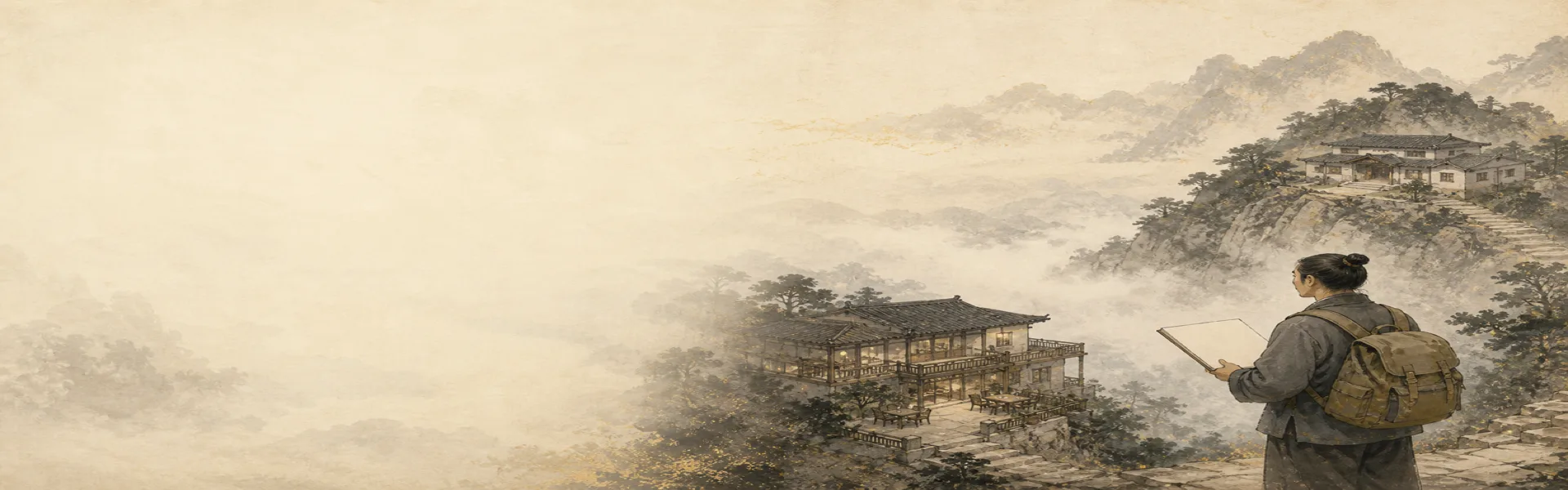
The town at the foot of the mountain
Most visitors stay in the town below, and for many it is the right choice.
What it gives you is choice and convenience. There is a range of accommodation at different standards, there are places to eat, there are shops, there is reliable transport, and there is somebody at a desk who can arrange a transfer. If you are arriving late, arriving without Chinese, or arriving with luggage, this is the low-friction option and there is no shame in taking it.
It also gives you a base. You can leave a case, do laundry, and return to a bed that is not cold, which over several days matters more than it sounds.
What it costs you is the early morning. Staying below means you enter the area with everybody else, arriving at the main sites in the middle of the day at the worst hour, having already spent time and energy on the approach. Every account of Wudang as overwhelmingly crowded is written by somebody who stayed below and went up at the usual time.
The compromise worth considering is to stay below for most nights and on the mountain for one, timed so that your summit or your most important complex falls on the following morning.
On the mountain
Accommodation exists inside the protected area, and taking it is the choice that most improves a visit.
The reason is arithmetic rather than atmosphere. Staying inside converts the two best hours of the day, early morning and late afternoon, from travel time into visiting time. You wake already there. You can be at a hall while it is quiet, in better light, possibly during the day's first service, before any coach group has reached the entrance.
It also removes the worst pressure of a Wudang day, which is the last internal service down. If you are staying up there, missing it does not matter, and the whole end of your day relaxes.
Be realistic about standards. Accommodation on the mountain is more limited in choice, generally simpler, and often more expensive than equivalent comfort below, for reasons explained in the next section. Heating in winter is frequently limited. Food options are fewer and close earlier.
Book it. Capacity inside the area is finite, it fills in season and around holidays, and turning up hoping to find a bed is a poor plan. If you can only secure one night inside, secure the night before the morning that matters most.
Why it costs what it costs
Visitors frequently find prices on the mountain surprising and read it as exploitation. It is worth explaining, because the reasons are structural and knowing them makes the decision easier rather than more annoying.
Everything inside the area arrives by the managed transport system. Every mattress, every crate of vegetables, every gas cylinder and every bag of cement comes up the same road on the same fleet, and goes back down as waste the same way. That logistics cost is embedded in the price of a bed and a bowl of noodles.
Capacity is fixed and cannot be expanded. This is a protected heritage and scenic area, so new building is constrained, which means supply does not respond to demand the way it would in a town. Fixed supply plus seasonal demand produces the pricing you observe.
Seasonality compounds it. A business inside the area earns heavily in a few months and thinly for the rest of the year, and prices reflect the whole year rather than the day you happen to be there.
None of this makes a given price reasonable, and you are entitled to decide it is not worth it. But it does mean the premium is a real cost being passed on rather than a captive market being squeezed, and it is the same premium you would find at any comparable protected mountain site.
Temple lodging
This is asked about constantly, so it is worth answering plainly: you cannot arrange to stay in a Wudang temple as a visitor.
The temples are religious institutions, not guest houses. Their residents are ordained Quanzhen clergy living in community, and the buildings are working liturgical spaces with living quarters that are private for the same reasons living quarters are private anywhere. There is no booking process, no rate, and no arrangement to be made, and asking at a gate will not produce one.
Historically, a Quanzhen public monastery did accommodate travellers, specifically ordained Taoists arriving with the correct credentials, and pilgrims in various informal ways. That is a real tradition and it is not a service currently offered to tourists. Reading about it in a historical account and expecting it to be available is a common error.
Where somebody does stay at a temple, it is because of a long-standing personal relationship with that institution, built over years and in Chinese. It is not purchasable, not arrangeable in advance from abroad, and not something a school, agent or website can organise for you. Anybody offering it is offering something else.
If what you want is the experience of being on the mountain at dawn, ordinary accommodation inside the protected area gives you that, which is the practical answer to the underlying wish.
Martial arts schools
Schools provide accommodation to their own students, and this is a different arrangement from tourist lodging.
If you are enrolling to train, accommodation is normally bundled with instruction and food in a single charge, and it is covered in the section of this site on studying at Wudang. Standards are simple: a shared or single room, basic furniture, shared washing facilities, canteen food at fixed times.
Schools are located in and around the town and the valley near the foot rather than up among the temples, so staying at a school is not a way to be on the mountain early. It is a way to train.
Some schools will accommodate a short-stay visitor who is not training, and some will not. If you are considering it, treat it as you would any other booking: establish what is included, what it costs, and what the arrangements are, in writing.
The important point is that a school is a private business and its relationship to the temples ranges from close to nonexistent. Staying at one is not staying in a religious community, and a school that implies otherwise is telling you something about itself.
Booking
The mechanics are worth knowing because they differ from what many visitors are used to.
Book ahead for anything inside the protected area, and book well ahead for holiday periods and weekends in season. Capacity is limited and does not expand.
Be aware that not every property in China accepts foreign guests. This is a real constraint, it varies by establishment, and discovering it at a reception desk late at night is unpleasant. Confirm in advance, in writing, that foreign guests are accepted, and take the confirmation with you.
International booking platforms show a subset of what exists, and domestic platforms show more but are harder to use without Chinese and a domestic payment method. Neither is complete, and a property absent from one may be well established.
Get the address in Chinese characters, on paper as well as on your phone. This solves a problem that arises far more often than visitors expect, particularly when arriving late or by taxi.
Ask about the transfer when you book. Accommodation that will collect you from the transport point, or tell you exactly how to reach them, has removed the single most stressful part of arrival.
A note for foreign visitors
Several practical points apply specifically and are better known in advance.
Registration of your place of residence with local authorities is an ordinary legal requirement in China, applying generally rather than aimed at foreigners. Hotels handle it automatically as part of check-in. If you stay somewhere informal, ask whether it has been done.
Bring your passport and expect it to be required at check-in. A photograph of it is not a substitute.
Payment can be awkward. Domestic mobile payment applications dominate, foreign card acceptance varies and is better in larger establishments than small ones, and cash in small notes remains the reliable fallback.
Heating and insulation are frequently limited, and winter here is damp cold rather than dry cold. Ask specifically about heating if you are coming in the cold months, and do not assume that a room that looks comfortable is warm.
Finally, adjust expectations of standard rather than of hospitality. Simple accommodation on a protected mountain is a fact about logistics and conservation, not about how you are regarded, and visitors who arrive expecting functional rather than comfortable have a much better time.
Sources and limits: this page describes types of accommodation and deliberately names no establishments and gives no prices, because both date rapidly and named recommendations are unfair to those omitted. Availability, standards, whether foreign guests are accepted, and registration arrangements vary by establishment and change, and must be confirmed directly and in writing before you travel.
Key points
- Where you sleep is the highest-leverage decision available, because it determines whether you get the early morning.
- The town below gives choice, convenience and a base, and costs you the best hours of the day.
- Staying inside the protected area converts early morning and late afternoon from travel time into visiting time, and removes the pressure of the last service down.
- If you can only get one night inside, take the night before the morning that matters most.
- Mountain prices reflect real logistics: everything arrives and leaves by the managed transport system, and capacity is fixed by protection rules.
- You cannot arrange to stay in a temple. It is not a guest house, there is no rate, and anyone offering it is offering something else.
- Schools accommodate their own students, sit near the foot rather than among the temples, and are private businesses rather than religious communities.
- Book ahead, and confirm in writing that foreign guests are accepted, since not every property in China does.
- Carry the address in Chinese characters on paper, and arrange the transfer when you book.
- Expect functional rather than comfortable, and ask specifically about heating in winter.