What a Trip to Wudang Mountain Costs
去武当山旅行需要多少费用
This page describes the shape of what a Wudang trip costs rather than the amounts. That is a deliberate choice and the reasoning is given below. What you get instead is the list of components, their relative weight, where money is genuinely wasted, and what a lean version and a comfortable version differ in. That is more durable than a number and, for planning purposes, more useful.
Why no numbers appear here
Prices change, sometimes at short notice, and a stale figure is worse than no figure because people trust it. A visitor who budgets from an obsolete number arrives underfunded and believes the site misled them. A visitor who arrives knowing they must check arrives prepared.
Exchange rates add a second layer of decay. A figure quoted in a foreign currency is out of date twice over: once because the local price moved and once because the rate did.
There is also a structural point. The single largest variable in what this trip costs is not any price on the mountain but how far you are travelling to reach it, which this site cannot know. For many visitors, transport to the region dwarfs everything spent once there, which makes a total meaningless without knowing where you started.
So what follows is proportion rather than quantity. Knowing that one item is likely to be several times another is genuinely useful for planning, and unlike a price it stays true.
The shape of the budget
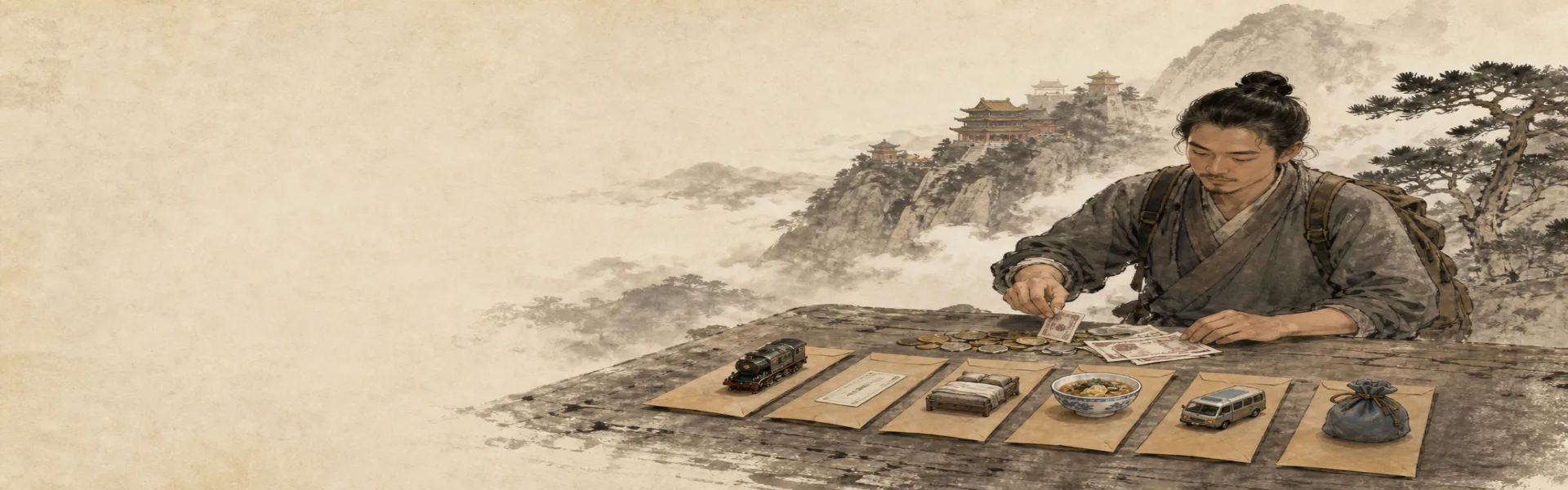
Six components account for essentially all of it, and they differ enormously in weight.
Getting to the region is usually the largest single item and is entirely outside anything the mountain controls. For a visitor coming from outside China it typically dominates the whole budget.
Accommodation is normally the second largest, and it scales with the number of nights rather than with anything else. It is also the component where the choice of location, mountain or town, changes both cost and the quality of the visit.
Entry and internal transport is the third, and the point to hold is that it is layered rather than single: area entry, shuttles, the cable car in each direction, and admission to individual sites. Visitors consistently underestimate this component because they budget for one ticket.
Food is fourth and is genuinely modest relative to the rest, unless you eat exclusively at the most convenient places on the mountain.
Local transport, meaning the transfers between the transport point, the town and the entrance, is fifth and small but not nil.
Discretionary spending is sixth: souvenirs, incense, donations, a guide, and anything you decide you want once you are there.
A seventh item belongs on the list even though it is not spent: a reserve. Hold enough that an extra night, a changed ticket or a taxi at an awkward hour is a decision rather than a problem.
Where the money actually goes
The proportions surprise people, and knowing them prevents the two common planning errors.
For most foreign visitors, travel to the region and accommodation together account for the large majority of the trip, and everything spent on the mountain itself is a minority of the total. This means that agonising over ticket layers while booking flights carelessly is the wrong way round.
The corollary is that the highest-leverage decisions are about nights, not about tickets. How many nights you stay and whether you stay on the mountain or in the town below affect both cost and experience more than any other choice available to you.
Within the on-mountain spending, the cable car and the layered entry charges are the items most often underestimated, because they are charged separately and in each direction. Food and local transport are the items most often overestimated.
Donations are worth mentioning precisely because they are not a cost in any planned sense. There is no expected amount, no minimum, and giving nothing is entirely normal. If you want to give, do it through a box or a temple counter, and let the amount be whatever you would give a comparable institution at home.
The three places money goes wrong
Waste at Wudang is predictable and concentrates in three places.
The first is buying convenience you do not need. A car hired to a gate that private vehicles cannot pass, a guide engaged before establishing what they will actually do, a package that bundles things you would not have chosen separately. The pattern is paying to remove a difficulty that the site's structure removes anyway or does not have.
The second is buying at the wrong moment. Anything bought at the entrance is carried all day, which converts a cheap purchase into an expensive burden. Water in bulk, souvenirs on the way in, a walking stick, incense to be used far above. Buy water and refill it, buy souvenirs on the way out, and buy incense near the temple where you will use it.
The third is the priced-after-the-fact transaction. Anything accepted before a price is stated, whether an amulet placed in your hand, a blessing already begun or a service you did not ask for, is the one category at Wudang with a real financial downside. Establish the cost before you take, touch or accept anything. Once you are holding it, the negotiation has moved.
A fourth, subtler waste is worth naming: paying for speed and losing the visit. Hurrying between sites in order to include more of them is the commonest way visitors spend money to have a worse day, because everything here rewards being unhurried.
What a lean trip looks like
A lean version is entirely reasonable and does not involve missing the point, which is worth saying because frugality here does not cost you much.
Travel by rail rather than air, which is often cheaper and frequently faster door to door. Stay in the town at the foot rather than on the mountain, accepting that you lose the early morning advantage. Eat where local people eat rather than at the most convenient point on the route.
Walk the sections you can and use mechanised transport only where it saves the most. Take one day on the mountain and use it properly rather than two used carelessly. Skip the guide and read a page in advance instead, which is what the reference pages in this section are for.
Buy nothing at the entrance except water. Give what you want at a donation box and nothing to anybody who approaches you.
What a lean trip should not economise on is footwear, a waterproof layer, and enough nights to allow an early start at least once. Those three are where a small saving costs you disproportionately.
What a comfortable trip looks like
The other end is also worth describing, because the money that genuinely improves a visit is not spent where people expect.
Stay on the mountain. This is the highest-value expenditure available, because it converts the two best hours of the day, early morning and late afternoon, from travel time into visiting time. If you spend more on one thing, spend it here.
Add a night rather than adding sites. Two unhurried days beat three compressed ones, and the second visit to a complex you have already seen is the one where you notice things.
Arrange the transfer from the transport point through your accommodation, particularly if you are arriving late, without Chinese or with luggage. The premium is small and it converts an uncertain problem into a solved one.
Take the cable car up and walk part of the way down. Engage a guide only after establishing what they will do, and tell them you care about architecture and history rather than legends.
What comfortable money does not buy is access. There is no paid route past a queue at the cable car, no premium entry to a hall, and no version of the summit that is not reached on foot at the end. The difficulty of arrival is part of what these places mean, and it is not for sale.
The reserve, and why it matters
The item people omit is the one that determines whether a problem becomes an ordinary inconvenience or a bad day.
Hold enough in reserve that the following are decisions rather than crises: an extra night because the cable car was suspended and you did not reach the summit, a changed rail ticket because you did not want to leave, a taxi at an awkward hour because you misjudged the last service down, or a hotel nearer the station because a train was delayed.
Every one of those is a common occurrence rather than a disaster scenario. Cloud on this mountain is frequent, the last internal service is earlier than people assume, and the descent takes longer than planned.
Practically, keep the reserve accessible. Payment in China runs overwhelmingly through domestic mobile applications and foreign card integration varies, so a reserve that exists only on a card you cannot use is not a reserve. Carry some cash in small notes, which is also the only thing donation boxes and small stalls accept.
And insurance belongs in the same category of thought. You are undertaking a long day of steps in a mountainous area at some distance from major hospitals, and cover that includes medical evacuation is the provision that actually matters if something serious happens. Read the exclusions rather than the summary.
Sources and limits: this page deliberately contains no prices, fares, charges or exchange rates, because all of these change and stale figures are trusted more than they deserve. Current charges must be confirmed at the official entrance and with transport operators. Insurance terms must be confirmed with the insurer in writing. Nothing here is financial, legal or medical advice.
Key points
- No figures appear here on purpose: prices and exchange rates both decay, and travel distance dominates the total anyway.
- Six components: travel to the region, accommodation, layered entry and internal transport, food, local transfers, and discretionary spending.
- Travel and accommodation usually account for most of the trip, so nights matter more than tickets.
- Entry is layered, not single, and the cable car is charged separately in each direction. This is the most underestimated component.
- Donations are voluntary with no expected amount, and giving nothing is normal.
- Waste concentrates in three places: buying unnecessary convenience, buying at the entrance and carrying it all day, and accepting anything before a price is stated.
- Paying for speed to include more sites is how visitors spend money to have a worse day.
- A lean trip is entirely viable, but do not economise on footwear, a waterproof layer, or enough nights for one early start.
- The best money you can spend is on staying on the mountain, and on an extra night rather than extra sites.
- Hold an accessible reserve in small cash notes, and check that insurance covers medical evacuation.