When to Visit Wudang Mountain
什么时候去武当山最合适
When you come changes the visit more than almost any other decision, and unlike most travel choices this one involves genuine trade-offs rather than an obviously right answer. This page sets out what each season actually gives you and costs you, what fog does, why time of day matters more than season, and which periods are worth avoiding outright. No dates appear, because festival dates follow the lunar calendar and holiday periods change.
By season
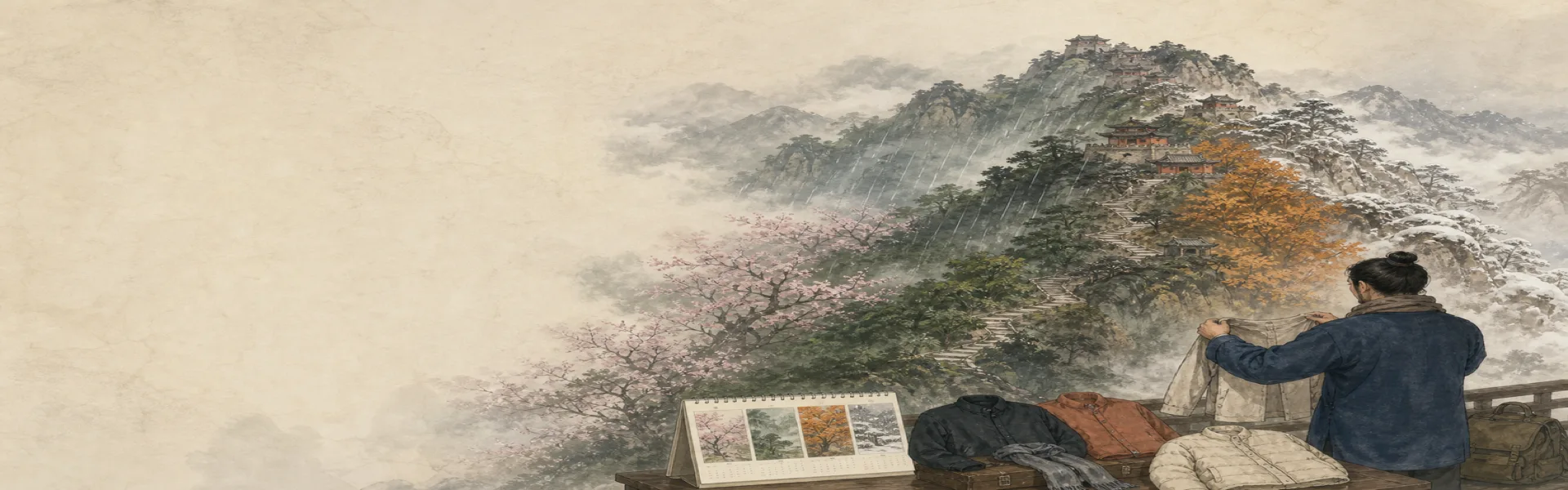
Spring is comfortable for walking, the vegetation is at its best, and conditions are generally kind. It is correspondingly popular, and the mountain is busy. Rain becomes more frequent as the season advances, and the weather is changeable enough that layers matter.
Summer is hot and humid in the valley and noticeably better on the mountain, which is one of the reasons the mountain was attractive to begin with. It is also the wettest and cloudiest period, with frequent afternoon rain and long spells of low cloud. It is the busiest season, particularly during school holidays, and stone steps in heavy rain are the least pleasant version of this visit.
Autumn is the best compromise for most visitors: settled weather, clearer air, comfortable temperatures for climbing, and the best chance of long views. It is popular for exactly those reasons, and the early autumn holiday period is one to avoid.
Winter is cold and damp rather than dry-cold. The mountain is quiet, the halls are at their least crowded, and the atmosphere is at its best for anybody who does not mind being cold. Snow and ice occur and can close sections of the route or make them hazardous. Buildings are often unheated or barely heated. This is the season experienced visitors frequently prefer and inexperienced ones frequently regret.
The general pattern is that comfort and company move together. The seasons that are pleasant to walk in are the seasons everyone else chooses, and the seasons that offer solitude ask something of you in return.
Fog
Cloud and fog deserve their own section because they are the defining weather feature of this mountain and the thing visitors are least prepared for.
Low cloud sits on Wudang frequently, in every season and most often in summer. It arrives quickly, it can persist for days, and it does not correlate reliably with rain. You can have a dry day in which you see nothing beyond thirty metres.
The obvious cost is the view. If long views are the point of your visit, fog removes them entirely, and the summit in cloud is a small bronze hall in a white void. Visitors who travelled a long way specifically for the panorama find this genuinely disappointing.
The less obvious point is that fog improves as much as it removes. A courtyard in cloud is transformed: the surrounding landscape disappears, the building becomes the whole of what there is, and the scale and quiet of a complex read far more strongly than on a clear day. A great deal of what makes these places affecting is closer than thirty metres away.
Practically, fog also makes stone slippery, obscures drops, and makes the descent slower and less safe. It is the main reason to build margin into the end of your day.
And it is the main argument for two days rather than one. A summit visit lost to cloud on the first day can be recovered on the second; a single-day visit has no such margin, and hoping for weather is not a plan.
Time of day
This matters more than season, and if you take one thing from this page it should be this.
Early morning is the single largest improvement available to any visitor. The halls are quiet, the light is better, the air is cooler for climbing, the day's first service may be under way, and the coach groups have not arrived. The same hall at seven and at eleven is close to two different places, and the difference is not marginal.
Late afternoon is the second-best time and shares some of the advantages, with good light and thinning crowds. Its disadvantage is that you are working against closing times and the last internal service down, which introduces a pressure early mornings do not have.
The middle of the day is the worst time at the main sites, and it is when most people are there, because it is when day visitors arrive. If your schedule forces you into it, use it for moving between places, for the outlying sites, or for lunch, and keep the halls for either end of the day.
The practical consequence is the strongest argument for staying on the mountain overnight. Doing so converts the two best hours of the day from travel time into visiting time, which is why it is the highest-leverage choice a visitor can make.
Festivals
Festival days transform the temples, and whether you want that is a real choice rather than an obvious one.
The most significant days for Wudang are those associated with Zhenwu, the god whose mountain this is, together with the general Taoist festival days observed everywhere. On these days the temples fill, additional rites are performed, incense consumption rises steeply, and the site is crowded with pilgrims rather than sightseers.
The case for coming is that a festival shows you the place doing the thing it exists to do, at a scale and intensity an ordinary Tuesday cannot convey. If you want to understand what a working temple means, this is when it is most legible.
The case against is equally strong. Quiet observation becomes nearly impossible, accommodation fills, the main routes become slow queues, and the experience of standing in a hall alone with a sculpture is not available.
Dates follow the traditional lunar calendar and therefore move against the ordinary calendar each year. This site does not list them, for the same reason it lists no prices: a wrong date is worse than none. If it matters to your plans, check locally or with a temple close to the time.
Periods to avoid outright
A short list, and the advice here is unusually firm.
National holiday periods concentrate domestic visitors dramatically. During these, the main routes become queues, accommodation is scarce and expensive, transport is fully booked well in advance, and the quiet early morning that makes this site worthwhile is not available. If you have any flexibility at all, use it to avoid these weeks.
School holiday periods in summer are the second thing to avoid, for the same reasons in a milder form, combined with the worst weather of the year.
Weekends are busier than weekdays throughout the year, and the difference is large enough to be worth planning around. A weekday in a busy season is often better than a weekend in a quiet one.
Periods of heavy snow or ice in winter are worth avoiding not because the mountain is unpleasant but because sections of the route may be closed and the parts that are open become genuinely hazardous. If you go in deep winter, check conditions locally before committing to a summit attempt.
Putting it together
A decision procedure, in order, since the factors interact.
First, avoid the national holiday weeks and the summer school holidays if you possibly can. This single filter improves the visit more than any positive choice you can make afterwards.
Second, prefer weekdays to weekends, and prefer autumn if you have a free choice, with spring second and winter a strong option for anyone who tolerates cold and wants quiet.
Third, plan for at least one early morning, and if possible stay on the mountain overnight to get it. This is worth more than an extra day spent arriving late.
Fourth, build in a margin for cloud. Two days is the point at which a lost summit becomes recoverable, and cloud on this mountain is frequent enough that a single-day plan is a gamble.
Fifth, decide deliberately about festivals rather than encountering one by accident. Either seek one out because you want to see the place working, or check the calendar to avoid one because you want the halls quiet. Both are good reasons; arriving unaware is not.
Finally, accept that you cannot control the weather, and choose an itinerary that does not depend on it. A visit built around courtyards, halls, sculpture and the walk between complexes works in fog. A visit built around a panorama does not.
Sources and limits: this page describes general seasonal patterns and deliberately contains no dates, festival dates, holiday periods or weather data, because these vary and change and festival dates follow the lunar calendar. Current conditions, closures, festival dates and holiday periods must be checked locally close to the time. Notices and instructions on site always take precedence.
Key points
- Comfort and crowds move together: the pleasant seasons are the busy ones, and quiet seasons ask something of you.
- Autumn is the best compromise, spring is comfortable and busy, summer is hot, wet and crowded, winter is cold, damp and quiet.
- Winter often gives the best atmosphere and the least crowding, but snow and ice can close sections.
- Low cloud is the defining weather feature. It removes views entirely but transforms courtyards, since much of what matters is closer than thirty metres.
- Fog makes stone slippery and obscures drops, so it is the main reason to build margin into the end of the day.
- Time of day matters more than season. Early morning is the single largest improvement available to any visitor.
- Staying on the mountain overnight converts the two best hours of the day from travel time into visiting time.
- Festivals show the place doing what it exists to do, and make quiet observation nearly impossible. Decide deliberately.
- Avoid national holiday weeks and summer school holidays, prefer weekdays, and check winter conditions before a summit attempt.
- Choose an itinerary that works in fog: courtyards, halls and sculpture do, a panorama does not.