What Martial Arts Training at Wudang Mountain Is Really Like
武当山武术训练的真实样子
This section describes the experience rather than the arrangements: what your days actually consist of, how the teaching feels, what living there is like, and what you can honestly expect to have gained. It is written plainly, including the unattractive parts, because the unattractive parts are what people are least prepared for and most likely to be defeated by.
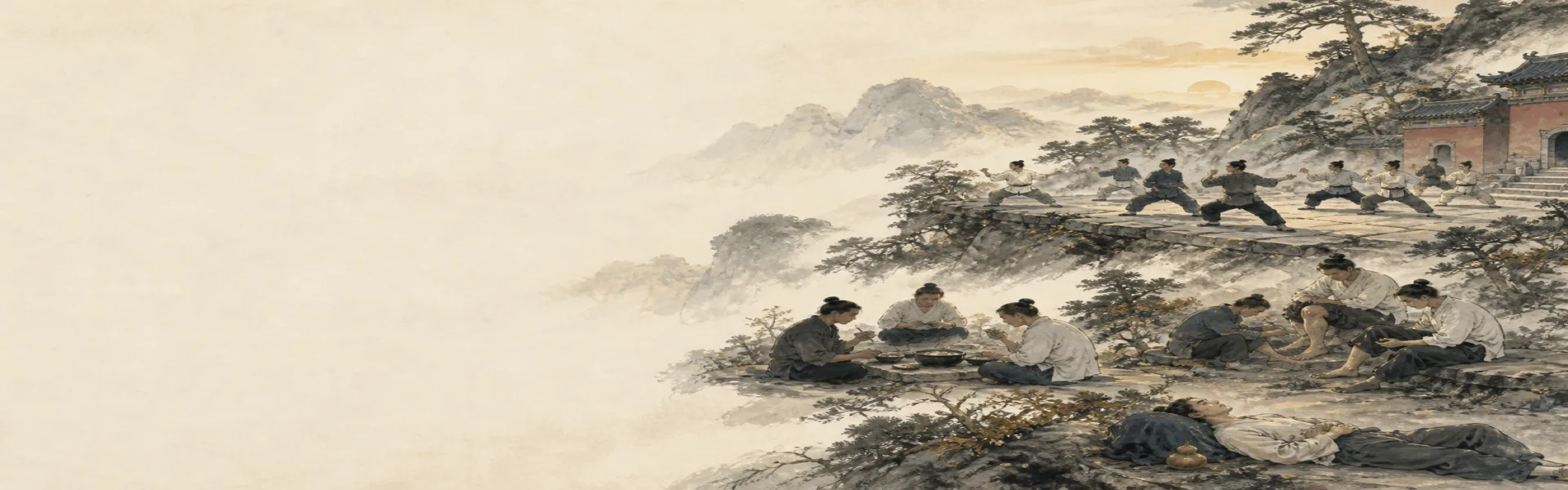
The shape of the day, and the boredom
A training day is long, early and repetitive. Most schools begin not long after dawn, break in the middle of the day, and train again in the afternoon, with total training time commonly somewhere between four and six hours. The rest of the day is eating, washing, resting and lying down.
What surprises people is how little variety there is inside that. A single session may consist of half an hour of stance work, half an hour of basic exercises repeated in lines, and then the same twenty movements of a form, corrected, repeated, corrected again. Tomorrow will be similar. Next week will be similar. The material advances slowly and deliberately, because the point is not to accumulate movements but to change how you perform the ones you have.
This produces boredom, and the boredom is not a failure of the school or of your attitude. It is a structural feature of learning a physical skill by repetition, and every student meets it. Those who do well are generally not the most enthusiastic arrivals but the ones who can be bored without becoming resentful. If you know in advance that weeks two and three will feel monotonous, you are much less likely to conclude that something has gone wrong.
There is also more standing still than any promotional material suggests. A significant fraction of your training time will be spent motionless, uncomfortable, and apparently achieving nothing. That is the training working.
The teaching style, and why it feels cold
Foreign students frequently experience the teaching as impersonal or even hostile, and almost always this is a misreading of a different pedagogical culture rather than an accurate perception of indifference.
Instruction is by demonstration and correction, not explanation. You will be shown a movement, you will copy it badly, and you will be corrected, often physically, often in front of everyone, often loudly. The correction will be about the movement and will not be softened. Praise is rare and, when it comes, brief. Explanation of why arrives later, if at all, and frequently after you can already do the thing.
This is not withholding. The underlying assumption is that understanding follows ability rather than preceding it, which for physical skills is often true. A student who wants the reasons first tends to spend the first month arguing internally with the method instead of practising it.
What genuinely does indicate a problem is correction aimed at you rather than your movement, or a teacher who does not watch. Blunt is normal. Contemptuous is not, and inattentive is worse than either.
The practical adaptation is to stop looking for encouragement and start reading attention as the signal. A teacher who keeps returning to correct your elbow is investing in you. A teacher who says nothing has either given up on you or is not looking.
Living conditions
Accommodation at most schools is simple: a shared or single room, basic furniture, shared washing facilities, and heating that ranges from adequate to notional. Rooms in the town and rooms nearer the mountain differ, and so do schools, but the general standard is functional rather than comfortable.
Food is usually canteen-style, rice or noodles with vegetables and some meat, served at fixed times, and repetitive. It is generally adequate and it is generally not what you are used to. Students with restricted diets should raise it before booking rather than after arriving, because a small kitchen cooking for forty people has limited capacity to accommodate individuals, and going hungry stops training faster than any injury.
Winter deserves specific warning. Wudang is cold and damp in winter, indoor heating is often limited, and clothes dry slowly. Students who arrive without genuinely warm layers spend the season being cold, which is a much larger factor in whether people finish their stay than they expect.
The internet works, the town has shops and restaurants, and you are not in a wilderness. But you are in a small place with limited options, and the narrowness that helps your training is the same narrowness that becomes tiresome in month three.
The people, and the turnover
The student population is transient, international, and unusual in composition, and this shapes the experience as much as the training does.
At any time a school holds a few long-term students, a larger group staying weeks to a few months, and a stream of very short-stay visitors. The consequence is constant turnover: people you train beside intensively for three weeks then leave, and the group reforms around you repeatedly. Some students find this refreshing and some find it lonely. The friendships formed are often intense and mostly do not last, which is worth knowing rather than being disappointed by.
The people who come are a self-selected group, which mostly means committed and interesting and occasionally means someone in the middle of a personal crisis using the mountain as a solution. A minority arrive with expectations no school could meet. You will meet both kinds, and you are not obliged to adopt anyone else's project.
Long-term students are the most valuable people to know. They can tell you what is actually taught, which teachers are worth seeking out, and how the place works. They are also the best evidence about the school, since their movement demonstrates what the teaching produces.
The dip, and injuries
The emotional curve is predictable enough to describe, and knowing its shape prevents people quitting at the standard low point.
The first week is exciting and produces apparently rapid progress, because everything is new. Weeks two and three are the dip: your legs hurt continuously, you now know enough to see how badly you perform, novelty has gone, the food is repetitive, and homesickness arrives. Most people who leave early leave here. Almost nothing has actually gone wrong; this is simply what the third week feels like.
After that, progress becomes step-like. A movement wrong for a month becomes right in one afternoon, usually unexpectedly. These moments arrive to students who trained through the flat stretches and not to students who changed schools looking for a better teacher, since changing restarts the curve.
Injuries are common and mostly minor: strained groins and hamstrings from stretching, sore knees from bad stance alignment, shoulder and wrist trouble from weapons work, and general overuse from doing far more than your body is accustomed to. Almost all of it comes from three causes: too much too soon, poor alignment held for too long, and enduring pain that should have been reported.
The rule that prevents most of it is simple. Discomfort is training; joint pain is a signal. If a knee hurts, raise the stance and tell the teacher immediately, in that order. Students who hide injuries in order to seem serious lose far more training time than students who report them, and a school worth attending will adjust the work rather than think less of you. Anything that does not resolve, or that involves swelling, giving way or numbness, needs a doctor rather than persistence.
Why people stay anyway
Given a description this unglamorous, it is worth explaining why a proportion of students extend, return, or stay for years.
The first reason is that the routine works. Four to six hours a day for three months does something to a body that weekly classes cannot, and people can feel it. Balance, leg strength, posture and general capability change measurably, and that change is satisfying in a way that is difficult to obtain from anything else.
The second is the simplicity. A life reduced to training, eating and sleeping removes an enormous number of decisions, and many people find that unexpectedly restful. The absence of options that makes month three tiresome is the same absence that makes the whole period feel clear.
The third is the material itself. These arts are deep enough that competence keeps receding as you approach it, and for a certain kind of person that is compelling rather than discouraging. Students who stay years are generally not the ones who came for transformation; they are the ones who found a problem interesting enough to keep working on.
The three pages
The pages following this one go into detail. One describes a typical day and the longer rhythm over weeks and months, including living conditions and time off. One covers costs, paperwork, visas, insurance and medical care in practical terms. One sets out realistic expectations for one week, one month, six months and several years, and what happens when you go home.
Sources and limits: this describes patterns reported consistently across schools at Wudang over many years rather than the arrangements of any particular school, which you should confirm directly. Training hours, conditions and food vary and no figures here should be treated as commitments. Nothing on this page is medical advice; injuries, persistent pain and any pre-existing condition are matters for your own doctor.
Key points
- Days are long, early and highly repetitive, with commonly four to six hours of training and little variety inside it.
- Boredom is structural, not a sign of a bad school. Tolerating it without resentment is the main predictor of success.
- Teaching is by demonstration and correction, blunt and public, with explanation arriving after ability.
- Read attention rather than encouragement: a teacher who keeps correcting you is investing in you.
- Conditions are functional rather than comfortable; winter is cold and damp and defeats the unprepared.
- Raise dietary restrictions before booking, because a small canteen has limited flexibility.
- Turnover is constant and friendships are intense and usually brief; long-term students are the most useful people to know.
- Expect a good first week and a difficult second and third. Most early departures happen at the standard low point.
- Discomfort is training; joint pain is a signal to raise the stance and tell the teacher at once.
- People stay because the routine visibly works, the simplicity is restful, and the material does not run out.