A Typical Day Training at a Wudang Martial Arts School
在武当武馆训练的一天
This page describes the texture of a training stay: what happens between waking and sleeping, how the experience changes over weeks and months, and what living at a school is actually like. Timings differ between schools and change with the season, so what follows is a shape rather than a schedule. Confirm the details with your own school.
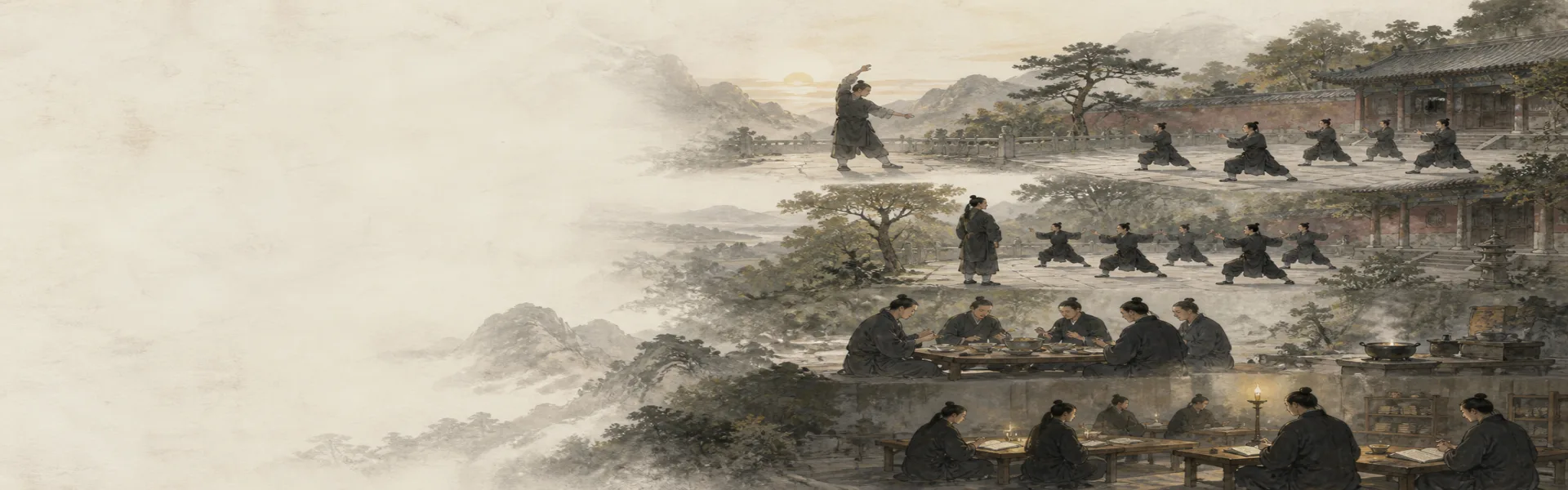
A typical day
Days start early. Most schools have students up not long after dawn, with the first session beginning before breakfast rather than after it. The first session is usually the quiet one: stance work, standing practice, a moving set, sometimes a walk. It is deliberately placed before food and before the day has properly begun, and long-term students often come to regard it as the best part of the day, though almost nobody thinks so in the first week.
Breakfast follows, then the main morning session, which is the longest and most demanding block. This is where basics and form work happen: leg conditioning, stretching, footwork drills, then sectional work on whatever form you are learning, with correction repeated until the group is dismissed.
The middle of the day is a real break, and it is longer than newcomers expect. Lunch, then rest. Most students sleep. This is not laziness; two demanding sessions on either side of it make the midday rest functional, and students who spend it exploring the town tend to struggle by the third week.
The afternoon session is typically shorter and often more varied: weapons, partner work, conditioning, or continued form practice. Some schools add a short evening session or an optional practice, and many students practise on their own afterwards, which is voluntary and where a good deal of actual improvement happens.
Evenings are free and quiet. Dinner is early, the town is small, and most people are tired enough that the evening consists of eating, washing, some conversation and sleep. This is one of the more surprising features of the experience: the day is so physically full that ordinary evening life largely disappears.
The first two weeks
The opening fortnight has a predictable shape, and knowing it in advance changes how you interpret it.
The first two or three days are disorientation plus enthusiasm. Everything is unfamiliar, the material is entirely new, and you will feel that you are learning quickly, because you are being shown a lot. Very little of it is going in.
Days four to seven are when the body objects. Legs that have never been asked to hold a low stance for twenty minutes hurt continuously, stairs become a problem, and you will discover muscles in your hips you did not know about. This is normal and it passes. What matters during it is not being heroic: raise the stance, report joint pain, and let the school adjust the work.
The second week is where the dip usually begins. Novelty has gone, soreness has not, you now know enough to see how badly you perform, the food has become repetitive, and homesickness arrives with no warning. Most people who leave early leave here, and almost none of them are leaving because of a genuine problem with the school.
The practical advice for this period is narrow and useful. Do not make decisions during it. Do not compare yourself to students who arrived three months earlier. Sleep more than you think you need. Eat more than you feel like eating. And treat weeks two and three as something to be got through rather than as evidence about anything.
The rhythm over months
Beyond the first month the experience changes character, and the changes are worth anticipating.
In the second month the body stops complaining and the mind starts to. Soreness resolves into general fitness, and the difficulty becomes psychological: the same form, the same corrections, apparently no progress. This is the refinement stage, and it looks like nothing is happening because the change is in quality rather than quantity. It is also where students most often ask to learn something new, and where a good school most often says no.
Somewhere in this period the step-like progress starts. A movement that has been wrong for weeks becomes right in a single session, usually while you are thinking about something else. These moments are the actual reward structure of the training, and they arrive irregularly.
By the third or fourth month, routine has become genuinely comfortable and a different problem appears: the narrowness of the place. The absence of options that helped in month one becomes tiresome. Long-term students handle this by building a life beyond the school, learning some Chinese, developing local habits and friendships, and taking real time off rather than training every day until they resent it.
Beyond six months the experience is no longer about learning material at all. Students at that stage are working on quality, teaching juniors informally, and treating training as ordinary daily life rather than a project. Almost everybody who reaches this point extended from a shorter commitment rather than planning it from the start.
Living conditions
Accommodation is functional. Expect a simple room, single or shared, basic furniture, a hard bed, shared or basic private washing facilities, and heating that varies from adequate to notional. Schools nearer the mountain and schools in the town differ in atmosphere more than in standard.
Laundry is usually done by hand or in a shared machine, and drying is slow in the damp months. Bring clothes that dry quickly and enough training kit that you are not dependent on a fast turnaround.
Food is canteen-style and served at fixed times: rice or noodles, vegetables, some meat, plain and repetitive. It is adequate. It is also non-negotiable in practice, so if you have restrictions, resolve them before you book. Students who cannot eat what is served either supplement from the town constantly, which is expensive and inconvenient, or gradually stop training properly.
Winter is the condition worth planning for. Wudang is cold and damp rather than dry-cold, buildings are often unheated or barely heated, and being cold indoors for weeks is a much bigger factor in whether a stay succeeds than most people credit. Warm layers, warm bedding if permitted, and warm training clothes matter more than any equipment.
The social side
The student body is international, transient and largely friendly, and the social experience is intense in a way that surprises people.
Because everyone is doing the same difficult thing at the same time, friendships form very fast. Because most people stay weeks rather than months, they also end fast, and the group around you reconstitutes itself several times during a long stay. This produces real warmth and a recurring low-level sadness, and both are normal.
Language shapes the social world more than nationality does. Students who share a language cluster together, and students who speak some Chinese have a completely different experience because they can talk to staff, local students and people in town. The isolation some foreign students describe is usually linguistic rather than cultural.
A word about the awkward part. A minority of students arrive in the middle of personal difficulty, treating the mountain as a remedy, and a few of those become intense company. You are entitled to keep your distance. Equally, if you are the one struggling, the long-term students and staff are more used to it than you would expect, and saying so is better than absorbing it alone.
Time off
Most schools train five and a half or six days a week, with one rest day, and how you use it matters more than it sounds.
The temptation on a day off is to climb the mountain, which is a long day of steps and stairs and leaves you worse than you started for the following week. Doing it is worth it. Doing it repeatedly is not, and doing it during the dip is a poor idea.
Better uses of a rest day are genuinely restful: sleeping, going into town, eating something different, washing everything, sitting somewhere and doing nothing. Students who train on their rest day out of enthusiasm usually pay for it, and schools generally discourage it for good reason.
Over a longer stay, take real breaks. A few days away every couple of months, ideally somewhere with different food and different scenery, resets the tiredness that accumulates invisibly. Students who never leave tend to arrive at resentment around month four and blame the school for it.
Sources and limits: schedules, conditions and rest arrangements vary between schools and by season, and this page describes typical patterns reported over many years rather than any school's actual timetable, which you should confirm directly. No timings here should be relied on for planning. Nothing on this page is medical advice; pain, injury and any existing condition are matters for your own doctor.
Key points
- Days begin before breakfast with quiet work, build to a long demanding morning session, break substantially at midday, and finish with a shorter varied afternoon.
- The midday rest is functional, not indulgent. Students who spend it sightseeing struggle later.
- Days four to seven are when the body objects. Raise the stance and report joint pain rather than being heroic.
- The dip usually begins in week two. Do not make decisions during it.
- Month two is psychologically hard because refinement looks like no progress. Progress then arrives in steps.
- By month three the narrowness of the place becomes the difficulty; a life beyond the school is the remedy.
- Conditions are functional, laundry is slow, and food is plain and fixed. Resolve dietary restrictions before booking.
- Winter cold and damp indoors is a bigger factor in finishing a stay than most people expect.
- Friendships form and end fast; isolation is usually linguistic, and a little Chinese changes everything.
- Use the rest day to rest. Climbing the mountain is worth doing once, not weekly, and not during the dip.