Auspicious Stars and Day Officers in Chinese Date Selection
择吉中的吉星、值日神与神煞
If the stems and branches supply the underlying grammar of date selection, the notional stars and spirits supply much of its vocabulary. Alongside the cyclical qualities of the day, the tradition populates the calendar with a large cast of unseen influences, auspicious and inauspicious, each moving through the days according to its own rule, and each lending its character to the days it touches. To read an almanac's judgements at all deeply, one has to understand this second layer, which is often what a specialist is really tracking.
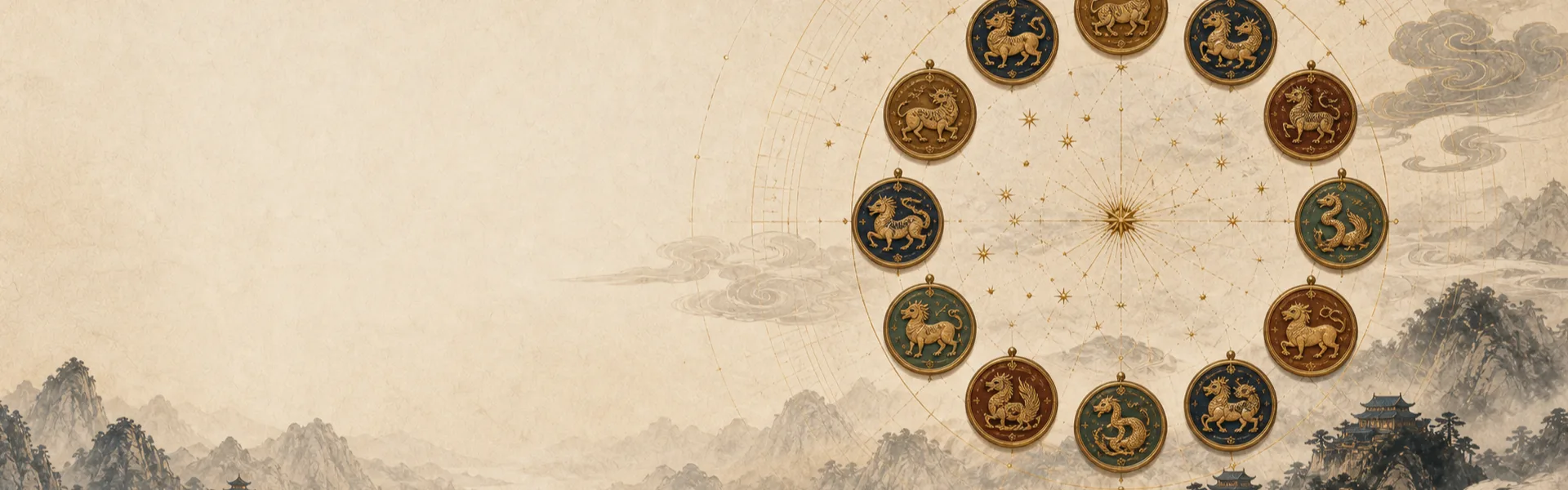
Not the stars of the sky
These influences are usually spoken of as stars or spirits, though they are not the stars of the visible sky. They are notional entities, positions in a cycle rather than points of light, each defined by a rule that fixes where it falls on any given day, month, or year. Some are regarded as benevolent, their presence marking a day as favourable for particular activities; others are regarded as harmful, their presence warning against certain undertakings. The tradition names a great many of them, and the specialist's skill lies partly in knowing which are strong enough to matter for a given purpose and which may be set aside.
Benevolent influences
Among the benevolent influences are those thought to bring good fortune, protection, or the blessing of heaven, and a day on which several of these gather is prized for important beginnings. Among the harmful influences are those associated with loss, obstruction, calamity, or death, and a day heavy with these is avoided, especially for weddings, burials, and other weighty affairs. Between these extremes lies a graded field of lesser influences, and the art of the specialist is to weigh them against one another rather than to react to any single one, since almost every day carries some mixture of good and ill.
The twelve day officers
A particularly important scheme is the cycle sometimes called the twelve day officers, a set of twelve governors that rotate through the days in a fixed order, each taking charge of one day in turn. Each officer is associated with a characteristic activity or mood, one favouring establishment and stability, another removal and clearing away, another fullness, another openness, another closure, and so on around the cycle. Because the officers turn in a regular sequence, the scheme gives every day a ready label that suggests what it is fit for. The almanac's lists of suitable and unsuitable activities draw heavily on this cycle, and it is one of the more accessible parts of the system for a lay reader to follow.
The twelve officers are worth learning because they are the most systematic part of the whole apparatus and the easiest to check. Their names — Establish, Remove, Full, Level, Stable, Grasp, Break, Danger, Complete, Receive, Open, Shut — form a sequence with an evident internal logic, moving from initiation through fullness to closure. The rule that fixes them is simple: within each solar month, the day whose earthly branch matches the month's own branch is Establish (建), and the other officers then follow in order, one per day. Anyone with a calendar can verify an almanac's assignment of officers, which is not true of most of the material on the page.
The twelve yellow and black road spirits
Running in parallel with the day officers is a second set of twelve, divided into two groups of six. The yellow road (黄道) six — Green Dragon, Bright Hall, Golden Casket, Heavenly Virtue, Jade Hall and Director of Destinies — are counted auspicious. The black road (黑道) six — Heavenly Punishment, Vermilion Bird, White Tiger, Heavenly Prison, Dark Warrior and Hooked Chen — are counted inauspicious.
This set is the source of an expression that has passed into ordinary Chinese far beyond any divinatory context: huangdao jiri (黄道吉日), "a yellow-road auspicious day," used casually to mean a good day for something. A great many people use the phrase daily without knowing that it names six particular spirits in a rotation of twelve.
One clarification is needed because the wording invites confusion. The "yellow road" here has nothing to do with the ecliptic, which is called by the same name in Chinese astronomy. The two uses share a word and nothing else; no position of the sun is involved in deciding whether a day belongs to the yellow road or the black.
Several of these names will be familiar from elsewhere. Green Dragon, Vermilion Bird, White Tiger and Dark Warrior are the four directional emblems of Chinese cosmology, met in temple decoration and in feng shui. Their appearance here as day spirits is a good example of how this material was assembled: existing figures of wide cultural currency were recruited into a rotation and given a new job.
The malefic spirits
The unfavourable names are considerably more numerous than the favourable ones, and a full list is beyond any single almanac. Among the commonest are Year Breaker (岁破) and Month Breaker (月破), the Four Extinctions (四废), the Three Killings (三煞), Robbery Killing (劫煞), Disaster Killing (灾煞), Wangwang (往亡, "going and perishing," forbidding journeys and appointments), Double Mourning (重丧), Heavenly Dog (天狗), Mourning Gate (丧门) and Five Ghosts (五鬼).
Well over a hundred such names can be collected from the literature, and no two schools adopt exactly the same set. Their rules of appearance are equally varied: some are keyed to the year, some to the month, some to the day's branch, some to a combination.
This proliferation is precisely the problem the Qianlong compilers set out to solve. With so many spirits, defined by so many incompatible rules, the same day could be marked both suitable and forbidden for the same activity depending on which authority one followed. The imperial compendium worked by adjudication — discarding names judged spurious, ranking those retained, and issuing a standard.
This fact is worth stating more than once, because of where it comes from. It is not a modern sceptic's objection. It is the considered judgement of the tradition's own official custodians that the system of spirits was internally contradictory and required human editing to be made coherent.
Where these spirits came from
The origins of this crowded sky of influences are various. Some of the spirits descend from very old beliefs about the powers that govern time and direction; others were systematised by astrologers who wanted rules precise enough to compute; still others accumulated over centuries as different schools added their own refinements. The result, by late imperial times, was a system of considerable intricacy, in which dozens of influences might in principle bear on any given day. It was partly to tame this profusion that the imperial compilations of date-selection method were produced, sorting the influences, ranking their importance, and laying down rules for when a benevolent influence could be said to overcome a harmful one.
What the almanac user actually sees
For the person consulting an almanac, most of this machinery stays out of sight. What reaches them is the distilled verdict: this day is suitable for a wedding, that day should be avoided for a funeral. But knowing that these verdicts rest on a moving pattern of notional stars and rotating officers helps make sense of the tradition. It explains why two days that look identical in the plain calendar can be judged quite differently, and why a specialist consulted for an important choice will look past the almanac's summary to the particular influences in play for a particular person.
Coherence and reality
As with the rest of date selection, an honest account must separate the coherence of the scheme from the reality of its claims. The cycles of stars and officers are defined by exact rules and can be computed without ambiguity; in that sense they are perfectly real, as patterns. Whether the influences they track exert any actual power over human affairs is another matter entirely, and here the tradition rests on belief rather than evidence. There are no such spirits known to move through the days, and no demonstrated effect of the day officers on the success of the activities assigned to them. The scheme is best understood as an elaborate symbolic system, a way of giving each day a distinct meaning and mood, rather than as a map of forces that actually shape events.
A word of warning
A range of paid services attaches itself to these spirits, most commonly under the headings of "settling Taisui" (安太岁), "dissolving the killing" (化煞) and "repairing fortune" (补运). Two quite different things need separating here.
Temples that maintain a Taisui hall and hold blessing ceremonies at published times, for published fees, are conducting ordinary religious activity. Whether to take part is a personal decision, and there is nothing untoward about it; making an offering at the start of a year is a normal act of devotion with a long history.
It is a different matter when someone approaches you, unasked, to say that you offend Taisui this year, that a serious malefic sits in your chart, and that payment is required to dissolve it. The principle stated elsewhere on this site applies exactly: legitimate religious and divinatory practice does not open by manufacturing fear, and it does not escalate its prices. A diagnosis and its cure arriving from the same person, with the cure priced, describes a sales technique rather than a rite.
The same caution applies to anything sold as a remedy for a spirit's presence — charms, bracelets, relocations, ceremonies at increasing cost. There is no way to verify that the problem exists and no way to verify that it has been fixed, which is a combination that has always attracted people willing to exploit it.
Two practical consequences follow from all this. The first is that a person who understands where the spirits came from is unlikely to be frightened by one. Knowing that Five Ghosts is a name in a rotation, assigned by a rule someone wrote down, changes what it feels like to see it printed against a Tuesday.
The second is that the vocabulary remains worth knowing even so. These names are everywhere in Chinese culture — in opera, in fiction, in temple iconography, in ordinary speech. Understanding the system is what allows a person to enjoy that inheritance without being governed by it, which is the position these pages have tried throughout to make available.
Key points
Stems and branches give date selection its grammar; the stars and spirits give it its vocabulary.
These “stars” are notional positions in a cycle, not visible astronomical bodies.
Each is defined by a rule that places it on particular days.
Some are benevolent, associated with fortune, protection or heavenly blessing; others are inauspicious.
The twelve day officers form a particularly important governing cycle.
The spirits come from varied sources, some descending from very old beliefs about days.
Almanac users see only the distilled verdict, not the machinery behind it.
The scheme is coherent, but coherence is separate from the reality of the influences it names.
Sources drawn on for this article include: Richard J. Smith, Fortune-tellers and Philosophers: Divination in Traditional Chinese Society, on the spirits and stars of the almanac; Joseph Needham, Science and Civilisation in China, on Chinese astrology and the reckoning of time; and the scholarship on the imperial compilations that systematised date-selection method.