The Twenty-Four Solar Terms: Seasonal Time in the Chinese Calendar
二十四节气:中国历法中的季节时间
The Twenty-Four Solar Terms, or ershisi jieqi (二十四节气), divide the Sun’s annual apparent path into twenty-four named moments. They give the Chinese lunisolar calendar a seasonal framework: lunar months follow the Moon, while the solar terms keep calendrical life connected to the solar year. Their names also preserve layers of observation, farming knowledge, festival practice and local memory.
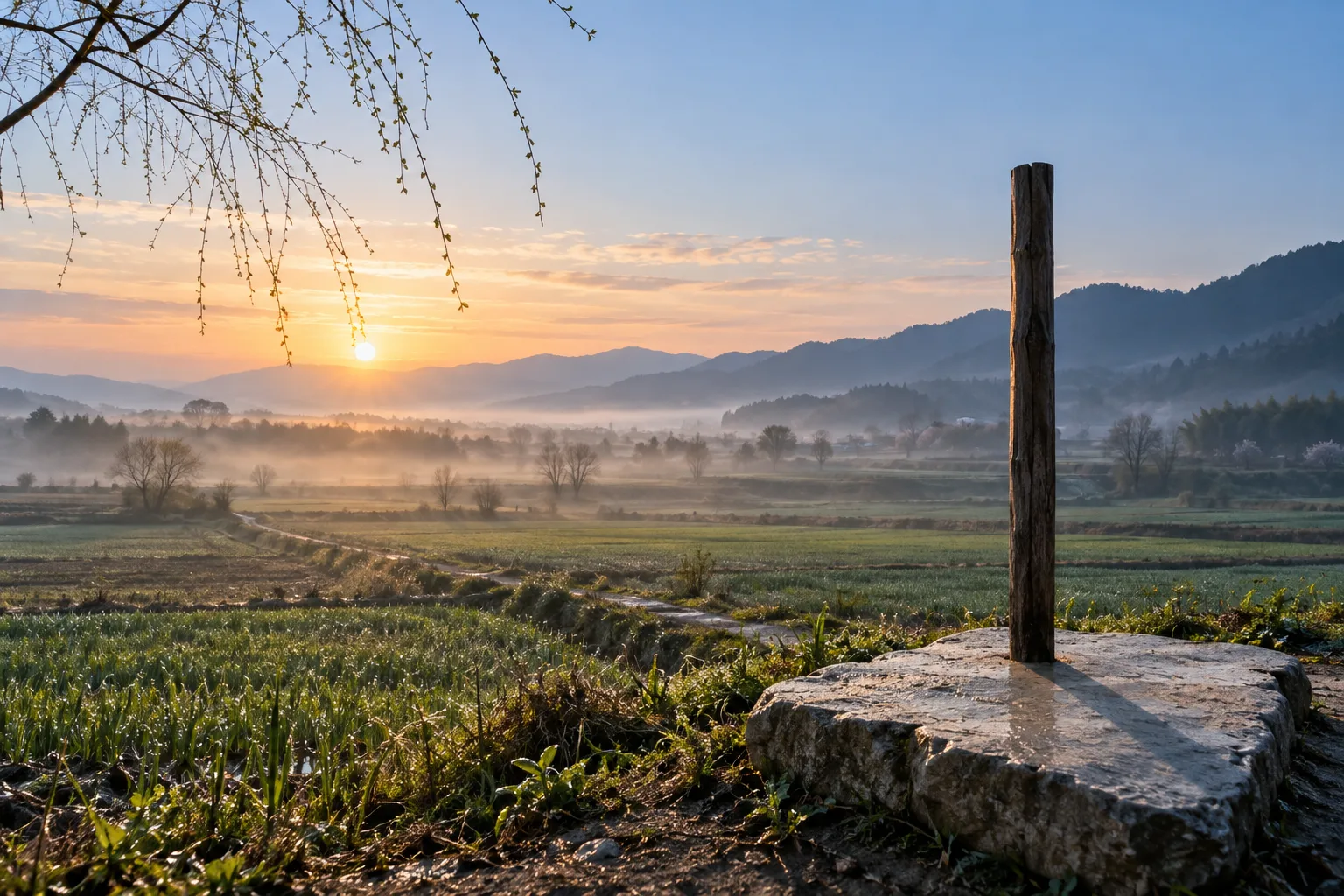
This guide complements the site’s introductions to Chinese date selection, the traditional almanac and the Heavenly Stems and Earthly Branches. It explains the astronomical structure first, then asks how seasonal names acquire meaning in particular climates and communities. A solar term is not automatically an auspicious date, a weather forecast or a medical instruction.
The solar terms connect a lunisolar calendar to the Sun
Each term marks a position, not a block of identical weather
The Hong Kong Observatory explains that the ecliptic is divided into twenty-four equal segments, with 15 degrees of solar longitude between consecutive terms. The equinoxes and solstices are four familiar points within this system. A term begins at an astronomical moment; in ordinary speech, however, its name can also refer to the roughly fifteen-day interval that follows.
This distinction prevents a common mistake. “Grain Rain” or “White Dew” does not mean that every place experiences rain or dew on one prescribed civil date. The term fixes the Sun’s position. Weather, crops and visible seasonal change depend on latitude, altitude, monsoon patterns, local ecology and the particular year.
Twelve sectional terms alternate with twelve principal terms
The twenty-four points alternate between twelve jie (节) and twelve zhongqi (中气). Together they structure the solar year, while the principal terms also help organize the relationship between lunar months and intercalation. This is why calling the traditional Chinese calendar simply a “lunar calendar” is incomplete.
The Hong Kong Observatory’s explanation of the agricultural calendar describes it as lunisolar: its months begin with new moons, but its seasonal framework follows the Sun. The two cycles are coordinated rather than reduced to one another.
Exact dates and times require a year and time zone
Because a term is defined by the Sun reaching a specified longitude, its instant must be calculated for a particular year. When converted into civil calendars, the displayed date can differ by time zone, and the intervals between terms are not all exactly the same number of hours. A printed list should therefore name its year, calendar convention and time standard.
The Observatory’s solar-term table is a good model: it connects each name to a longitude and publishes year-specific times. For cultural history, the important lesson is that stable named positions can coexist with changing civil dates and evolving calculation methods.
Twenty-four names turn one orbit into a seasonal vocabulary
Four seasons each contain six terms
Spring is named through Beginning of Spring, Rain Water, Awakening of Insects, Spring Equinox, Clear and Bright, and Grain Rain. Summer continues with Beginning of Summer, Lesser Fullness, Grain in Ear, Summer Solstice, Lesser Heat and Greater Heat. Autumn moves through Beginning of Autumn, End of Heat, White Dew, Autumn Equinox, Cold Dew and Frost’s Descent. Winter closes the sequence with Beginning of Winter, Lesser Snow, Greater Snow, Winter Solstice, Lesser Cold and Greater Cold.
Translations are useful but imperfect. Xiaoman (小满), for example, literally suggests a lesser or partial fullness and has accumulated agricultural explanations that vary by region. Keeping the Chinese name beside a cautious translation helps readers avoid turning one gloss into a universal definition.
The names remember observation but do not describe every region
Many names evoke precipitation, temperature, frost, crop development or visible life. They emerged from long observation and calendrical administration within particular historical environments. China’s enormous climatic range means that the same term can meet very different conditions in the North China Plain, the south coast, the Tibetan Plateau or a mountain area.
At Wudang, elevation and terrain can shift flowering, mist, leafing and cold relative to a lowland calendar. The site’s guide to the mountain landscape is therefore a better companion than a generic claim that one phenological sign must appear everywhere on schedule.
Names become useful through comparison, not prediction alone
A solar-term name can prompt attention: what has changed in daylight, wind, soil, water, insects or plants since the previous term? Its value lies in repeated comparison. A single warm day does not cancel “Lesser Cold,” and an unexpected frost does not prove the calendar false. The astronomical marker and the local observation answer different questions.
This evidence-first approach also improves the site’s discussion of cyclical day qualities. Solar terms describe a place in the annual solar cycle; day officers, stems and branches, festivals and local customs are additional systems. They may meet in an almanac without becoming synonyms.
Living heritage adds food, work, ritual and memory
UNESCO recognizes knowledge and practices, not only a list
In 2016 UNESCO inscribed the Twenty-Four Solar Terms on the Representative List of the Intangible Cultural Heritage of Humanity. The nomination concerns knowledge of time and the practices developed around observation of the Sun’s annual motion—not merely the memorization of twenty-four names.
UNESCO records their roles in agricultural production and daily life, while also noting regional calendars, sayings, rituals, foods, stories and forms of transmission. Heritage status does not freeze these practices into one national script. It recognizes a living system carried by communities and adapted to different settings.
Festivals and foods attach unevenly to the sequence
Some terms have especially visible social lives. Qingming is both a solar term and a festival context associated with tomb visiting; Dongzhi has major family and ritual traditions in many regions. Other terms may be marked mainly by agricultural work, local sayings, seasonal foods or media reminders. Their prominence is not equal everywhere.
Food traditions should be described as traditions, not prescriptions. Seasonal dishes can preserve family and regional memory, but they are not proof that one ingredient suits every body or climate. The site’s discussion of living with the seasons should likewise be read as cultural context, not a substitute for medical or nutritional advice.
Calendars have always been technical and political objects
Calendrical reform required observation, calculation, institutions and authority. A Cambridge University Press study of Han and Roman calendrical reform notes that Chinese court calendrical change in 105 BCE addressed an inherited system that no longer aligned adequately with observed phenomena. Later Chinese calendars continued to refine methods rather than preserving one unaltered ancient calculation.
This history connects the solar terms to the site’s history of date selection without making them identical. Courts issued calendars, specialists calculated them, and households used them, but an astronomical framework could support many practical, ritual and political purposes.
Read a solar term through astronomy, place and practice
Use a six-step seasonal observation method
- Name the term. Record its Chinese name, a cautious translation and its solar longitude.
- Fix the time standard. Note the year, civil calendar and time zone used by the published timetable.
- Locate the observer. Record latitude, elevation and the immediate landscape instead of assuming one national climate.
- Describe what changed. Compare daylight, temperature, water, plants, animals and work with the preceding term.
- Separate layers. Distinguish astronomy, weather, phenology, festival, household custom and almanac interpretation.
- State the limit. Mark local exceptions, uncertain translations and claims that require a historical or community source.
This method turns the terms into a disciplined observation practice. It can be used in a city balcony, a farm, a school garden or a mountain visit without pretending that today’s surroundings reproduce an ancient landscape.
Use the almanac without confusing categories
A tongshu may print solar terms beside lunar dates, stems and branches, day officers, festivals and activity recommendations. Read each layer by its own rules. The moment of an equinox can be astronomically calculated; an auspiciousness judgement belongs to a different interpretive tradition.
The site’s guide to choosing a date in practice shows why a term alone cannot settle a personal decision. Modern readers should also consider legal deadlines, weather forecasts, health, safety, travel and the people affected by the plan.
Let local records correct the stereotype
Keep a modest log across several years: the term’s exact instant, first buds, insect activity, rainfall, heat, frost, farm work or a family custom. Patterns may emerge, but so will variation. That variation is evidence, not noise to be forced into a fixed poem.

Responsible practice means preserving both precision and humility. Use reliable astronomical tables for timing, named sources for history, community evidence for custom and direct observation for place. The site’s guide to responsible date-selection practice offers the same durable boundary: cultural systems can guide attention without erasing evidence, consent or practical judgement.