The Hetu River Chart: Numbers, Directions and the Five Phases
河图:数字、方位与五行结构
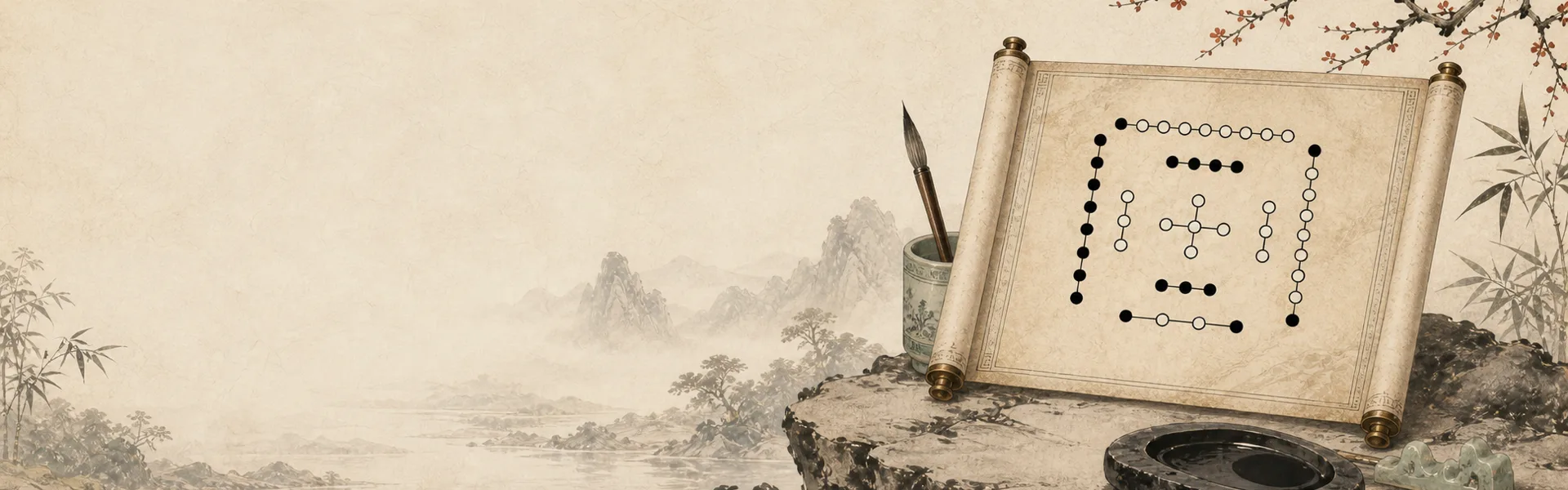
The Hetu, or River Chart, is the more static and harmonious of the two diagrams. In its standard Song-dynasty form it consists of black and white dots—white for odd, “yang” numbers and black for even, “yin” numbers—arranged in five groups around a center. The numbers one through ten are all present, paired and positioned so as to display the generative order of the Five Elements. Where the Luoshu is dynamic and computable, the Hetu is balanced and complete: it is often described as the diagram of the cosmos at rest, before movement begins.
What is on the diagram
The Hetu is a pattern of dots, black and white, arranged in five groups around a centre.
White dots represent odd numbers, which are yang; black dots represent even numbers, which are yin. The groups are placed by direction: one and six below (north), two and seven above (south), three and eight to the left (east), four and nine to the right (west), five and ten at the centre.
Every position therefore holds a pair, and in every pair the two numbers differ by exactly five. The dots total fifty-five.
Two things about this arrangement are worth noticing at once. It is perfectly symmetrical — one could not rearrange it without breaking the pattern of pairs. And the orientation is the traditional Chinese one, with south at the top, which reverses the modern convention and regularly confuses readers coming to these diagrams from a European map habit.
Generating and completing numbers
The arrangement follows a clear logic. The numbers are grouped into five pairs, each pair consisting of one “generating” number (one through five) and its corresponding “completing” number (six through ten), with the two members of each pair differing by five. One and six sit at the bottom (north) and belong to Water; two and seven at the top (south) belong to Fire; three and eight on the left (east) belong to Wood; four and nine on the right (west) belong to Metal; and five and ten occupy the center, belonging to Earth. In this way every direction is assigned a pair of numbers and one of the Five Elements, with Earth holding the middle as the pivot around which the others turn.
The distinction that organises the whole figure is between generating numbers (生数), one to five, and completing numbers (成数), six to ten. The traditional formulation runs that heaven produces water with one and earth completes it with six; earth produces fire with two and heaven completes it with seven; and so on through wood, metal and earth. Each phase thus receives a small number that brings it into being and a larger one that finishes it, and the difference between them is always five — the number of the centre.
Whether this scheme was derived from anything, or simply constructed to be tidy, is not recoverable. What can be said is that it is internally consistent and that its consistency is a property of the design rather than a discovery about water or fire.
The five phases and the directions
What makes the Hetu significant is that this layout traces the “generating” or productive cycle of the Five Elements when read in a particular way. The tradition reads the diagram as encoding how each element gives rise to the next—the familiar sequence in which Water nourishes Wood, Wood feeds Fire, Fire produces Earth (as ash), Earth yields Metal, and Metal, condensing moisture, returns to Water. The pairing of a smaller “birth” number with a larger “maturity” number for each element expresses the idea that everything in the cosmos comes into being and is then brought to completion, a movement from potential to fullness.
Where it is actually used
The generative and completing numbers are a shared language across a wide body of literature, and a reader who does not know them cannot get far in it.
They appear in the assignment of numbers in fate calculation and divination, in the derivation of nayin phases, and in the numerical correlations of six-line divination. They are commonest of all in medical literature: organs, directions and seasons are routinely marked by number, and commentators speak constantly of "one-six water" and "two-seven fire." Internal alchemy texts use them to discuss the relation of water and fire, lead and mercury. Certain numerical selections in feng shui and in date selection derive from the same source.
The practical function of the Hetu is therefore that of a concordance table: it pins together four systems — the five phases, the directions, the seasons and the numbers — so that each can be memorised and translated into the others. Understood that way it is genuinely useful, and understood any other way it tends to be overinterpreted.
The division of labour with the Luoshu
The difference between the two diagrams is not simply ten numbers against nine.
The Hetu has a central pair, five and ten; its ten numbers form five couples; the whole is static, symmetrical, and concerned with generation. The Luoshu places nine numbers in nine cells, and those cells can be traversed along a fixed path, making it dynamic and computable.
The consequence is visible throughout later practice. Every art that needs to calculate something — Flying Star feng shui, the Purple-White stars, the Qimen board — uses the Luoshu palaces. The Hetu is used mainly for exposition and for fixing correlations.
A traditional formula holds that the Hetu governs generation and the Luoshu governs change. It is a simplification, but the direction is right, and it is a useful thing to carry into the later pages.
Fifty-five, and the great expansion number fifty
The dots of the Hetu total fifty-five, which matches the Great Treatise's statement that the numbers of heaven and earth total fifty-five.
But the same Great Treatise, describing the milfoil procedure, says that the number of the great expansion is fifty, of which forty-nine are used. Fifty-five and fifty differ by five; forty-nine falls one short of fifty. These gaps have been explained for two thousand years without resolution. In the Han, Jing Fang, Ma Rong and Xun Shuang each offered accounts — subtracting the five phases, subtracting the pole star, removing numbers held in reserve — and Zhu Xi produced another in the Song. There is still no settled answer.
This episode is worth knowing, and not because any one explanation is correct. A number regarded as utterly fundamental has generated a dozen mutually incompatible explanations, which indicates that the explanations were supplied afterwards by each commentator from within his own system, rather than transmitted as definite knowledge from antiquity.
It also supplies a quick test of any book on these numbers. An honest author will tell you this point is disputed; an author in a hurry to build a system will simply hand you an answer.
What needs to be said plainly
It is worth stressing, once more, that these are interpretive conventions rather than empirical discoveries. The correspondences between numbers, directions, and elements are features of a coherent symbolic system built up over centuries, not measurable properties of the physical world. The Hetu is best appreciated as an elegant piece of cosmological design: a way of picturing balance, generation, and completeness that has shaped Chinese thought for a thousand years, and whose companion—the Luoshu—supplies the dynamic, world-in-motion counterpart examined in the next section.
A warning
Articles circulate online connecting the numbers of the Hetu to the value of pi, the speed of light, the genetic code or the periodic table, and claiming that the ancients had already grasped some modern knowledge.
The problem with these arguments is the number of degrees of freedom. Ten small integers can be added, subtracted, multiplied, divided, summed, differenced and grouped in an enormous number of ways, and producing a result close to some constant is not difficult. What the author shows you are the combinations that worked; the far larger number that did not are not mentioned.
There is a clean standard for judging such claims. A genuine encoding permits predictions that are made in advance and that could turn out false. If a proposed decoding can only be matched to an answer already known, it has supplied no information at all — it has merely demonstrated that small numbers are flexible.
The same test applies well beyond this subject, and it is worth carrying away from this page even if nothing else on it is retained.
What its value actually is
Set aside the claims of hidden knowledge and the Hetu remains genuinely worth understanding, for reasons that do not depend on any of them.
It is the key to a large body of Chinese writing. Medical commentary, alchemical texts, divinatory manuals and philosophical works all use its vocabulary as shorthand, and a reader without it is locked out of a great deal.
It is also an elegant piece of mnemonic design. Compressing four separate classification systems into a single figure that can be held in the mind at once is a real intellectual achievement, and it did the work asked of it for a thousand years.
And it is a historical document of how one civilisation organised its knowledge — by correlation, by pairing, by binding categories together so that each could be recalled through the others. Those are three solid reasons to study it, and none of them requires believing that the numbers encode the structure of the universe.
Key points
The Hetu, or River Chart, is the more static and harmonious of the two diagrams.
It is drawn as black and white dots — white for odd yang numbers, black for even yin numbers.
The numbers form five pairs, each joining a generating number (one to five) with its completing number (six to ten).
Each pair is assigned a direction and a Five Phase element.
The layout traces the generating cycle of the Five Phases, which is why it is treated as harmonious.
Its generating and completing numbers are a shared shorthand in medical, alchemical and divinatory writing.
Arts that calculate use the Luoshu palaces; the Hetu serves mainly to fix correlations.
These are interpretive conventions rather than empirical discoveries.