The Nine Palaces (Jiugong): Directions, Time Cycles and Traditional Uses
九宫:方位、时间周期与传统用途
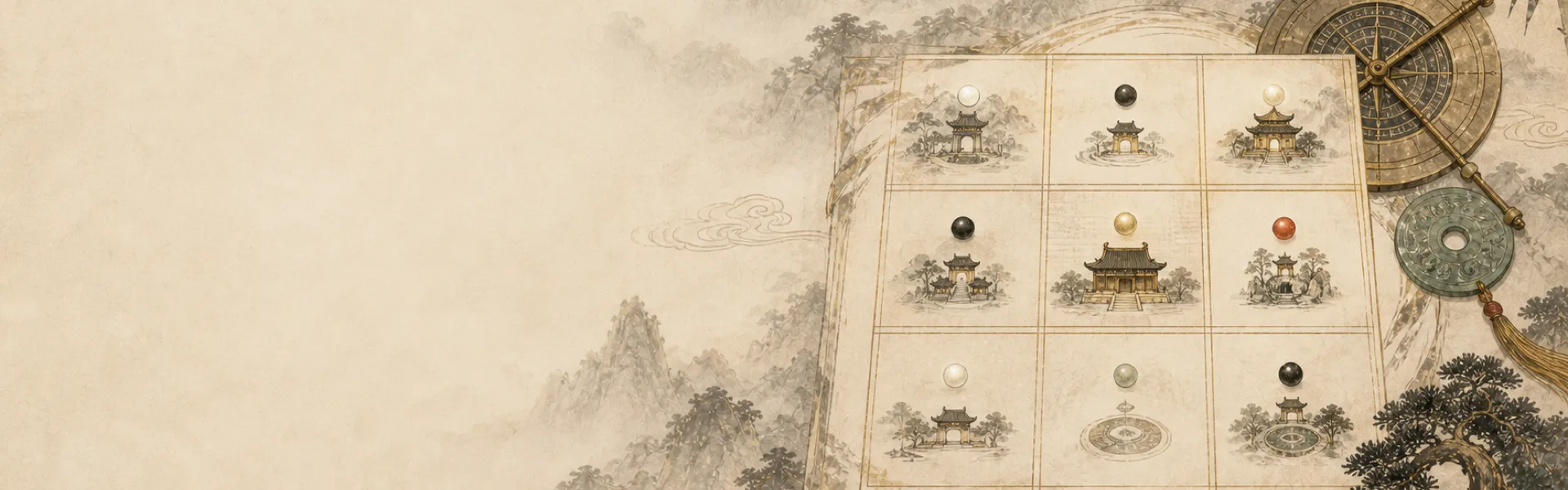
The Nine Palaces, or jiugong, are what you get when the nine cells of the Luoshu are treated not as an abstract number-square but as a map of space. The center and the eight surrounding cells are identified with a center plus the eight directions—the four cardinal and four intercardinal points—and each is called a “palace.” Onto this simple grid the tradition layers a remarkable amount of meaning: each palace receives a number from the Luoshu, one of the eight trigrams in the “later heaven” sequence, one of the Five Elements, a season or phase, and a set of human and natural associations. The Nine Palaces are, in effect, the operating table on which several of the most technical Chinese arts are performed.
From numbers to a framework
The Luoshu is a square of numbers. The nine palaces is what that square becomes once it stops being an object of contemplation and starts being used as a map.
The step is small and consequential. Place the nine numbers into a three-by-three grid, overlay the Later Heaven trigrams, assign each cell a direction, a phase and a colour, and the result is a template that can be laid over almost anything: a room, a house, a city, a body, a year, a century.
At that point the numbers have stopped mattering in themselves. What is being used is the structure — a centre with eight surrounding positions, each carrying several labels at once. Everything described on this page follows from that single move, and it is worth being clear that the move is a decision about how to organise information rather than a discovery about the world.
Three ways of using it
The nine-palace grid is put to three distinct kinds of work, and distinguishing them prevents most of the confusion in this area.
Spatially, the nine cells correspond to a centre and eight directions, and the framework is applied to building layout, city planning, and the auspiciousness of orientations.
Temporally, years, months, days and hours are assigned to the cells in sequence, producing cycles. The three cycles and nine periods, and the annual Purple-White stars, belong here.
Sequentially, one moves through the cells in the order one to nine, tracing a fixed route through the grid — the "flying" path, or Luoshu step.
That a single grid can represent both "where" and "when" is the most powerful property of the nine palaces, and the one most easily overused. A framework that can encode anything encodes nothing in particular, and much of the elaboration in the later arts consists of applying all three readings at once until the grid can be made to say whatever is wanted.
What flying the stars actually is
The feature that makes the Nine Palaces genuinely dynamic, rather than a static chart, is the practice of “flying” the numbers. In this technique the nine Luoshu numbers do not stay fixed in their home palaces; they move, or “fly,” from palace to palace in a set order that traces the same path each time. Which number occupies which palace changes according to the year, month, day, or hour under consideration. This is the mechanism behind Xuankong Feixing, the “Flying Star” school of Feng Shui, one of the most intricate systems in the entire tradition.
It is worth stating what flying actually consists of, because the terminology suggests something more mysterious than the operation. A number is placed in a starting palace and the remaining numbers follow the fixed Luoshu route through the grid, wrapping round when they run out. It is modular arithmetic performed on a nine-cell board — the same operation each time, entirely deterministic, and reproducible by anyone who knows the starting position and the direction of travel.
This is worth knowing for a practical reason. Two practitioners who agree on the starting conditions must produce identical charts, because no judgement enters the calculation. Where two Flying Star readings differ, the disagreement is either about the starting conditions — the period, the facing direction, the boundary of a year — or about interpretation. It is never about the arithmetic, and a practitioner who suggests otherwise does not understand the procedure they are performing.
The Bright Hall, the capital and the nine provinces
The most solid traces of the nine palaces are in institutions and architecture rather than in divination.
The Bright Hall described in the Da Dai Liji is a nine-chamber structure in which the Son of Heaven moved from room to room with the seasons. The Kaogongji section of the Zhouli specifies a capital nine li square, with three gates on each side and nine roads running each way — again a three-by-three division. The well-field land system divided a plot into nine parts with the central one held in common. Yu the Great is said to have divided the realm into nine provinces; the bureaucracy had nine ranks; there were nine ancient cauldrons.
Not all of these derive directly from the Luoshu, and it would be careless to claim they do. What they share is a single spatial imagination: a complete world made of a centre plus eight directions.
For anyone reading Chinese institutional, urban or ritual history, this template has to be loaded into the mind first. Its traces run from the planning of Han Chang'an to the axis and symmetry of Ming and Qing Beijing.
The nine palaces in medicine
The Lingshu chapter on the nine palaces and eight winds is worth reading directly. It opens by giving the positions and numbers of the nine palaces, then names the winds from each of the eight directions, discusses which parts of the body each is associated with, and relates all this to the solar terms and to how one should live at different times of year.
A familiar division can be made here. Wind direction does vary with season; certain illnesses genuinely are more common at particular times of year; and avoiding cold draughts is sound advice. These are explicable observations.
That a wind from a specific direction necessarily injures a specific organ, or that an injury received on a particular day will manifest at a particular site, is a constructed correspondence. No observation supports it, and the assignment follows the grid rather than the body.
Both layers sit in the same chapter, in the same voice, and reading them apart is what makes the text useful rather than either authoritative or absurd.
Qimen and date selection
These flying numbers underlie several specialized arts. In Feng Shui’s Flying Star system, the chart of numbers for the period in which a building was constructed, combined with its facing direction, generates a map of favorable and unfavorable palaces that practitioners use to site bedrooms, doors, and desks. In the personal art sometimes called Nine Star Ki, a person’s birth year yields a governing number and palace said to describe temperament and yearly fortune. And in Qimen Dunjia—the most elaborate of all, once reserved for military strategy and statecraft—the Nine Palaces become a board on which stars, gates, deities, and stems are arranged to advise on timing and direction. In each case the Luoshu grid is the shared foundation.
The three cycles and nine periods
The Flying Star tradition divides time into periods of twenty years, nine of which make a cycle of a hundred and eighty years — the three cycles and nine periods.
By the standard reckoning, 2004 to 2023 was the eighth period, and 2024 began the ninth. At each change of period the auspicious and inauspicious character of the various directions is held to change with it.
The practical function of the scheme is to name and divide long stretches of time, giving people a handle on periods longer than a life. That is not nothing — historians and economists reach for similar devices.
But two things need to be clear. The succession of periods is generated by a numerical rule and has no relation to geology, climate or social change; the eighth period did not begin because anything happened in 2004. And nobody has ever tested whether anything measurable differs before and after a change of period, despite the transitions being known centuries in advance, which would make such a test unusually easy to design.
Why three by three works so well
It helps to see why the same small grid can support so much. The Nine Palaces work because they are a general-purpose coordinate system: any set of nine-fold correlations—directions, elements, trigrams, seasons, or moving numbers—can be laid over them and read off in relation to one another. This flexibility is exactly what made the grid so productive across Feng Shui, personal fortune-telling, and strategic divination. The diagram supplies the structure; the various arts supply the specific rules for what the structure means and how its numbers move.
Key points
The Nine Palaces treat the Luoshu’s nine cells as a map of space rather than an abstract square.
The centre and eight surrounding cells are identified with directions, trigrams, elements and other categories.
Trigrams are assigned by the “later heaven” arrangement attributed to King Wen, ordered by the seasons.
The system becomes dynamic through “flying” the numbers, moving them around the grid in a fixed sequence.
Feng Shui’s Flying Star method and several other arts are built on this movement.
The grid works because it is a general-purpose framework that any set of nine categories can be mapped onto.
That flexibility is its strength as an organising device and the reason it explains nothing by itself.