Origins and History of the Hetu and Luoshu Diagrams
河图与洛书图式的起源与历史
The Hetu and Luoshu occupy a curious place in Chinese intellectual history. They are among the most famous images in the entire tradition, invoked as the ultimate source of the Yijing, the Five Elements, and the numerology that underlies Feng Shui and the calendar. Yet the diagrams as they are drawn today are relatively late, and the path from ancient legend to standardized figure is neither short nor straight. Understanding that path is the best defense against the two common errors: treating the diagrams as literal prehistoric artifacts, or dismissing them as meaningless decoration.
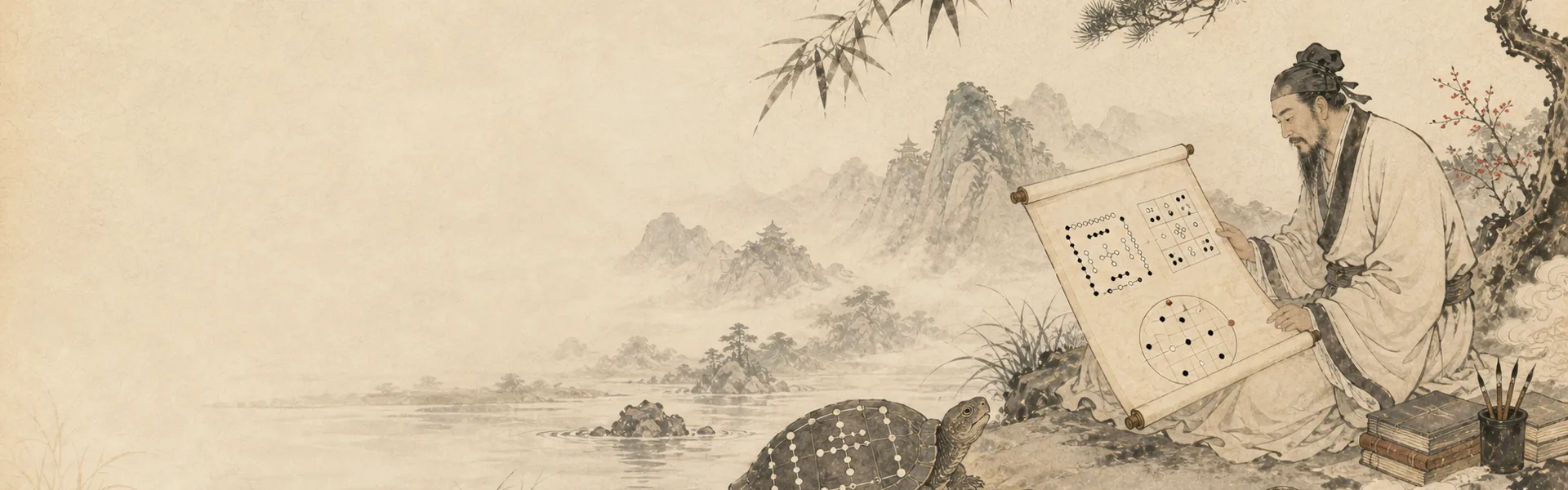
The accretion of legend
The classical origin stories are unambiguous in their grandeur. According to accounts that took shape over many centuries, the Hetu—the “River Chart”—appeared on the flank of a dragon-horse that rose from the Yellow River during the reign of Fu Xi, the mythic culture-hero credited with inventing the eight trigrams. The Luoshu—the “Luo Writing”—was said to have been carried on the shell of a divine turtle that emerged from the Luo River in the time of Yu the Great, the tamer of floods. These are foundation myths, not records. They express a deeply held conviction that the patterns of number and cosmos were revealed to sages, not invented by them.
Where the names first appear
The earliest textual traces are suggestive but sparse. The phrase “the River produced the Chart, the Luo produced the Writing” appears in the “Great Commentary” (Xici) appended to the Yijing, and the Hetu and Luoshu are mentioned in a handful of other early texts, including the Book of Documents and the Analects, where Confucius laments that “the River brings forth no chart” as a sign of his troubled age. Crucially, however, none of these early references includes an actual picture. For most of the first millennium and beyond, the names circulated without any agreed-upon diagram attached to them.
The Han "Hetu" and "Luoshu" were something else entirely
A large body of Han texts carries the titles Hetu and Luoshu, and they are among the commonest sources of confusion on this subject.
These belong to the apocryphal prognostication literature. Their content is portents, calamities, omens of the mandate, and political prophecy, used to argue that a particular person was destined to rule. Liu Xiu, the founder of the Eastern Han, drew heavily on such texts when he took the throne.
It has to be said plainly: these works are political prophecy and have nothing whatever to do with the black-and-white dot diagrams of later centuries. Most were lost from the Northern and Southern Dynasties onward, and survive only as fragments in later collections.
Treating the Han apocryphal Hetu as the same object as the Song diagram is a common error, and it is one that makes the diagrams appear far better attested than they are. A citation of the Hetu in a Han source proves only that a prophecy book of that name existed.
The numerical arrangement was already in use in the Han
The other half of the story must be given equal weight, or one ends up dismissing everything as a Song fabrication.
The three-by-three arrangement is explicitly recorded in Han sources. The Da Dai Liji, discussing the institution of the Bright Hall, lists the sequence two-nine-four, seven-five-three, six-one-eight — which is precisely the nine-palace numbers set out by position. The Lingshu chapter of the Huangdi Neijing on the nine palaces and eight winds opens with the directional assignment of these numbers, using it to discuss winds from the eight directions and their relation to illness. The Shushu Jiyi, attributed to Xu Yue, mentions nine-palace calculation.
The magic square is therefore not a Song invention. It had entered ritual institutions and medicine by the Han. It was simply called the nine palaces; the name Luoshu had not yet been attached to it.
The Song: the diagrams are drawn
The decisive turn came in the Song dynasty. It was then, roughly a thousand years ago, that scholars associated with the “Images and Numbers” school—above all the Taoist figure Chen Tuan and, later, thinkers such as Liu Mu and Zhu Xi—produced and debated the black-and-white dot diagrams that we now recognize. A fierce and long-running controversy followed over which diagram deserved which name. In one influential arrangement the ten-number diagram was called the Hetu and the nine-number square the Luoshu; a rival camp reversed the labels. The version that eventually prevailed, endorsed by Zhu Xi in his enormously influential works, made the Hetu the diagram of ten numbers arranged by the Five Elements and the Luoshu the nine-number magic square. This is the pairing that later tradition inherited.
The details are worth having precisely. Liu Mu's Yishu Gouyin Tu presents a full set of Yijing diagrams including these two, and is the earliest source for the figures now in circulation. But note that Liu Mu's naming is the reverse of today's: he called the nine-number diagram the Hetu and the ten-number diagram the Luoshu. In the Southern Song, Zhu Xi and Cai Yuanding, in the Yixue Qimeng, reassigned them — ten as Hetu, nine as Luoshu — and that assignment became standard and has held ever since.
This episode is more damaging to the traditional account than any argument from outside. If these two diagrams genuinely recorded the fundamental numbers of heaven and earth, two major scholars would not have disagreed about which was which, and the matter would not have been settled by one of them simply deciding. Names given to a discovery are not interchangeable at the discretion of a later editor.
The Song context: the learning of charts and writings
The River Chart diagrams did not appear in isolation. They belong to an entire movement of chart-and-writing learning (图书之学) that arose in the Song.
Zhou Dunyi's Explanation of the Diagram of the Supreme Ultimate, Shao Yong's Prior Heaven learning, and an array of hexagram-transformation and directional diagrams all took shape in this period. A good many of them arrived through Taoist transmission lineages, and the Song writers themselves record a chain running from Chen Tuan to Chong Fang, from Chong Fang to Mu Xiu and Li Zhicai, and onward to Liu Mu and Shao Yong.
What this body of diagrams did was significant: it converted doctrine that had previously been carried in prose into structures that could be seen. The effect on later Yijing studies, on Neo-Confucian philosophy and on Taoist imagery was enormous.
Understanding this prevents a misreading. The River Chart and Luoshu are not an isolated oddity or a single act of invention. They are part of a systematic change in the form knowledge took, and that change is a genuinely important episode in Chinese intellectual history whatever one concludes about the diagrams themselves.
Qing evidential scholarship settled it
The specific works are worth naming, since they are the evidence. Huang Zongxi's Yixue Xiangshu Lun, Huang Zongyan's Tuxue Bianhuo and Mao Qiling's Hetu Luoshu Yuanchuan Bian each examine the provenance of the Song diagrams. Hu Wei's Yitu Mingbian is the most thorough: it sets out for every diagram its first appearance, its line of transmission and the variant accounts, and concludes that all of them are Song productions with no connection to the Hetu and Luoshu named in pre-Qin texts.
This was a clean scholarly victory, and its provenance matters. The conclusion came from Chinese scholars, using Chinese philological methods, in the seventeenth and eighteenth centuries — before any relevant Western contact. Anyone who claims that questioning the River Chart is an imported attitude can be answered by naming Hu Wei.
Modern scholarship treats the whole edifice with careful skepticism. Historians point out that the received diagrams cannot be traced with any confidence before the Song, that the early textual references may have meant something quite different—possibly jade tokens, maps, or omens rather than numerical charts—and that the Song reconstructions were shaped by the metaphysical concerns of their own time. Some scholars have argued for connections to earlier divination diagrams or to the cosmological “nine provinces” schemes of the Han dynasty, but the evidence is circumstantial. What can be said with confidence is that the diagrams represent a brilliant later systematization of much older numerical and directional ideas, not a fossil handed down intact from the age of sage-kings.
Magic squares are not uniquely Chinese
One further piece of evidence is worth knowing.
Magic squares of the third and higher orders were discovered independently in India, in the Islamic world, in Europe and in Japan. The most famous European instance is the fourth-order square in Dürer's engraving Melencolia I of 1514.
The same mathematical object turning up repeatedly in civilisations with no contact between them shows that it is a natural product of number theory and combinatorics — anyone who plays seriously with numbers will run into it.
This fact supports two conclusions at once, and they pull in opposite directions, which is why it is worth stating carefully. The mathematics of the Luoshu is real, which is exactly why it was found independently in so many places. And its cosmological interpretation is local, because the people who found the same square elsewhere gave it entirely different meanings — a talisman against plague in one tradition, an emblem of melancholy and Jupiter in another. A structure that carries whatever significance a culture assigns to it is not disclosing a significance of its own.
Key points
The Hetu and Luoshu are among the most famous images in Chinese thought and among the least securely documented.
Tradition presents them as the ultimate source of the Yijing, the Five Phases and much else.
The origin stories describe the River Chart appearing on a dragon-horse and the Luo Writing on a turtle’s shell.
Early textual references to them are brief and do not describe the diagrams we now have.
The diagrams in their familiar form were reconstructed by Song-dynasty scholars about a thousand years ago.
Historians therefore treat the received images as Song creations projected onto antiquity.
This does not diminish their importance — they became genuine organising devices for later thought.