The Taoist Sound Tradition
道家的音声传统
Sound genuinely matters in Taoist practice, and it has for a very long time. Temple liturgy is sung, ritual is accompanied by specific instruments, scriptures are recited aloud, and a body of health practice uses vocalised sounds. This page describes that tradition as it actually is, which is both more interesting and more specific than the modern therapeutic version that borrows its prestige.
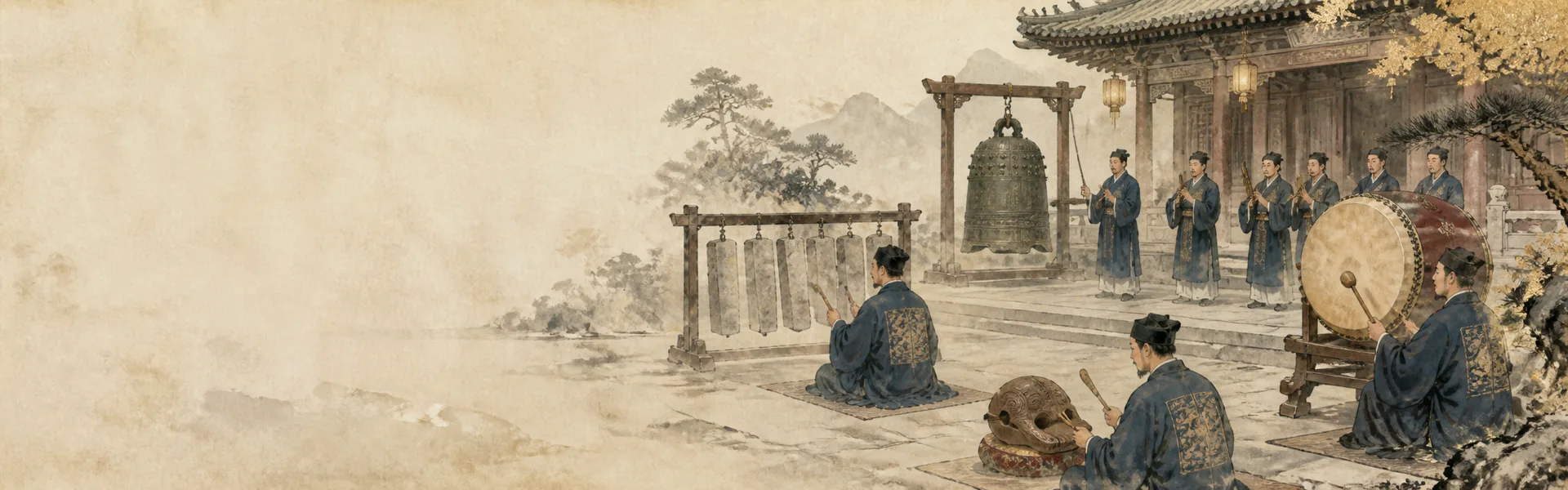
The distinction to hold throughout: this is ritual and cultivation practice, not therapy. Taoists used sound to communicate with deities, to structure ceremony, to mark time, and in one specific case to regulate breathing. They did not run sound healing sessions.
Why sound was thought to be efficacious
The underlying assumption is that sound does something rather than merely represents something. A spoken formula is understood to act, not to describe. This is a common assumption in ritual traditions and it is not distinctively Taoist, but Taoism developed it in particular directions.
Correct pronunciation matters in this framework because the sound is the operative element. Texts specify pronunciations, and transmission of the correct sound from teacher to student is treated as necessary in a way that transmission of the meaning is not.
There is also a cosmological argument. If the universe is patterned and those patterns are expressible in number and proportion, then music, which is number made audible, participates in that order directly. This idea is shared with Confucian thought, which developed an elaborate account of music's role in social harmony.
Liturgical chanting
The core of Taoist sound practice is the chanting of scriptures and ritual texts during ceremonies. This is a trained skill, taught to ordained clergy over years, with defined melodies, rhythms, and vocal techniques.
Different lineages maintain different repertoires. The Quanzhen tradition, which is dominant at Wudang, has its own body of chant with characteristic melodic patterns. Regional variation is substantial, and a ceremony in one province sounds noticeably different from the same ceremony elsewhere.
Chanting is typically accompanied by percussion marking structure and transitions: wooden fish, bells, cymbals, drums. The instruments are functional as well as devotional, coordinating a group of participants through a long sequence.
Ceremonies can last many hours, and sustained group chanting over that length produces effects on participants that are well recognised and not mysterious: synchronised breathing, altered time perception, and a strong sense of collective participation.
Ritual music
Beyond chant, Taoist ceremony uses instrumental music with a defined repertoire. Wind instruments, plucked and bowed strings, and percussion appear in various combinations depending on lineage and occasion.
Wudang has its own documented ritual music tradition, and this is one of the mountain's better-substantiated cultural claims. It has been studied, recorded, and is recognised as intangible cultural heritage. It absorbed court music influence during periods of imperial patronage, which is consistent with the mountain's Ming-dynasty status.
This music is performed as part of ceremony rather than as concert repertoire, though recordings and staged performances now exist. Hearing it in its ritual context is a different experience from hearing it performed.
The six healing sounds
This is the one part of the Taoist sound tradition that is genuinely a health practice, and it is treated in more detail on the qigong pages. In summary: six vocalised sounds are paired with six organ systems, each produced on a long exhale, sometimes with accompanying movement.
The practice is documented from the sixth century and the traditional claim is that each sound regulates its associated organ. The mechanism that can be defended is that producing a sustained sound requires a long controlled exhale, which has consistent measurable effects, and that the audible sound gives objective feedback about breath steadiness.
The sounds have shifted in pronunciation over fifteen centuries and across dialects. If precise acoustic resonance with an organ were the operative mechanism, this drift would be fatal to the practice. That practitioners of all versions report benefit suggests the exhale is doing the work.
Recitation and internal sound
Beyond public liturgy, Taoist cultivation includes silent or subvocal recitation, and some traditions describe attending to internal sound.
Repetition of a divine name or short formula, mentally or under the breath, serves the same function as similar practices elsewhere: it occupies verbal attention and gives the mind a stable object. This is a technique for regulating attention, and it works for reasons that have nothing to do with the specific words.
Some meditative literature describes hearing internal sounds during deep practice. Practitioners report ringing, humming, rushing, and tones. These reports are consistent and probably describe real perceptions — the auditory system generates such sensations in quiet conditions with directed attention, and most people can produce something similar in a silent room. The tradition interprets them as significant markers of progress. That interpretation is a framework laid over the perception.
The relationship to Chinese music theory
Chinese music theory developed a five-note scale mapped onto the five phases, and by extension onto organs, seasons, directions, and emotions. Each note is assigned an organ system.
This correspondence is the historical basis of modern claims about music therapy for specific organs, and it is worth being clear about its status. It is a classification scheme generated by the five-phase system, not a set of observations about what particular pitches do to people.
Recordings marketed as traditional five-phase music for organ health are modern products built on this correspondence. Listening to them is pleasant and may be relaxing. The organ-specific claim has no evidential basis and did not come from clinical observation in the first place.
Silence, which the tradition values equally
An account of Taoist sound that omits silence misses something central. The tradition places at least as much weight on stillness and quiet as on vocalisation, and the two are not in tension.
The Tao Te Ching contains a much-quoted line about the great sound having a faint tone, or on some readings no sound at all. Whatever the precise sense, the passage is pointing at something the tradition returns to repeatedly: that the most significant things are not the loudest, and that what is complete does not need to announce itself.
In practice, cultivation methods generally move toward quiet. Recitation is used to settle attention in the early stages and is often dropped once attention is stable. The elaborate liturgical apparatus belongs to communal ritual; solitary practice is largely silent.
This matters for reading modern claims. A practice built entirely around continuous sound, and marketed as Taoist, is not obviously continuous with a tradition whose solitary cultivation is conducted in silence. The presence of sound in temple liturgy does not make sound the tradition's method.
What visitors actually encounter
At Wudang, the sound you are most likely to hear is morning and evening liturgy at the temples, performed by resident clergy. This is genuine practice, not performance, and it happens whether or not visitors are present.
Ceremonies on festival days are longer and more elaborate, with fuller instrumentation. These are the best opportunity to hear the tradition properly.
Staged performances for visitors also exist, and they are a legitimate presentation of the music, but they are a different thing from liturgy and it is worth knowing which you are attending.
An informal musical exchange at Wudang
Not every musical encounter at Wudang is liturgy or a staged performance. In one Everyday Wudang recording, visitors from France brought their own instruments and joined Wudang musicians for an informal session, with guqin and handpan sounding in the same room.
Watch French Visitors Play with Wudang Musicians.
This is a contemporary cultural exchange at Wudang Mountain, not an example of Taoist ritual music. Its value lies in that modest scale: music lets people from different places meet, without turning an everyday moment into proof of an ancient continuity.
What this tradition is not
It is not a therapeutic system. No traditional source describes treating patients with sound baths, gongs, or bowls.
It is not the origin of modern sound healing, which assembled in the West from unrelated sources.
It does not involve singing bowls, which are not Chinese and were not used in Taoist ritual.
It does not support claims about specific frequencies, which are a twentieth-century invention with no traditional counterpart.
Saying this is not diminishing the tradition. The actual practice — a trained liturgical repertoire maintained over a millennium, a documented ritual music tradition, and a breathing practice with a defensible mechanism — is more substantial than the version that has to borrow modern therapeutic language to seem impressive.
Key points
Taoist sound practice is ritual and cultivation practice, not therapy, and no traditional source describes treating patients with sound.
Liturgical chanting is a trained clerical skill with defined melodies, regional variation, and functional percussion accompaniment.
Wudang's ritual music tradition is genuinely documented and absorbed court influence during imperial patronage.
The six healing sounds work most plausibly through the extended controlled exhale, not organ-specific resonance.
The five-note scale mapped to organs is a five-phase classification, not an observation about what pitches do.
Singing bowls and specific healing frequencies have no place in this tradition and come from elsewhere entirely.