Getting Started & Further Reading
如何入门与延伸阅读
This page covers how to approach this area if you want to explore it, what can usefully be done alone, how to choose between practitioners, and what to read. It also sets out, at the end, why this section has been written the way it has.
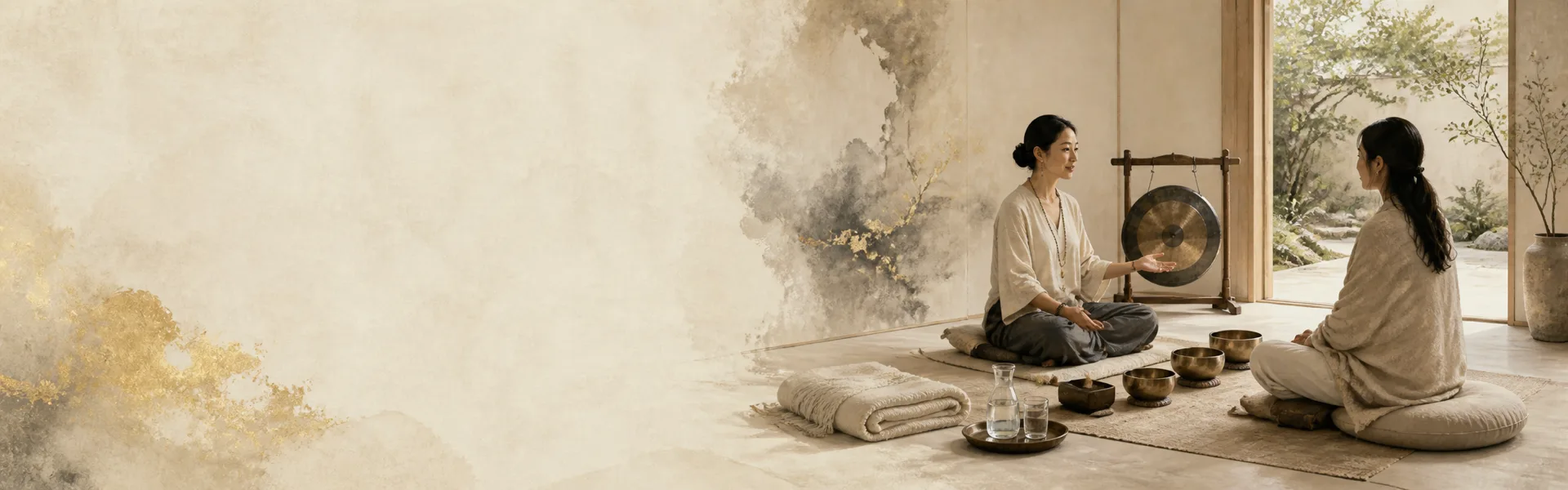
The recommendation throughout is not to avoid these practices. It is to attend them for what they reliably deliver, which is rest and attention, and to decline the larger claims without feeling that doing so spoils anything.
Deciding whether this is for you
Three questions are worth asking honestly before spending money.
What do you want from it? If the answer is rest, relaxation, or a break from demands, these sessions supply that and you are likely to be satisfied. If the answer is treatment for a condition, they do not supply that and you are likely to be disappointed or worse.
Are you comfortable lying still with your eyes closed for an hour, sometimes in a room with strangers, sometimes being touched? Not everyone is, and there is no benefit in enduring something you find unpleasant.
Would you be able to walk away if the practitioner made claims you did not accept? If the answer is no, that is worth knowing about yourself before you are in the room.
What you can do without a practitioner
Most of the reliably active ingredients are available for free.
Lie down somewhere quiet and warm for thirty minutes with no phone, no task, and nothing to listen to but continuous ambient sound if you want it. This delivers the relaxation response, which is the main mechanism.
Breathe slowly with the exhale longer than the inhale for ten minutes. This is the single best-evidenced element in this entire section and requires nothing.
Use the six healing sounds if you want a traditional practice with a defensible mechanism. Each sound on a long exhale, repeated several times.
Attend to a continuous sound as a meditation object. Recorded ambient sound, rain, or a single sustained tone all work equally well for this purpose, and the choice is aesthetic rather than technical.
What you cannot supply yourself is the touch and the undivided attention of another person, which are genuine ingredients and reasonable things to pay for.
Choosing a practitioner
There is no meaningful regulation in most jurisdictions, so certification tells you mainly that someone paid for a course. Judge by behaviour instead.
Good signs: clear description of what happens; explicit consent about touch; willingness to say what they do not treat; encouragement to see a doctor for anything medical; transparent pricing; no pressure to book further sessions; comfortable answering a question about evidence without reframing it.
Warning signs: diagnostic claims; treatment claims for named conditions; advice about medication; escalating packages; treating reasonable questions as an obstacle; discouraging you from consulting anyone else; and training programmes with expensive tiered levels, which reward recruitment over competence.
One test is unusually informative. Ask directly whether they think the effects might come from relaxation and attention rather than energy. A practitioner who can discuss that possibility calmly is thinking about their work. One who cannot is not.
If you are unwell
This deserves stating clearly rather than being softened.
These practices are appropriate as supportive comfort alongside medical care. They are not appropriate as treatment for anything, and no responsible practitioner offers them as such.
Tell your doctor what you are doing, not because of interaction risk, which is negligible, but because withholding it is a habit that becomes dangerous with practices that do carry interaction risk.
If a practitioner suggests reducing or stopping medication, or delaying investigation of a symptom, leave and consider reporting them if a reporting body exists.
If you have a trauma history, a dissociative disorder, or a history of psychosis, extended sessions of eyes-closed inward attention can be destabilising. This is not a reason to avoid them entirely, but it is a reason to start short, stay in control of the session, and tell someone.
Building your own quiet hour
If the honest conclusion of this section is that rest and attention are doing the work, the practical question is how to get them without depending on anyone else. This is worth taking seriously, because the barrier is rarely knowledge.
The obstacle is almost always permission. Most people will not lie down for half an hour with nothing to show for it, because it feels like idleness, and they will pay someone else to make it legitimate. Recognising this is useful, because once you see that you are buying permission rather than treatment, you can decide whether to keep buying it or to give it to yourself.
A workable home version: a fixed time, a warm room, a blanket, a phone in another room, and thirty minutes with no task. Sound optional. If it helps to have a defined structure, use ten minutes of slow breathing, fifteen minutes of simply lying still, and five minutes before getting up.
The one thing worth keeping from the commercial format is the boundary. Sessions work partly because they have a beginning and an end that someone else enforces. At home you have to enforce it yourself, which is harder than it sounds and is the main reason home practice fails.
What visitors to Wudang should know
If your interest in this material brought you to a Taoist site, one practical note is worth having.
What is genuinely available at Wudang is temple liturgy, which anyone may attend respectfully, and which is a far more interesting encounter with Taoist sound than any commercial session. It costs nothing, it is real, and it has been performed continuously for centuries.
Morning and evening services happen regardless of whether visitors are present. Festival ceremonies are longer and fuller. Attending one is a matter of arriving quietly, standing or sitting at the back, not photographing during the ritual, and leaving when it ends.
If what you wanted from a sound session was contact with something old and serious, this is where it is, and it is not being sold to you.
Reading on the traditional material
For genuine Taoist ritual music and liturgical practice, academic ethnomusicology is the reliable source. Studies of Chinese Taoist ritual music exist in English and are far more interesting than promotional material about sound healing.
For the six healing sounds and the qigong context, the sources listed on the qigong pages apply.
For the history of the modern movement, David Palmer's work on the qigong boom explains where external qi therapy came from and why it took the form it did.
Reading on the evidence
For placebo and expectation effects, the research literature is genuinely fascinating and explains most of this field better than anything written within it. The work on how ritual, expectation, and practitioner confidence modulate physiological response is worth reading for its own sake.
For therapeutic touch specifically, the 1998 experiment in a major medical journal is short, clear, and worth reading directly as an example of how a simple test can address a large claim.
For distant healing, the systematic reviews are the reliable summaries.
Cochrane reviews cover several relevant modalities and are written for general readers.
Reading to avoid
Material that presents singing bowls as ancient Tibetan therapeutic instruments, since this is straightforwardly false and its presence indicates the author has not checked anything.
Anything citing specific healing frequencies with numerical values, which originate in modern speculative writing and are presented as ancient.
Anything using vibration, frequency, or resonance without specifying a quantity.
Anything that treats a negative reaction as evidence of effectiveness.
Why this section is written as it is
A reader may reasonably ask why a site about Taoism includes a careful discussion of modern practices marketed under a Taoist heading.
The answer is that the alternative is worse. A site presenting modern commercial practices as ancient Taoist tradition would be misleading people about Taoism, which is the thing it exists to explain. And a tradition with a genuine two-thousand-year history of ritual sound, cultivation practice, and medical thought does not need to be credited with a format invented in California in the 1970s.
Being accurate about what is old, what is new, what works, and what has not been shown is a form of respect for the tradition rather than an attack on it. The real material is more interesting than the marketing, which is generally the case.
Key points
Attend for rest and attention, which these sessions reliably deliver, rather than for treatment, which they do not.
Most of the active ingredients — quiet rest, slow breathing with extended exhale, attending to continuous sound — cost nothing.
Certification means little in an unregulated field; judge practitioners by consent practices, transparency, and how they handle a question about evidence.
These practices belong alongside medical care and never in place of it, and advice about medication is a reason to leave.
Avoid material claiming ancient origins for singing bowls or specific healing frequencies, both of which are modern.
Separating genuine tradition from modern marketing respects the tradition rather than attacking it.