A Session: What to Expect
一次课程:会经历什么
This page is practical rather than evaluative. If you are going to attend a sound or energy session, whether at Wudang or anywhere else, it describes what actually happens, what to ask beforehand, and how to tell a well-run session from a badly run one.
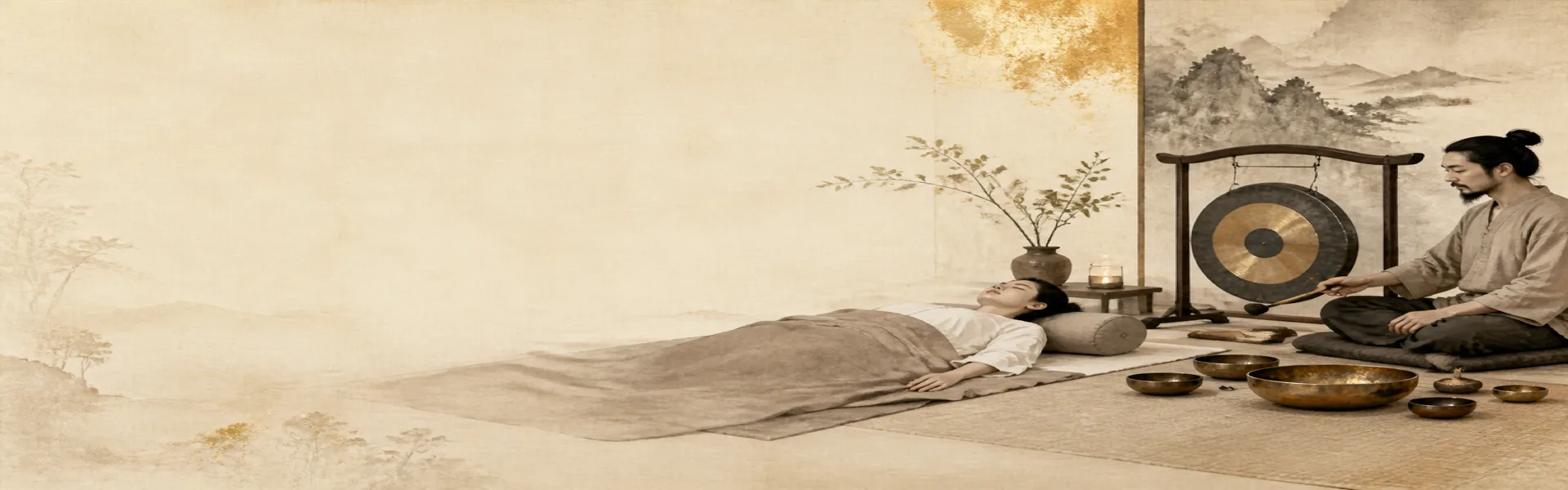
The assessment of whether these practices do what is claimed is covered on other pages in this section. This one assumes you have decided to go and concerns itself with going well.
Before you book
A few questions asked in advance sort most of the field. What exactly will happen in the session. How long is it. What instruments or techniques are used. What is the total cost, and is there any expectation of a course of sessions. What are the practitioner's qualifications, and from what body.
The answers matter less than how they are given. A practitioner who answers directly and specifically is likely to run a session the same way. One who responds to a practical question with a description of energy is telling you something about how they will handle a practical problem during the session.
It is also reasonable to ask what they do not treat. Anyone whose answer is that they treat everything has answered badly.
What to wear and bring
Loose comfortable clothing you can lie in for an hour without adjusting. Layers, because body temperature drops when lying still, and most people get cold before the end.
Socks. Floors are cold and shoes usually come off.
Nothing else is required. Some venues supply blankets, bolsters, and eye covers; asking in advance saves discomfort.
Avoid a large meal immediately before, mostly because lying flat on a full stomach for an hour is unpleasant.
How a session is structured
Most follow the same shape regardless of modality.
An initial conversation, usually five to fifteen minutes, covering why you have come, any health conditions, and what will happen. This is also when you should mention medication, pregnancy, injuries, hearing sensitivity, and anything else relevant.
Settling: lying down, arranging supports, a few minutes of breathing or simple instruction.
The main part: continuous sound, or a sequence of hand positions, lasting forty-five to seventy-five minutes.
A closing period of silence, usually five to ten minutes, before you are invited to move.
A short conversation afterwards. Practitioners often ask what you experienced. You are not obliged to have experienced anything, and a good practitioner will not be disappointed if you did not.
Consent and touch
This deserves its own section because it is where most complaints in this field originate.
You should be told before the session whether you will be touched, where, and why. If bowls are to be placed on your body, you should be told and asked. If hands will rest on you, the same applies. Consent should be sought before the session begins, not implied by your having attended.
You are entitled to decline touch entirely and still receive the session. A practitioner who treats this as a problem, or who suggests the work will be less effective, is not someone to continue with.
You can stop at any point. Sessions are conducted lying down with eyes closed in a dim room, which is a vulnerable position, and a well-run session makes explicit at the start that you can sit up, speak, or leave.
What you are likely to experience
Deep relaxation is the most common report. Many people fall asleep, which practitioners generally treat as fine.
Physical sensations are frequently reported: warmth, tingling, heaviness or lightness, a sense of the body's boundaries becoming vague. Small involuntary twitches are common as muscles release.
Altered time perception is very common. An hour may feel like twenty minutes or like three hours.
Emotional responses happen. Some people cry without an identifiable reason. This is unremarkable and usually passes quickly, but it is worth knowing it can occur.
Some people feel nothing much at all, and this is also normal. It is not a sign of resistance or blockage, whatever anyone tells you.
Things that can be uncomfortable
Volume, particularly with gongs and crystal bowls. If this is a concern, say so beforehand and position yourself further from the instruments.
Cold, which is the commonest practical complaint and easily solved by bringing an extra layer.
Physical discomfort from lying still. It is acceptable to shift position, and you should.
Restlessness. Not everyone finds an hour of enforced stillness pleasant, and there is no obligation to.
Disorientation afterwards, particularly if you fell asleep. This is why the closing silence exists.
Afterwards
Get up slowly. Blood pressure drops when lying still and standing quickly is the main way people come to harm at these sessions.
Do not drive immediately if you feel drowsy or vague. Allow ten or fifteen minutes.
Drink water if you want to, though the elaborate explanations often given for this are unnecessary.
Some people feel tired for the rest of the day. If a practitioner describes this as a healing crisis or detoxification, note that this framing converts any negative response into evidence of effectiveness, which is a structure worth recognising.
Warning signs during or after
Being told you have a blockage, an illness, or a problem the practitioner has detected. This is a diagnostic claim and they are not qualified to make it.
Advice about your medication in any direction.
Pressure to book a course, particularly framed as necessary to complete a process that has been started.
Any suggestion that your doubt reduced the effect, which makes the practice unaccountable.
Touch that was not discussed, or that continues after you have asked it to stop.
Claims that a serious condition can be treated this way.
Group sessions and one-to-one
The two formats are different experiences and suit different people, and the choice is usually presented as a matter of price when it is really a matter of what you want.
Group sound sessions are the more common format. They are cheaper, less intense in terms of personal attention, and carry no expectation that you interact with anyone. For many people this is an advantage: there is no obligation to report an experience, no sense of being observed, and it is easy to attend once without any commitment. The disadvantage is that the practitioner cannot adjust anything for you specifically, and if the volume or duration does not suit you, it does not suit you for the whole hour.
One-to-one sessions are more expensive and considerably more intense, because the defining ingredient is another person's undivided attention. Some people find this the most valuable part. Others find it uncomfortable, particularly if they are not used to being the sole object of someone's focus for an hour.
If you are trying this for the first time, a group session is the lower-commitment option and tells you whether the format suits you at all. If you already know you find it restful, one-to-one is where the individual adjustment becomes available.
Cost, and how to think about it
Prices vary enormously and are not related to anything measurable about what is delivered. This section does not give figures, which would date immediately and vary by country, but a few principles hold.
Treat the cost as the price of an hour of guided rest, because that is what is reliably delivered. Judged that way, it is comparable to other things people pay for to relax, and it is either worth it to you or it is not.
Be much more cautious about packages. Multi-session bundles are standard commercial practice, but in this field they are often justified by claims about cumulative effects that have no evidential basis. A discount for buying several is ordinary business. A claim that the benefit requires a series is a claim about efficacy, and it is unsupported.
Certification and training costs are a separate matter. Practitioner training courses in these modalities are frequently expensive and are sometimes structured with escalating levels, which is a model that rewards recruitment rather than competence. Anyone considering training should look carefully at whether the qualification means anything outside the organisation issuing it.
Sessions at Wudang specifically
Two quite different things are available and it is worth knowing which you are attending.
Temple liturgy is genuine Taoist ritual practice, performed by clergy, open to observation. It is not a therapy, nothing is being done to you, and attending is a matter of respectful presence rather than participation.
Commercial sessions in the surrounding visitor economy use the modern sound bath and energy work formats described here. These are perfectly legitimate as what they are, and the same questions and cautions apply as anywhere else.
The thing to watch for is presentation that blurs the two, implying that a modern format carries the authority of temple tradition.
Key points
- Ask in advance what happens, how long, what instruments, total cost, and qualifications; how the answers are given matters as much as the content.
- Bring layers and socks, since lying still for an hour makes most people cold.
- Consent to touch should be sought explicitly before the session, and declining should not affect the session.
- Deep relaxation, physical sensations, altered time perception, and occasionally emotion are all common; feeling nothing is also normal.
- Get up slowly, since the main practical risk at these sessions is standing too quickly.
- Diagnostic claims, medication advice, pressure to book courses, and blaming doubt are all reasons to leave.