How Taoist and Modern Medicine Relate
道家医学与现代医学如何相互参照
How can someone value Taoist traditions while making sound decisions about medical care? The useful starting point is not a contest between ancient wisdom and modern science. It is a distinction between cultural meaning, a particular treatment claim and the care a person actually needs.
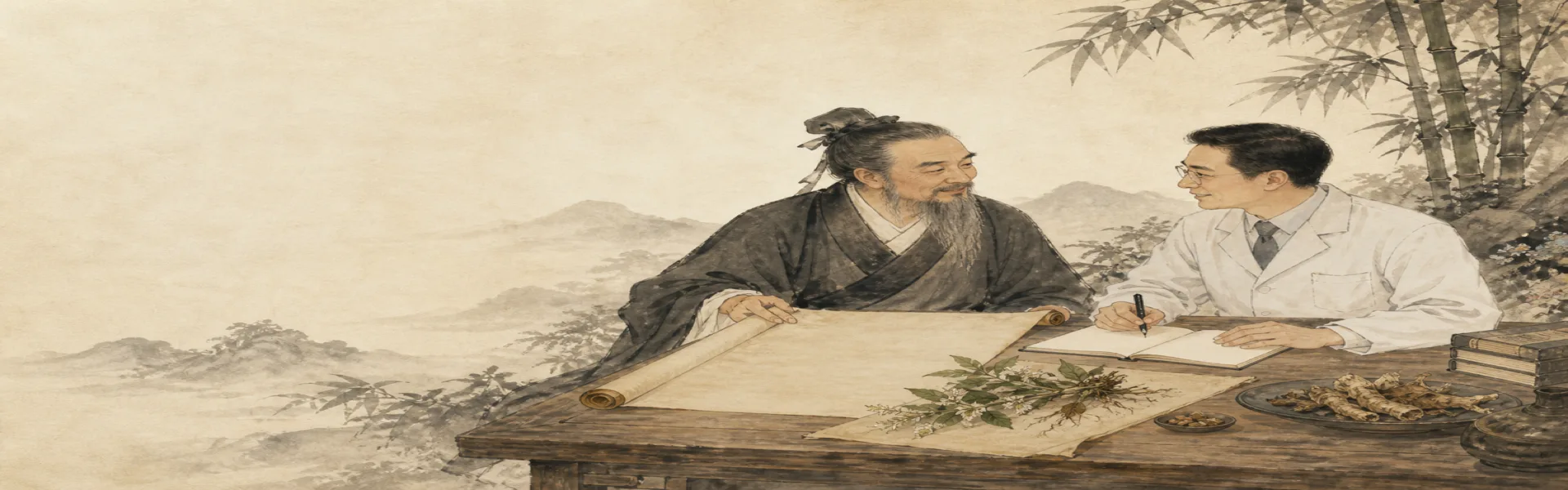
This guide explains how to make those distinctions, assess evidence and discuss complementary approaches with healthcare professionals. It is educational, not a diagnosis or an individual treatment plan.
Taoist traditions are not the whole of Chinese medicine
Taoist cultivation and Chinese medical traditions have interacted, but they are not interchangeable. Taoist practices may pursue spiritual transformation and a relationship with the Dao, not simply the treatment of illness. Their body imagery therefore cannot be read as a modern anatomical chart. The Stanford Encyclopedia of Philosophy’s account of religious Daoism explains this distinction.
On this site, “Taoist medicine” is a cultural entry point, not the name of one uniform clinical system. A breathing class, a religious observance, a herbal prescription and an acupuncture appointment need different questions. Calling all four “traditional” does not establish shared effects, risks or professional qualifications.
Complementary care is different from replacement
The NCCIH terminology guide distinguishes a complementary approach used alongside conventional care from an alternative used instead of it. Integrative care aims to coordinate approaches and providers. These terms describe a relationship between services; they do not certify every treatment offered under the label.
For example, asking your treating team whether an additional approach could help a troublesome symptom is different from abandoning the treatment of the underlying disease. A useful plan makes that difference explicit: what continues, what is added, who checks safety and when the decision will be reviewed.
If a proposal changes from supporting comfort to promising a cure, revisit the decision. The word “complementary” does not, by itself, make that change acceptable.
Ask a specific question about a specific intervention
“Does traditional medicine work?” is too broad to guide a decision. A clearer question identifies the intervention, the people studied, the comparison and the outcome. Was a defined course of treatment tested for pain, daily function, disease progression or something else? Was it compared with usual care, no additional treatment or a credible sham procedure?
Clinical benefits and harms can be studied even when a proposed mechanism remains uncertain. Conversely, a plausible mechanism or a finding in cells does not by itself show that a treatment helps people. Evidence about one preparation, condition or outcome should not be transferred automatically to another.
Historical and spiritual interpretations need their own careful reading. When a provider makes a practical claim about preventing or treating disease, however, the claim also calls for clinical evidence. Respect for the tradition and scrutiny of the claim can coexist.
Acupuncture shows why the comparison matters
NCCIH’s acupuncture review describes evidence of benefit for some pain conditions, including back or neck pain. In the research it summarizes, differences from no treatment are often larger than differences from sham acupuncture. Those comparisons ask related but different questions.
This is neither proof that every acupuncture claim is correct nor a reason to dismiss a person’s relief. It means a decision should consider the particular condition, expected benefit, uncertainty, safety and available alternatives. An improvement in pain does not automatically demonstrate repair of the underlying tissue or validate every explanation given for the treatment.
Acupuncture also requires suitable training and safe delivery. The same NCCIH resource discusses harms associated with improper treatment. A reputable name for a tradition cannot replace questions about the practitioner and procedure.
Supportive care is not treatment of the disease itself
Symptom relief can be a worthwhile goal. It should be named accurately. Helping someone feel more comfortable is not the same outcome as controlling cancer, clearing an infection or changing long-term survival.
NCCIH’s cancer guidance discusses selected approaches for particular symptoms and treatment side effects, while warning against replacing or delaying conventional cancer care with unproven approaches. This does not amount to an endorsement of all herbs, bodywork or energy practices for everyone undergoing treatment.
If you are receiving care for a serious illness, discuss additions with the treating team before starting. Ask which outcome is being targeted, how the proposed approach fits your current treatment and whether your circumstances make it unsuitable.
Share one complete medicines and supplements list
“Natural” does not mean free from interactions. Supplements may increase or decrease a medicine’s effects, or interact harmfully with it. NCCIH’s interaction guide explains why disclosure matters.
Bring a current list of prescriptions, over-the-counter medicines, herbs and supplements, including doses and frequency, to each healthcare provider. Packaging can help identify ingredients. Update the list when something changes. See NCCIH’s practical advice for speaking with providers.
Do not assume that taking two products at different times eliminates an interaction. Ask a pharmacist or the relevant clinician to assess the actual combination. This guide does not provide a personal dosing schedule or advise stopping a prescribed medicine.
A plant preparation is not interchangeable with a medicine
Artemisia is a useful example. In its 10 October 2019 position statement, WHO does not support Artemisia plant material for malaria prevention or treatment. A plant preparation is not a substitute for an appropriate antimalarial medicine.
The broader reading principle is simple: identify what was actually tested. A plant name, an isolated compound, a standardized product and a finished treatment regimen are not identical objects. Evidence for one cannot establish the effectiveness of everything sharing its name or origin. Nor does a limitation of one product settle the value of an entire cultural tradition.
Read beyond the headline of a study
A useful research report allows you to see what was done, to whom, compared with what, and for how long. The NCCIH guide to scientific articles offers a starting point.
- Participants: do their condition and circumstances resemble the people to whom the claim is being applied?
- Comparison: were groups treated similarly apart from the intervention being tested?
- Outcomes: was the change meaningful to patients, and were harms and withdrawals reported?
- Uncertainty: how precise is the estimate, and are results consistent with other relevant studies?
Masking participants or practitioners can be difficult in some procedures, but difficulty is not the same as impossibility in every study. Look at the actual design and its safeguards. A review is helpful when it assesses the quality of its included studies; simply collecting many papers does not remove their weaknesses.
Take experience seriously without confusing it with proof
If a person feels better after an appointment, that experience deserves attention. It does not, on its own, identify the cause. Improvement may involve the intervention, expectation and the care relationship, natural fluctuation, other treatments or several influences together.
NCCIH’s explanation of placebo effects describes how expectation and provider interaction can contribute to a response. Not every change observed in a placebo group is necessarily caused by a placebo: symptoms can also change over time. Appropriate comparisons help distinguish these possibilities.
There is no need to call someone’s symptoms imaginary. Equally, a reassuring conversation is not evidence that the underlying disease has resolved. Good communication belongs in all healthcare; it is not the exclusive property of any tradition.
Make a practical plan before committing
Use the following questions as a discussion aid, not as a substitute for assessment:
- What am I trying to improve, and what needs medical assessment first?
- What benefit is reasonably expected, and what evidence supports that particular use?
- What are the risks, interactions and less burdensome alternatives?
- What qualifications does this provider hold, and what is outside their scope?
- What will the full course cost in money, travel and time?
- When will we review progress, and what would prompt stopping or seeking other care?
A plan should leave room to decline, ask questions and change course. Appropriate assessment does not mean requesting every possible test. It means discussing symptoms and circumstances with a qualified professional and choosing investigations when they are clinically indicated.
Recognize boundaries and warning signs
Be cautious when a provider promises a cure for unrelated diseases, discourages indicated care, withholds ingredient information, demands secrecy between providers or treats every worsening symptom as proof that treatment is working. Worsening needs assessment, not an automatic explanation such as “detoxification.”
Do not replace or delay necessary healthcare with an unproven approach. New, persistent or worsening symptoms deserve appropriate medical attention; emergencies require urgent services. If a recommendation conflicts with your existing care, seek clarification from the treating team rather than quietly choosing between contradictory plans.
Continue exploring the tradition
Cultural learning does not have to become a medical experiment. You can study a text, ask how a concept is understood in a particular lineage and reflect on everyday habits without claiming that this proves a treatment works.
Return to the Taoist Medicine overview, explore Taoist views of the body, or read about practices for nourishing life. For daily routines and climate, continue with prevention and the seasons.