The Three Treasures
三宝
Essence, energy, and spirit — jing, qi, and shen — are the organising concepts of Taoist internal practice. Every cultivation method is described using them, and understanding what they are supposed to be is necessary for reading anything in this area.
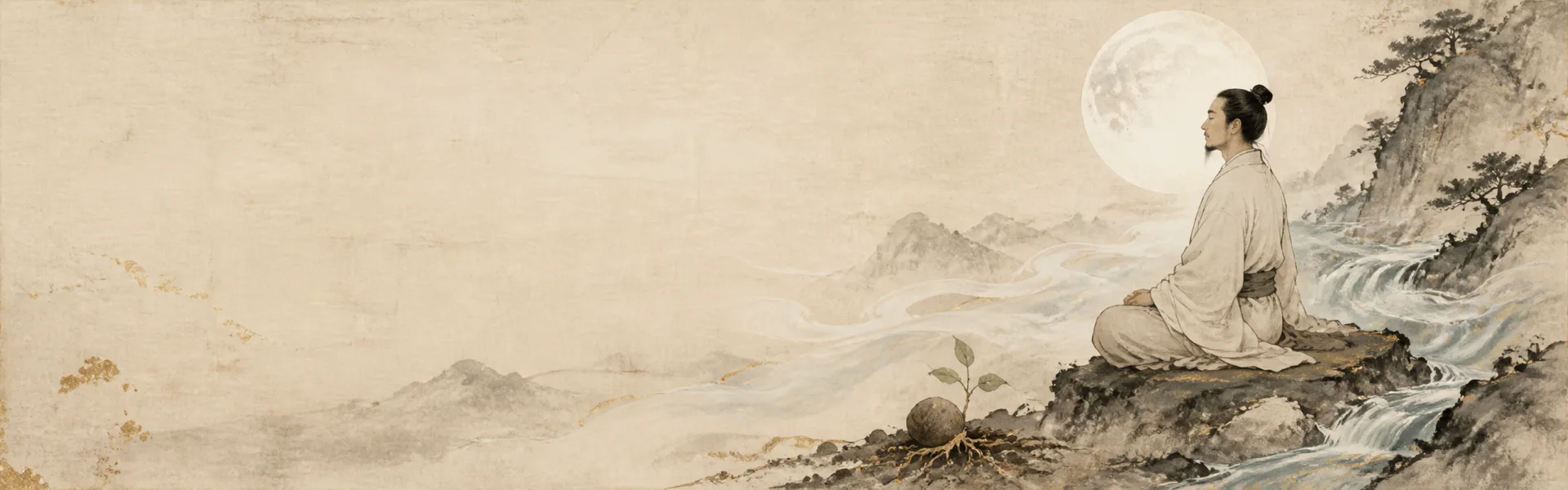
The usual translations are unavoidable and misleading. Essence suggests a fluid; energy suggests physics; spirit suggests religion. None of these is quite what is meant, and the terms are best kept in transliteration once their sense is established.
What kind of concepts these are
The three are not substances that could be isolated, and they are not three separate things. They describe a continuum from dense and material to rarefied and immaterial, with each capable of being refined into the next.
The traditional analogy is water, steam, and the space steam disperses into. The comparison is loose, but it conveys the intended relationship: same underlying stuff, different states, transformation possible between them in both directions.
Read as a classification of observable conditions rather than as physics, the scheme is more coherent than it first appears. It distinguishes constitutional robustness, day-to-day functional capacity, and mental clarity, which are genuinely different things that vary somewhat independently in real people.
Jing
Jing is the densest of the three, associated with the material basis of life. It governs conception, growth, sexual maturation, reproduction, and ageing. Bone, teeth, hair, and hearing are said to depend on it, and its decline is what ageing consists of.
The tradition distinguishes prenatal jing, received from one's parents and fixed in quantity, from postnatal jing, derived from food and air and continuously replenishable. The prenatal store is depletable and not restorable, and the tradition treats its conservation as a central concern.
This framework maps loosely onto things that are real. Constitutional endowment does vary between individuals and is largely fixed. Reproductive capacity does decline with age. Bone density, dentition, and hearing do deteriorate. The tradition observed these correlations and grouped them under one heading.
Where it goes beyond the observations is in treating jing as a quantity that can be spent and conserved through specific behaviours. This is the origin of the tradition's extensive concern with sexual moderation.
Sexual practice and jing conservation
Because jing is associated with reproductive substance, its conservation became linked to sexual behaviour, particularly for men. Ejaculation is described as expending jing, and various traditions prescribe frequency limits adjusted by age and season, or techniques intended to avoid loss.
Several things should be said about this plainly. There is no evidence that ejaculation depletes a finite vital reserve or shortens life. Techniques for retaining semen do not conserve anything and can cause urological problems. The associated anxiety has caused genuine distress, and the tradition's framing has been used to sell remedies for a condition that does not exist.
At the same time, the broader principle of moderation, and the observation that exhaustion follows excess of most kinds, is unobjectionable. The specific physiological claim is what fails.
Qi
Qi is the functional level, the capacity to act, transform, warm, defend, and hold things in place. When the tradition says the body runs on qi, it means something like functional capacity considered as a whole.
The word has an ordinary sense in Chinese long predating any technical use, meaning breath, air, vapour, and by extension atmosphere or manner. This ordinary sense matters, because it means Chinese speakers do not encounter qi as an exotic technical term the way English speakers do.
Medical theory subdivides qi extensively by source and function: qi derived from food, from air, from the prenatal endowment, qi that defends the surface, qi that circulates in the vessels, qi specific to each organ system.
Qi is not a form of energy in the physical sense and does not correspond to anything measurable. Attempts to identify it with heat, bioelectricity, or electromagnetic fields have not succeeded. It is best read as a functional abstraction, similar in kind to older Western concepts like vital force, and useful as a way of talking about capacity rather than as a description of a substance.
Shen
Shen is the most rarefied of the three, covering awareness, mental clarity, presence of mind, and the coherence of the personality. The same word means deity or spirit in religious contexts, and the overlap is not accidental.
Clinically, shen is assessed by observation: the brightness of the eyes, the coherence of speech, responsiveness, and a general quality that practitioners describe as whether someone is present. Physicians are trained to notice this, and the assessment is not mystical. Experienced clinicians in any tradition make similar judgements.
Shen is said to reside in the heart system, which is why the heart in Chinese medicine governs consciousness. Disturbance of shen covers insomnia, anxiety, confusion, and in severe forms psychiatric disturbance.
The refinement sequence
Internal alchemy describes cultivation as a sequence of transformations: refining essence into qi, refining qi into spirit, refining spirit and returning it to emptiness. Each stage is associated with particular practices and with characteristic experiences.
The first stage is where nearly all practitioners work. It involves building physical robustness, conserving what the tradition regards as depletable, and establishing the basic breath and attention work.
The later stages are described in increasingly abstract and metaphorical language, and the descriptions become correspondingly harder to check. This is a general feature of the literature: precision decreases as the claims become more ambitious.
How the three are assessed in practice
Practitioners do not measure these, but they do assess them, and the assessment follows recognisable rules that are worth setting out because they show what the concepts are actually doing.
Jing is assessed largely by history and constitution: how the person developed, the state of their hair and teeth, hearing, bone strength, reproductive history, and how they have aged relative to their years. These are long-timescale indicators, and they change slowly if at all.
Qi is assessed by current function: energy through the day, digestion, voice strength, breathing, resistance to illness, and how quickly the person recovers from exertion. These are medium-timescale indicators that shift over weeks.
Shen is assessed immediately, in the first moments of an encounter, from the eyes and bearing. It is the fastest-changing of the three and can shift within a single conversation.
Laid out this way, the framework looks less like metaphysics and more like a scheme for organising observations by the timescale over which they vary. That is a defensible thing for a clinical system to do, and it explains why the three-part division has proved so durable.
The problem of unfalsifiability
The three treasures framework has a structural feature worth naming. Because none of the three can be measured, no claim about them can be checked.
If a practitioner is told their jing is depleted, there is no test that could confirm or refute this. If a practice is said to build qi, no measurement establishes whether it did. The framework generates statements that feel informative and that cannot be wrong.
This is not an argument that the framework is worthless. Unmeasurable concepts can organise practice usefully, and clinicians in every tradition use judgements that resist quantification. But it does mean the framework cannot correct itself, and that a practitioner making confident specific claims about a patient's jing is not reporting a finding.
What survives translation
Several observations embedded in this framework hold up independently of it.
That constitutional robustness varies between people and is largely inherited. That functional capacity fluctuates with sleep, food, and exertion in ways that are noticeable and worth attending to. That mental clarity is a genuine variable connected to physical state. That exhaustion follows sustained overreach and is not cheaply reversed. That an experienced observer can often tell a great deal about someone's condition from their eyes, voice, and bearing.
These are worth having. They do not require the three treasures to be real things, and they are what the framework was built to record.
Key points
Jing, qi, and shen describe a continuum from dense to rarefied rather than three separate substances.
Jing groups together constitutional endowment, reproduction, and the tissues that deteriorate with age, which are genuinely correlated.
The claim that ejaculation depletes a finite vital reserve has no evidential support and has caused real anxiety and exploitation.
Qi is a functional abstraction similar to older Western vital force concepts and does not correspond to anything measurable.
Shen assessment by eyes, speech, and responsiveness is a real clinical skill that experienced practitioners in any tradition use.
None of the three can be measured, so the framework generates confident statements that cannot be checked or corrected.
Common Questions About the Three Treasures
Are jing, qi and shen the same in every Taoist lineage?
No. The vocabulary is widely shared, but texts and lineages differ in how they define the three, where they locate them, which transformations they emphasise and what practices they prescribe. A responsible account names its source instead of presenting one school’s sequence as universal Taoist doctrine.
Can jing, qi or shen be measured?
Not as the traditional categories are defined. A study may measure sleep, hormone levels, breathing, physical performance, mood or attention, but those results do not become a measurement of jing, qi or shen. Any proposed modern correlate is a hypothesis that must be tested rather than a translation that can simply be assumed.
Does feeling tired mean qi deficiency?
No. Tiredness can follow poor sleep, stress, activity, medication or many health conditions. If it persists, affects daily life or arrives with other symptoms, it should be assessed appropriately rather than self-diagnosed as qi deficiency. A traditional label does not identify the cause.
Should sexual activity be restricted to preserve jing?
There is no evidence-based universal schedule for “saving” a finite vital reserve. Moderation can be a personal or ethical choice, but guilt, fear or post-activity tiredness do not prove that life has been shortened. Pain, urinary symptoms or sexual difficulties call for qualified health care, not a stronger retention practice.
Using the Vocabulary Responsibly
Four checks keep the language useful. Name the text, teacher or lineage using the term. Separate the practice instruction from the explanation attached to it. State the observable change being sought. And never use an unmeasurable category to replace diagnosis, promise a cure or tell someone to stop medical treatment.
Continue Reading
The Taoist View of the Body places the Three Treasures inside the wider landscape of organs, channels and dantian. Wudang Internal Cultivation, Qigong and Standing Practice then show how posture, breath and attention are organised in living practice.
Qigong — Compare the inherited vocabulary with modern movement and breathing practices.
Standing Practice — Begin with observable changes in alignment, balance and unnecessary effort.