Preventing Illness & the Seasons
防病与顺应四时
Living with the seasons is a longstanding theme in Chinese traditions of yangsheng, or nourishing life. It brings attention to rest, food, movement and the wider environment. These traditions have a history broader than Taoism alone; they are not one standard programme taught everywhere at Wudang.
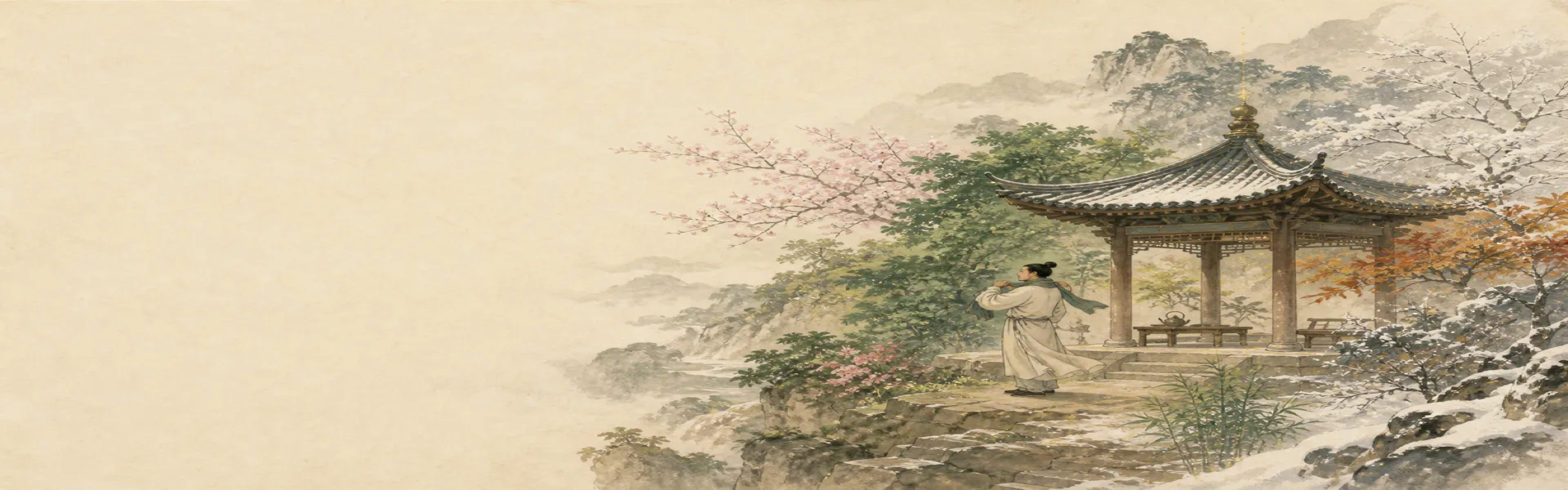
A useful reading separates three questions: what did a recommendation mean within its tradition, what practical circumstances does it address, and what evidence supports applying it today? A calendar can encourage observation without becoming a medical prescription.
How seasonal correspondences are understood
Yin and yang, qi and the five phases provide ways of describing transformations in the body and the world. The Stanford Encyclopedia of Philosophy discusses their place in Chinese medicine and self-cultivation. Seasonal regimens use this wider language to connect the unfolding year with daily life.
The organ systems in these correspondences should not be read as direct equivalents of modern anatomical organs. A seasonal association can have historical or symbolic meaning without establishing a biological mechanism. Likewise, evidence that a particular habit helps in particular circumstances does not validate every traditional explanation attached to it.
Claims about later illness caused by behaviour in an earlier season require evidence for the specific prediction. It is not enough to praise their complexity or dismiss them as automatically beyond testing.
Spring: growth and renewal
Common presentations associate spring with wood and the liver system, emphasizing growth and outward movement. This language can invite reflection on what you would like to begin or return to. A contemporary reader might ask what activity is enjoyable, feasible and suited to the conditions.
This is not a reason to prescribe a liver cleanse or assume everyone should follow the same routine. Traditional references to wind belong to their own explanatory framework; practical decisions should also consider actual weather and the individual's circumstances.
Summer: activity and heat
Summer is associated with fire and the heart system, with imagery of expression and expansion. That imagery should not be turned into an instruction to exercise harder in extreme heat. Cultural meaning and environmental safety answer different questions.
Follow local warnings and adapt the time or place of outdoor activity. A gentle practice does not make heat exposure harmless. Traditional food categories also do not establish that everyone's digestion becomes weaker in summer or that all cold drinks are unsuitable.
Late summer and seasonal transitions
Different presentations connect the earth phase with late summer or with intervals between seasons. State which convention a particular source uses instead of assuming one universal arrangement.
The variation does not, by itself, show that a fifth season was invented for one particular reason. Nor does it demonstrate the medical effects of either scheme. The historical question of how an interpretation developed is different from the practical question of what a person should do today.
Autumn: gathering in
Autumn is associated with metal and the lung system, often through images of gathering and settling. These can provide a cultural setting for reading, reflection or quiet activity. They do not diagnose lung disease from an emotion.
The traditional autumn–grief association is not evidence that it identified modern seasonal affective disorder. The NHS describes a depressive illness with a seasonal pattern, often in winter but sometimes in summer. Persistent low mood or disruption to daily life deserves appropriate help, not a diagnosis based on a correspondence chart.
Winter: conservation and local conditions
Winter is associated with water and the kidney system, with an emphasis on conservation. Read as an invitation to examine overcommitment, the image may be useful. It does not establish that everyone should sleep longer, eat richer food or reduce exercise for several months.
Cold outdoor conditions, a heated home and a tropical city are different environments. Adapt to the place you actually inhabit and to your own needs. The WHO's physical-activity guidance supports regular movement; changing an activity's setting or timing does not imply becoming inactive through winter.
Solar terms and the climate where you live
The twenty-four solar terms, or jieqi, are astronomical reference points rather than simply the beginnings of lunar months. The Hong Kong Observatory explains their division by 15-degree intervals of the Sun's apparent longitude. Their names combine astronomical markers with weather and agricultural associations.
A term's name does not forecast the weather everywhere. Snow, new growth or heat may not arrive locally on the date suggested by a traditional name. The astronomical reference remains usable, while its seasonal interpretation requires attention to place. The Southern Hemisphere's seasonal cycle is opposite to the Northern Hemisphere's.
For Singapore, the national meteorological service describes an equatorial climate with monsoon and inter-monsoon periods. Copying a temperate four-season health timetable is therefore less useful than noticing the actual environment. A solar term can still be a cultural occasion to observe, read or prepare a familiar meal.
Preventive ideals and medical prevention
Zhi weibing (治未病), often understood as attending to illness before it develops, expresses a preventive ideal. The intention to prevent a problem does not establish that a proposed method detects it or changes its course.
Changes in sleep, appetite or comfort do not automatically reveal hidden disease. Feeling well does not exclude every risk either. Describe persistent or concerning symptoms clearly and seek appropriate assessment rather than translating every sensation into a hidden imbalance.
Medical prevention has specific tools. Vaccination targets particular infections. Screening assesses selected apparently healthy groups and has limitations as well as benefits. Follow relevant local programmes and discuss decisions according to age, risk and personal circumstances; more tests are not automatically better.
These approaches can coexist with cultural practice. The important distinction is their purpose and evidence, not a contest between tradition and modernity. This article is not an individual prevention plan.
Practical adaptation to real conditions
Before walking or practising outdoors, consider the conditions, the route, an accessible alternative and the option to stop. Check relevant local warnings for heat, storms, cold or poor air quality. These are practical decisions, not proof of traditional weather-related disease categories.
The WHO's heat guidance includes avoiding strenuous activity during the hottest part of the day and seeking cooler surroundings. Its UV guidance also shows why temperature alone is not a measure of sun exposure. Protective measures are recommended from a UV index of 3.
Seasonal food can carry family memory and enjoyment without being a treatment. An ingredient's flavour, colour or traditional thermal category does not establish that it benefits a named organ. The WHO's dietary guidance emphasizes adequate, balanced, varied and safe food rather than a single cultural calendar.
Herbal products require separate consideration. As NCCIH explains, some products have quality or safety problems. A seasonal label is not a safety guarantee. Do not stop prescribed treatment or delay care for a seasonal course of herbs.
Cultural meaning and medical evidence are different
A seasonal image may be useful for reflection; a slippery path calls for a change of route; a claim to prevent disease needs evidence about the proposed intervention and outcome. These are different judgments, and keeping them separate makes discussion more precise.
There is no need to dismiss an entire cultural tradition to reject an unsupported medical promise. Equally, respect for a tradition does not require accepting a diagnosis without justification. Ask what a claim actually means, how it is assessed, what alternatives exist and what would count as a reason to stop.
Be cautious if ordinary variation is repeatedly turned into a problem that only an open-ended course or product can resolve. A cultural practice need not make every meal and every sensation into a test.
Observe without turning every change into a diagnosis
- Describe today's actual setting and constraints.
- Choose a realistic activity you already understand.
- Allow an alternative time, place or plan.
- Record a simple observation rather than an improvised medical explanation.
- Simplify or stop tracking if it becomes a source of anxiety.
This is an editorial framework for organizing a choice, not a validated health protocol. It does not require buying anything or meeting a fixed seasonal target.
For persistent, significant or worsening symptoms, seek appropriate care. A mental health crisis involving immediate danger requires urgent local help. Do not wait for a more favourable season or interpret deterioration as necessary progress.
Key points
- Seasonal traditions can encourage attention to daily life without supplying a universal prescription.
- Historical correspondences, astronomical markers and medical evidence are distinct.
- Adapt to the actual place, weather and person rather than a rigid food or activity calendar.
- Cultural practice can coexist with medical prevention when their functions are kept clear.